
Binance's Market Crash Response and Its Implications for Crypto Investor Trust
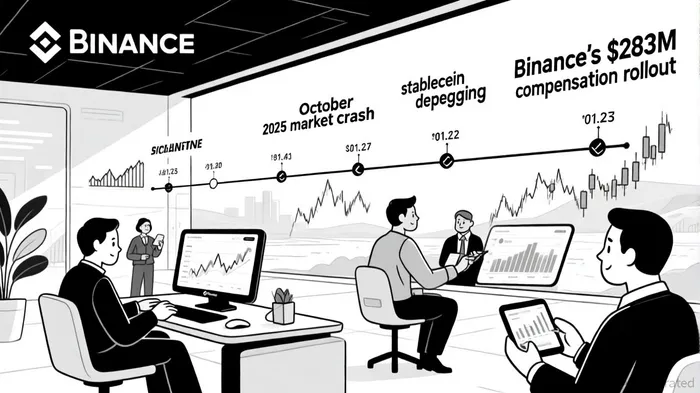
In October 2025, Binance faced one of the most severe crises in its history. A combination of geopolitical shocks-triggered by former U.S. President Donald Trump's announcement of potential 100% tariffs on Chinese imports-and technical glitches led to a cascading market crash. Stablecoins like USDeUSDe--, BNSOL, and WBETH depegged, causing over $7 billion in liquidations within an hour, according to a Coingape report. Binance's response-a $283 million compensation program for affected users-has since become a case study in crisis management and platform accountability. This analysis explores how Binance's actions reflect broader shifts in risk management and investor trust within the crypto ecosystem.
The Compensation Program: A Strategic Move to Rebuild Trust
Binance's $283 million payout was structured in two phases: the first addressing liquidated positions, and the second covering delayed redemptions and internal transfer issues, according to an FXLeaders report. The exchange attributed the depegging to "broader market conditions and a display error" rather than internal system failures, as reported in a Coinotag article. CEO Richard Teng publicly apologized, emphasizing Binance's commitment to "improving risk controls and liquidity protections," in coverage by CoinCentral.
The compensation was distributed within 24 hours, a rapid response that contrasted sharply with the FTX collapse in 2022, where users faced prolonged uncertainty. As CoinCentral reported, the market reacted positively: BitcoinBTC-- rebounded 3.74% to $114,913, and Binance Coin (BNB) hit a record high of $1,370, according to CryptoRank. This immediate financial stabilization signaled to investors that Binance prioritized user trust over short-term reputation management.
Risk Management Lessons from FTX
Binance's approach to the 2025 crisis highlights its evolution since the FTX scandal. Post-2022, Binance transitioned to a compliance-first model under CEO Richard Teng, securing licenses in key markets and implementing a $1 billion SAFU fund for security, as discussed in a Coinomist analysis. The exchange also adopted stricter internal controls, including 98% user verification rates and independent audits under DOJ oversight, according to EconoTimes.
In contrast to FTX's opaque governance, Binance's 2025 response included technical reforms: shifting to conversion-ratio pricing for wrapped tokens, setting soft price floors, and increasing risk parameter reviews, as outlined in a Dzilla analysis. These measures align with recommendations from traditional finance experts like Brevan Howard Digital's Gautam Sharma, who stressed the need for 24/7 risk management and stress testing in a CoinDesk piece. By addressing both technical and governance vulnerabilities, Binance has positioned itself as a leader in post-FTX crypto resilience.
Investor Trust: A Mixed Bag of Optimism and Skepticism
Binance's global user survey in late 2024 revealed a nuanced picture of investor sentiment. While 23.89% of respondents expected AI tokens to dominate 2025, 43% allocated less than 10% of their total wealth to crypto, reflecting cautious optimism, according to a Crypto.ro survey. The survey also noted that 45% of users joined the market in 2024, indicating growing mainstream adoption, per CoinLaw.
However, trust metrics remain fragile. Critics questioned the adequacy of Binance's technical safeguards, with some alleging market manipulation during the crash, as discussed on OneSafe. Third-party audits, while a step forward, have faced scrutiny: Binance's 11th audit in 2023 was criticized for being self-verified rather than independently conducted in a Reddit post. Despite this, the exchange's SOC 2 Type II audit by A-LIGN in late 2023 reinforced its commitment to traditional financial standards, according to a CryptoNews report.
Regulatory and Market Implications
The 2025 crash has intensified calls for stronger crypto regulations. Unlike traditional markets, crypto lacks circuit breakers or clearinghouses to mitigate rapid liquidations, as noted in a Bloomberg analysis. Binance's compensation program, while a goodwill gesture, underscores the need for systemic safeguards. Regulatory bodies are now scrutinizing cross-exchange liquidity risks, with the EU's MiCA framework expected to standardize compliance globally, as OneSafe noted.
Market reactions also highlight crypto's interconnectedness. The crash revealed how algorithmic deleveraging on one platform can trigger cascading losses across others, as seen with Hyperliquid and Binance, in a CoinDesk postmortem. This interdependency demands coordinated risk management strategies, a challenge Binance is addressing through enhanced order book transparency and external price oracles, according to an OurCryptoTalk report.
Conclusion: A New Era of Accountability
Binance's 2025 crisis response demonstrates that crypto exchanges can balance rapid innovation with accountability. By prioritizing user compensation, technical reforms, and regulatory alignment, Binance has set a benchmark for crisis management in the post-FTX era. However, investor trust remains a work in progress. As the industry evolves, the lessons from this crash-alongside FTX-will shape whether crypto can mature into a mainstream asset class. For now, Binance's actions suggest that transparency, speed, and adaptability are no longer optional-they are existential imperatives.






Comentarios
Aún no hay comentarios