
Binance's KGST Listing: A Strategic Play for BNB and Central Asian Crypto Growth
The recent listing of KGST, a stablecoin pegged 1:1 to the Kyrgyz Som (KGS), on Binance marks a pivotal moment in the convergence of blockchain innovation and geopolitical strategy in Central Asia. This move, announced for December 24, 2025, is not merely a product of market demand but a calculated alignment with Kyrgyzstan's ambition to become a regional crypto hub. By enabling the KGST/USDT trading pair and integrating Trading Bots services, Binance is positioning itself at the intersection of emerging market financial inclusion and global blockchain adoption. The implications for BNBBNB-- (Binance Coin) and Central Asia's crypto ecosystem are profound, reflecting a broader narrative of technological sovereignty and economic diversification in a region historically dominated by Russian and Chinese influence.
Geopolitical Context: Central Asia's Blockchain Ambitions
Central Asia's blockchain strategies are increasingly shaped by a delicate balancing act between China's centralized digital infrastructure and the EU's push for decentralized, standards-driven innovation. China's Blockchain-based Service Network and its digital yuan (e-CNY) have positioned the country as a dominant force in the region, leveraging blockchain to expand its Belt and Road Initiative (BRI) networks. However, Central Asian nations like Kyrgyzstan are seeking to diversify their digital dependencies. Kyrgyzstan's collaboration with Binance, including the establishment of a National Cryptocurrency Reserve and localized Binance app, signals a strategic pivot toward private-sector-driven blockchain adoption. This shift is critical for Kyrgyzstan, which aims to reduce its reliance on China and Russia while capitalizing on its tech-savvy youth and digital infrastructure.
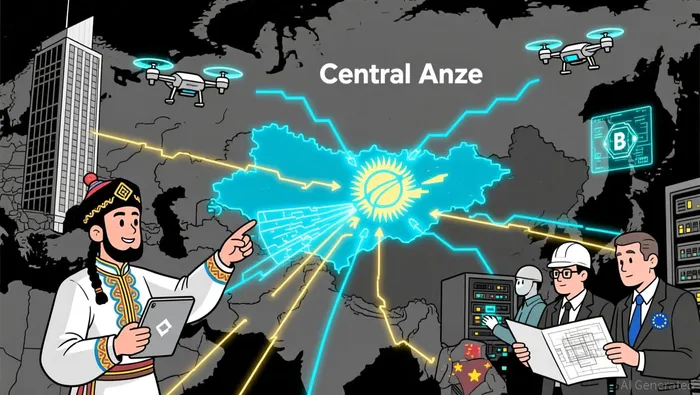
The EU's growing engagement in Central Asia further complicates this landscape. Following the 2023 Joint Roadmap agreement, the EU has emphasized digitalization and sustainable infrastructure as pillars of its partnership with Kazakhstan and Uzbekistan. While the U.S. remains less prominent in the region's blockchain discourse, the EU's institutional focus on cross-border standardization and digital governance offers a counterpoint to China's state-centric model. Binance's KGST listing, therefore, operates within a multi-polar framework where geopolitical actors vie for influence through technological and economic integration.
Blockchain and Economic Integration: Cross-Border Remittances and CBDCs
The practical utility of KGST lies in its potential to revolutionize cross-border remittances and financial inclusion. Kyrgyzstan, a nation where remittances from migrant laborers account for a significant portion of GDP, stands to benefit from low-cost, high-speed transactions enabled by the BSC blockchain. By pegging KGST to the KGS, Binance is addressing a critical pain point for Central Asian economies: the inefficiency of traditional remittance channels dominated by Western banks and intermediaries. This aligns with broader trends in emerging markets, where blockchain is increasingly seen as a tool to bypass legacy systems and reduce transaction costs.
Simultaneously, Central Asian CBDC initiatives are gaining momentum. Projects like the multi-CBDC bridge (m-CBDC) and cross-border experiments such as "Project Mariana" highlight the region's efforts to integrate digital currencies into global trade frameworks. While Kyrgyzstan's KGST is a private stablecoin, its success could catalyze further CBDC development by demonstrating the viability of blockchain-based financial systems. This is particularly relevant as Central Asian nations seek to de-dollarize their economies and assert monetary sovereignty in the face of global volatility.
Strategic Implications for BNB and Central Asian Crypto Growth
Binance's KGST listing is a strategic play for BNB, the native token of the BNB Chain. By anchoring KGST to its blockchain, Binance is incentivizing users to transact in BNB for gas fees, staking, and governance, thereby increasing demand for the token. This mirrors Binance's broader strategy of expanding its ecosystem through region-specific tokens, as seen with the Binance-pegged stablecoins in other markets. The localization of the Binance app for Kyrgyz-speaking users further underscores the company's commitment to long-term engagement in Central Asia.
For investors, the KGST listing represents more than a speculative opportunity. It reflects Binance's ability to navigate complex geopolitical landscapes and position itself as a bridge between emerging markets and global crypto infrastructure. Central Asia's growing digital asset literacy, supported by Binance's educational initiatives, could accelerate adoption rates, creating a flywheel effect for BNB and other blockchain-native assets.
Conclusion: A Convergence of Power and Potential
Binance's KGST listing is emblematic of a larger trend: the fusion of blockchain technology with geopolitical strategy in emerging markets. By aligning with Kyrgyzstan's digital asset ambitions, Binance is not only expanding its user base but also challenging the dominance of state-centric models like China's BSN and e-CNY. For investors, this represents a high-conviction opportunity in a region poised for transformative change. As Central Asia navigates its path between competing global powers, the KGST listing serves as a microcosm of the broader struggle for technological and economic sovereignty-a struggle where blockchain is increasingly the battleground.






Comentarios
Aún no hay comentarios