
The Binance-Kaspa Rift: A Battle for Crypto's Core Values and Investment Future
The Ideological Divide: Centralization vs. Cypherpunk Decentralization
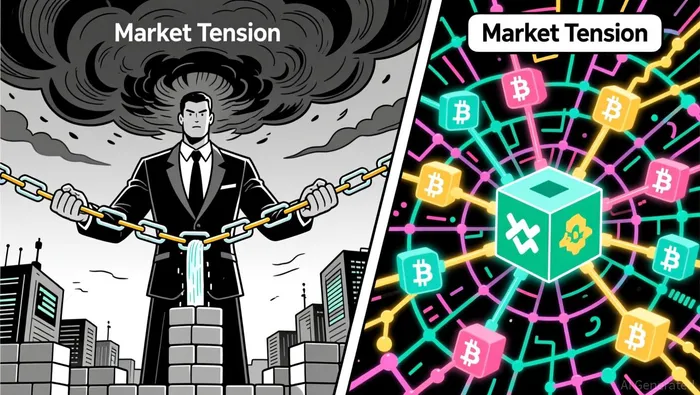
Binance's influence is undeniable. As a centralized exchange, it wields significant control over market liquidity, listing decisions, and investor behavior. Critics argue that this centralization undermines the decentralized ethos of blockchain technology, favoring institutional partnerships and regulatory compliance over grassroots innovation, as noted in a Reddit post by Kaspa founder Yonatan Sompolinsky. In contrast, Kaspa positions itself as a direct heir to Satoshi Nakamoto's vision. Built on the GHOSTDAG protocol, Kaspa's blockDAG architecture enables parallel block processing, enhancing scalability without compromising pure proof-of-work (PoW) principles, as noted in the same Reddit post. The project's fair launch-no pre-mine, no ICO-further cements its alignment with cypherpunk ideals of community-driven development and equitable access, as also noted in the Reddit post.
This ideological rift is not merely theoretical. It reflects a broader debate within crypto: Should the industry prioritize scalability and mainstream adoption through centralized infrastructure, or preserve decentralization at the cost of slower growth? For investors, the answer is not binary but deeply contextual.
Market Dynamics: Binance's Influence and Kaspa's Resilience
Despite Binance's dominance, Kaspa has carved out a niche in the DeFi space. As of November 2025, Kaspa's token (KAS) trades at $0.04560, with a market capitalization of $1.21 billion and a 24-hour trading volume of $43.27 million, according to a press release from OpenPR. While the token has seen a 4.93% decline in the last 24 hours, its blockDAG innovation continues to attract attention from investors seeking long-term value, as noted in the OpenPR report.
Binance's role in this ecosystem remains ambiguous. The exchange has not explicitly outlined strategies for KAS, though its listing on platforms like CoinMarketCap's "Made in America" category suggests ongoing market interest, as noted in a Coinrise article. Meanwhile, technical indicators like the MACD hint at potential bullish divergence, signaling a possible recovery if KAS breaks out of its descending wedge, as also noted in the Coinrise article.
This dynamic underscores a critical question: Can projects like Kaspa thrive despite the gravitational pull of centralized exchanges? The answer may lie in their ability to balance innovation with accessibility. Kaspa's blockDAG architecture offers a compelling alternative to traditional blockchains, but its success hinges on adoption-both from users and institutional players who often favor Binance's ecosystem.
Investment Implications: Values vs. Volatility
For investors, the Binance-Kaspa dynamic highlights a key trade-off: centralized stability versus decentralized potential. Binance's market influence provides liquidity and visibility, but at the cost of ideological compromise. Kaspa, meanwhile, embodies the disruptive spirit of crypto but faces volatility and scalability challenges.
Data from 2025 reveals this tension. While Kaspa's price has dropped 70% from its all-time high, its blockDAG technology is viewed as a "major price jump" catalyst by analysts, as noted in the Coinrise article. Conversely, Binance's recent listings-such as Janction (JCT) and MetaArena (TIMI)-signal a focus on high-growth, speculative assets, as reported in a Coinotag article and a LookonChain feed. These moves reflect a strategy prioritizing short-term gains over long-term decentralization.
The broader implication is clear: Investors must align their portfolios with their values. Those seeking stability may lean toward Binance's ecosystem, while those prioritizing innovation might allocate capital to projects like Kaspa, despite their volatility.
Conclusion: A Fork in the Road
The "Binance-Kaspa rift" is less a direct conflict and more a symbolic representation of crypto's existential debate. As the industry matures, the tension between centralized efficiency and decentralized ideals will only intensify. For investors, the challenge is to navigate this landscape with clarity, recognizing that neither model is inherently superior-only more aligned with specific goals.
In 2026, the winners will be those who understand this duality. Whether through Binance's centralized bridges or Kaspa's blockDAG highways, the future of crypto belongs to those who can reconcile its competing visions.







Comentarios
Aún no hay comentarios