
Binance's Influence on Altcoin Price Surges: Exchange Listings as Catalysts for Short-Term Volatility and Long-Term Value Recognition
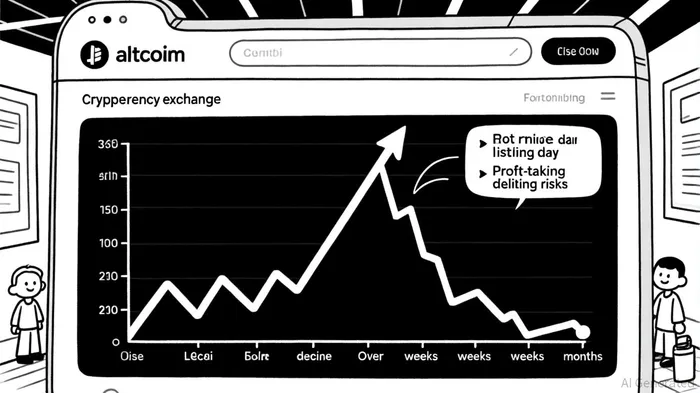
The rise of Binance as the world's largest cryptocurrency exchange has cemented its role as a pivotal force in shaping altcoin price dynamics. For investors, the platform's listing of new tokens often acts as a double-edged sword: while it catalyzes explosive short-term gains, the long-term value recognition of these assets remains elusive. This duality—sharp volatility versus muted sustainability—has become a defining feature of the altcoin market in 2024–2025, driven by Binance's unparalleled liquidity, institutional influence, and retail trader behavior.
The Short-Term Surge: Binance Listings as a Volatility Catalyst
When a token is listed on Binance, the immediate price reaction is often dramatic. Historical data reveals that altcoins experience an average price increase of 87% on the day of listing, fueled by the exchange's massive user base and liquidity pools[1]. For instance, the AI-agent token ACT surged 2,247% on its listing day in 2024, while DeFi tokens like ORCAORCA-- and ACXACX-- saw gains exceeding 100% and 120%, respectively[2]. These surges are not anomalies but rather a systemic outcome of the “Binance Effect,” where the platform's visibility and trading infrastructure create a self-fulfilling prophecy of demand[3].
However, this initial euphoria is rarely sustained. Within the first week, most tokens begin to correct, with an average price drop of 6.34% as early investors and whales take profits[4]. By six months post-listing, the average token loses 37.64% of its listing price, underperforming even EthereumETH--, a benchmark for altcoin performance[5]. For example, while the AI token JUPJUP-- was one of the few 2024 Binance listings to maintain positive returns, over 90% of other tokens, including those backed by top-tier venture capital firms, saw double-digit declines[6].
Long-Term Value Recognition: A Mixed Bag of Outcomes
The long-term sustainability of Binance-listed altcoins hinges on their fundamentals, regulatory environment, and broader market conditions. Academic studies underscore that while Binance listings generate short-term liquidity, they rarely translate into lasting value. A 2025 analysis found that 98% of Binance-listed tokens eventually lose value post-listing, with only 3 out of 27 2025 tokens—FORM, RED, and LAYER—posting positive returns by April[7]. This underperformance is exacerbated by thin liquidity and speculative trading, which amplify price swings and erode investor confidence[8].
Regulatory shifts further complicate the picture. Binance's expansion into 21 jurisdictions in 2024 and compliance with EU's MiCA regulations have introduced new layers of scrutiny[9]. While these measures aim to attract institutional capital, they also create friction for retail investors, who often migrate to decentralized exchanges to avoid KYC-heavy environments[10]. For tokens lacking robust use cases, this regulatory uncertainty can accelerate their decline, as seen with Pi Coin's waning momentum[11].
Academic Insights: Volatility Transmission and Market Underperformance
The mechanisms behind Binance-driven volatility are well-documented. Research highlights that the exchange's tether-margined perpetual contracts act as a primary source of volatility, transmitting price shocks to other instruments, particularly during U.S. trading hours[12]. This volatility is further amplified by the “profit-taking” behavior of early investors, who often cash out within days of a listing, creating artificial price floors[13].
Empirical analysis also reveals a stark disconnect between Binance-listed tokens and broader market trends. Over six months, these tokens underperform Ethereum by -39.46%, with their correlation to the benchmark dropping from 0.7–0.8 to 0.34 post-listing[14]. This divergence suggests that while Binance listings create short-term hype, they rarely align with the long-term fundamentals that drive sustained value creation.
Implications for Investors: Navigating the Binance Effect
For investors, the Binance listing effect demands a nuanced strategy. While the platform's liquidity can unlock quick profits, the risks of overvaluation and rapid corrections are significant. Diversification, stop-loss orders, and a focus on projects with strong utility (e.g., Ethereum's infrastructure upgrades) are critical for mitigating downside risks[15]. Additionally, monitoring macroeconomic factors—such as the Fed's rate cuts and U.S.-China trade dynamics—can provide early signals of capital rotation into altcoins[16].
Conclusion
Binance's influence on altcoin price surges is undeniable, but its role as a catalyst for long-term value recognition remains unproven. While the exchange's listings ignite short-term volatility, the broader market's skepticism and regulatory headwinds often erode these gains. For investors, the key lies in balancing opportunistic trading with a disciplined focus on fundamentals—a strategy that acknowledges Binance's power while resisting its siren call of speculative hype.






Comentarios
Aún no hay comentarios