
Binance's HEMI Margin Pairs: A Strategic Edge for Aggressive Crypto Traders
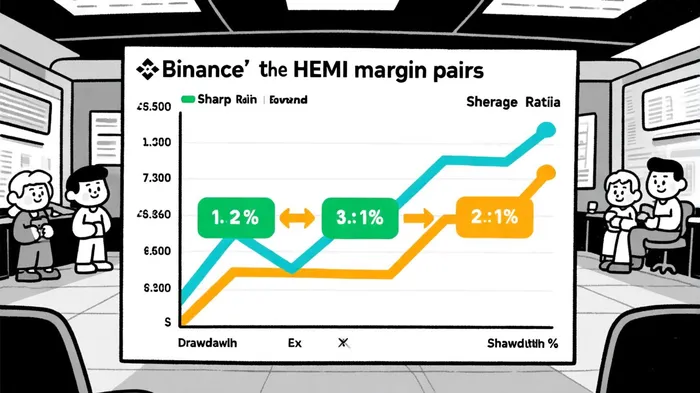
Binance's recent introduction of HEMI/USDT and HEMI/USDC margin pairs has ignited renewed interest among aggressive crypto traders seeking to exploit leverage in volatile markets. These pairs, available for cross and isolated margin trading since September 23, 2025, offer amplified exposure to HEMIHEMI--, a token with growing liquidity and market depth[2]. For traders willing to accept elevated risk, the platform's leverage options—up to 20x for cross-margin and 10x for isolated-margin accounts—present opportunities to capitalize on both bullish and bearish price swings[2]. However, as historical data from Binance accounts reveals, leveraged strategies often come at the cost of subpar risk-adjusted returns and significant drawdowns[3].
Leverage Efficiency and Liquidity Dynamics
Binance's margin trading framework allows users to deploy cross-margin (pooling collateral across positions) or isolated-margin (limiting risk to individual trades) strategies[2]. For HEMI pairs, this flexibility is critical. Cross-margin accounts, with their 20x leverage cap, enable traders to scale positions using total equity as collateral, potentially enhancing returns during sustained trends. Isolated-margin accounts, meanwhile, restrict risk to specific trades, capping losses but also limiting upside.
Liquidity provisions for HEMI have improved markedly, with the token now supporting stablecoin pairs (USDT/USDC) that reduce slippage in leveraged scenarios[2]. This is particularly advantageous for aggressive traders, as tighter spreads and deeper order books mitigate execution risks. However, liquidity can evaporate during extreme volatility, increasing the likelihood of liquidations—a risk amplified by HEMI's inherent price sensitivity[4].
Risk-Adjusted Returns: Sharpe, Sortino, and Maximum Drawdown
Quantifying the risk-return profile of HEMI margin trading requires scrutiny of metrics like the Sharpe Ratio, Sortino Ratio, and Maximum Drawdown (MDD). General Binance account data from a 90-day analysis reveals an average Sharpe Ratio of 0.043, a figure that suggests minimal excess return per unit of total risk[3]. While this metric is not HEMI-specific, it underscores the platform's broader challenges in delivering robust risk-adjusted performance.
The Sortino Ratio, which focuses exclusively on downside volatility, offers a more nuanced view. For leveraged strategies, where harmful volatility (i.e., price drops) is a primary concern, the Sortino Ratio could highlight HEMI's asymmetric risk profile. Unfortunately, no HEMI-specific data exists, but methodologies from projects like GitHub - Feroz29/Trade demonstrate how traders might calculate this metric using historical trade records[2].
Maximum Drawdown remains a critical red flag. The same Binance account analysis noted a -20.85% MDD, a stark reminder of the capital erosion possible in leveraged environments[3]. For HEMI, which is prone to sharp corrections, traders must factor in not only market risk but also counterparty and liquidity risks.
Market Capture Potential and Strategic Considerations
HEMI's margin pairs enable traders to hedge or speculate on its price trajectory with precision. In a bullish scenario, 20x leverage could transform a 5% price gain into a 100% return on margin. Conversely, a 5% drop would erase the entire position—a double-edged sword that defines leveraged trading.
Market capture potential is further influenced by Binance's risk management tools, such as stop-loss orders and dynamic margin requirements[4]. Aggressive traders might employ trailing stops or pyramiding strategies to lock in gains during trends, though these tactics demand rigorous discipline.
Risks and Mitigation
The risks of HEMI margin trading are non-trivial. Liquidation thresholds, interest costs (which vary with leverage levels), and the token's volatility create a volatile feedback loop. Cross-margin accounts, while offering greater flexibility, expose all positions to a single point of failure—if one trade incurs a large loss, it could trigger a cascade of liquidations[4].
Mitigation strategies include:
1. Position Sizing: Limiting leverage to 10x or lower for isolated-margin trades.
2. Diversification: Avoiding overexposure to HEMI by balancing it with less volatile assets in cross-margin accounts.
3. Stop-Loss Automation: Using Binance's tools to cap losses during rapid downturns.
Conclusion
Binance's HEMI margin pairs offer a strategic edge for aggressive traders, but this edge comes with a steep cost. While leverage and liquidity enhancements open new avenues for profit, the historical performance of Binance accounts—marked by low Sharpe Ratios and severe drawdowns—serves as a cautionary tale[3]. For HEMI, the key to success lies in disciplined risk management and a clear understanding of the token's volatility profile. As the crypto market evolves, traders must weigh the allure of amplified returns against the ever-present specter of liquidation.






Comentarios
Aún no hay comentarios