
Binance's Ethereum Network Maintenance: Implications for Liquidity and Operational Risk in Crypto Trading
The recent announcement of Binance's EthereumETH-- (ETH) network maintenance on December 25, 2025, underscores a recurring challenge in crypto trading: the tension between platform security and market stability. While such maintenance is routine, its implications for liquidity, operational risk, and investor behavior reveal systemic vulnerabilities in the crypto ecosystem. This analysis examines how Binance's actions, coupled with broader market dynamics, shape the landscape for traders and investors.
The Liquidity Conundrum: Volume Drops and Market Fragility
Binance's temporary suspension of ETHETH-- deposits and withdrawals during maintenance led to a 26.15% decline in trading volume over the following 24 hours, despite continued trading activity. This highlights a critical issue: even short-term disruptions can erode liquidity, particularly in markets already prone to volatility. According to market data, the October 2025 crash, triggered by macroeconomic stress and exacerbated by thin liquidity, saw order-book depth on major exchanges shrink by over 90%, with bid-ask spreads widening sharply. Such events expose the fragility of crypto markets, where leveraged positions and unified margin systems amplify cascading liquidations as research shows.
Ethereum's recent challenges-such as the Prysm bug-induced outage and a record 44-day unstaking queue-further complicate liquidity dynamics according to Binance reports. These technical hiccups, combined with routine maintenance, create an environment where traders must constantly recalibrate strategies to mitigate sudden access restrictions.
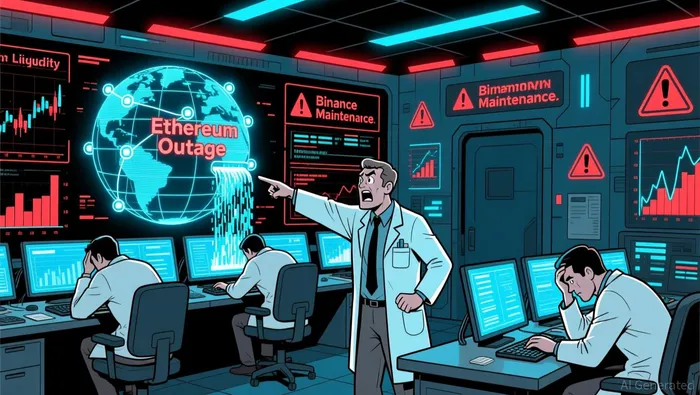
Operational Risk: Deleveraging and Systemic Vulnerabilities
Operational risks in crypto trading are magnified by the interplay of technical outages and market psychology. During the October 2025 crash, over $19 billion in leveraged positions were liquidated within a single day, driven by a combination of macroeconomic shocks and algorithmic deleveraging mechanisms. Binance's maintenance events, while less dramatic, contribute to a broader narrative of uncertainty. For instance, the suspension of ETH deposits and withdrawals-though temporary-can trigger panic selling or forced position adjustments, particularly among retail traders with limited risk buffers.
The October crash also exposed flaws in stablecoin collateral systems. USDeUSDe-- traded at a 35% discount on Binance during the sell-off, triggering markdowns in collateral values and pushing thousands of accounts below maintenance thresholds as data shows. This illustrates how operational risks extend beyond exchange outages to include systemic failures in collateral management and oracle design.
Investor Preparedness: Strategies for a Volatile Landscape
Given these risks, investors must adopt proactive strategies. Diversification across asset classes and consistent portfolio rebalancing are critical to reducing exposure to single-point failures according to financial experts. Hardware wallets and non-custodial solutions can mitigate the risks of exchange-specific outages, while stop-loss orders and predefined trading rules help enforce discipline during market turbulence as Binance reports.
Regulatory frameworks like El Salvador's mandatory multi-signature wallets and strict KYC protocols offer a blueprint for balancing innovation with investor protection according to industry analysis. Meanwhile, the Crypto-asset Operational Risk Management (CORM) framework emphasizes the need for real-time information sharing among virtual asset service providers (VASPs) to prevent illicit exploitation, as the 2025 Bybit hack demonstrates.
Conclusion: Navigating the New Normal
Binance's Ethereum maintenance events, while routine, serve as a microcosm of the broader challenges facing crypto markets. The interplay of liquidity fragility, operational risks, and investor behavior underscores the need for robust infrastructure and adaptive strategies. As the industry evolves, platforms and traders alike must prioritize resilience-whether through AI-driven risk tools, circuit breakers, or diversified portfolios-to navigate an increasingly volatile landscape.






Comentarios
Aún no hay comentarios