
Binance's Dominance in 2025: How Mid-Tier CEXs Are Reshaping Crypto Market Share and Liquidity Dynamics
In 2025, Binance remains the undisputed leader in the crypto exchange landscape, commanding a 20.9% global market share in trading volume and processing an average of $22.7 billion in daily spot volume. Its liquidity flywheel-driven-by deep order books, execution reliability, and a vast user base of 300 million registered accounts-has cemented its position as the industry's most liquid platform. Yet, beneath this dominance, mid-tier centralized exchanges (CEXs) like OKX, Bybit, and Bitget are reshaping the competitive dynamics through institutional-grade infrastructure and compliance-driven innovation. These platforms are not merely competing with Binance but redefining the parameters of liquidity, capital efficiency, and institutional adoption in a maturing market.
The Institutional Infrastructure Arms Race
Mid-tier CEXs have aggressively invested in institutional-grade tools to attract capital from traditional financial players. For instance, CoinbaseCOIN-- and Kraken have solidified their U.S. dominance by offering custody solutions, compliance frameworks, and APIs that integrate seamlessly with legacy financial systems. Bybit and Bitget, meanwhile, have expanded their derivatives markets and stablecoin rails to cater to institutional demand for real-time settlement and risk management. These developments are critical in a market where 86% of institutional investors now have exposure to digital assets, with 60% preferring registered vehicles for compliance.
Binance, despite its scale, faces challenges in this arena. While it raised $2 billion in Q1 2025 to bolster its institutional offerings, mid-tier platforms are leveraging regulatory clarity-such as the EU's MiCA framework and the U.S. GENIUS Act-to position themselves as compliant alternatives. For example, CME Group surpassed Binance in BTC futures open interest in 2024 and maintained its lead in 2025, offering institutional-grade options and ETF integrations that Binance lacks. This shift underscores a broader trend: liquidity is no longer confined to execution speed but is increasingly tied to compliance, custody security, and integration with traditional finance.
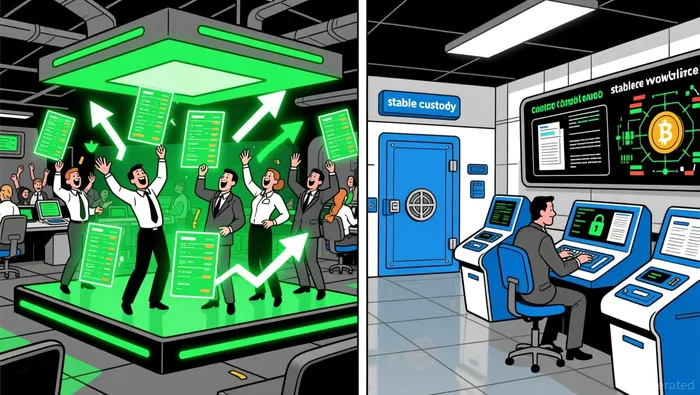
Liquidity Flywheel Dynamics: Binance vs. Mid-Tier CEXs
Binance's liquidity flywheel remains formidable. Its derivatives market alone recorded $25.09 trillion in annual volume in 2025, with daily spot trading exceeding $20 billion. The exchange's ability to maintain tight spreads and attract high-frequency traders during volatility has created a self-reinforcing cycle of capital inflows. However, mid-tier CEXs are disrupting this dynamic by fragmenting liquidity across specialized venues. OKX, Bybit, and Bitget collectively hold 62.3% of the derivatives market, with OKX alone capturing 12.5%. These platforms are leveraging stablecoin pools and Real World Asset (RWA) integrations to create localized liquidity flywheels, drawing capital from regions like Hong Kong and Singapore, where regulatory sandboxes favor compliance-driven innovation.
The rise of institutional custody solutions further illustrates this shift. While Binance offers custody services, mid-tier CEXs like Kraken and Coinbase have partnered with traditional custodians such as Fidelity and BlackRock to provide multi-signature wallets and insurance against theft. This has attracted institutional investors prioritizing security over raw liquidity, a segment that now accounts for 24.5% of the U.S. BTCBTC-- ETF market's $103 billion in assets under management.
The Future of Market Share and Liquidity
Binance's dominance is unlikely to wane in the near term, but its market share is being eroded by mid-tier CEXs' focus on institutional infrastructure. The crypto market's total value of $4 trillion in 2025 reflects not just speculative demand but a structural shift toward institutional-grade tools. As stablecoins process $46 trillion in annual transactions-rivaling Visa and PayPal-liquidity is becoming more distributed, with mid-tier CEXs acting as intermediaries between DeFi protocols and traditional finance.
For investors, this means a bifurcated market: Binance will continue to dominate in raw volume and global reach, but mid-tier CEXs will capture value through compliance, custody, and niche institutional services. The liquidity flywheel is no longer a monolith; it is a mosaic of execution-first environments, regulatory arbitrage, and capital efficiency.
Conclusion
Binance's 2025 dominance is a testament to its execution prowess and network effects. However, the rise of mid-tier CEXs-armed with institutional-grade infrastructure and regulatory agility-signals a maturing market where liquidity is no longer a zero-sum game. For investors, the key lies in balancing exposure to Binance's scale with the innovation-driven growth of mid-tier platforms. As the crypto ecosystem evolves, the winners will be those who adapt to a world where compliance, custody, and capital efficiency are as critical as liquidity depth.





Comentarios
Aún no hay comentarios