
Binance Delistings and Their Ripple Effect on Altcoin Valuation: A Deep Dive into Market Psychology and Liquidity Risk
Binance, the world's largest cryptocurrency exchange by trading volume, has long served as a bellwether for market sentiment and liquidity in the crypto space. Its recent delistings of underperforming altcoins in late 2025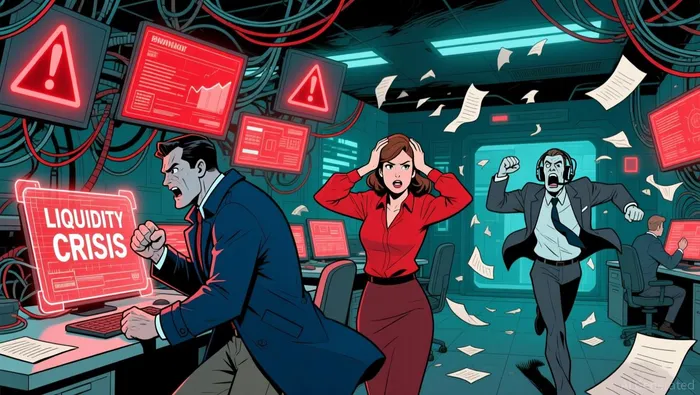 -spanning tokens like StaFiFIS-- (FIS), REI NetworkREI-- (REI), and VoxiesVOXEL-- (VOXEL)-have sent shockwaves through the ecosystem, exposing vulnerabilities in token valuation models and investor behavior. This analysis examines how Binance's stringent listing policies are reshaping market psychology and amplifying liquidity risks, with broader implications for altcoin ecosystems.
Market Psychology: Panic, Speculation, and Contrarian Bets
Binance's delistings are not merely administrative actions; they are psychological triggers that amplify investor anxiety or, paradoxically, spark speculative frenzies. For instance, the December 2025 delisting of FIS, REI, and VOXEL-announced alongside 18 other tokens in October-was met with divergent reactions. While most tokens experienced price declines due to reduced liquidity and perceived abandonment by a major exchange, FlamingoFLM-- (FLM) defied expectations by surging 19.7% post-announcement. This anomaly highlights the role of short-term speculation, as traders rushed to capitalize on tokens before liquidity access diminished.
The October 2025 delistings, however, revealed a darker side of market psychology. A cascade of forced liquidations exceeding $19 billion in a single day underscored the fragility of leveraged positions in thinly traded assets. The collapse of the stablecoin USDeUSDe--, which temporarily traded at a 35% discount on Binance, further exacerbated panic, triggering collateral markdowns and margin calls. These events exposed a self-reinforcing cycle: falling prices led to liquidations, which deepened the sell-off, eroding confidence in altcoin ecosystems reliant on momentum-driven demand.
Liquidity Risk: The Silent Killer of Altcoin Valuation
Liquidity risk-defined as the difficulty of converting an asset into cash without significantly affecting its price-has become a critical factor in altcoin valuation. Binance's delistings have exacerbated this risk by removing key trading pairs from a platform that accounts for over 50% of global crypto volume. Tokens like FIS and REI, which already traded below $1 million daily, faced immediate liquidity crunches post-delisting, with bid-ask spreads widening to 4–10% on remaining exchanges.
The October 2025 crash further illustrated the systemic risks of concentrated liquidity. As leverage-heavy positions unraveled, major BTC pairs saw their order books shrink dramatically, with slippage costs soaring. Altcoins, which often depend on reflexive buying from retail traders, were particularly vulnerable. Post-crash data shows that liquidity depth in these assets remains 30–50% lower than pre-October levels, even as Binance and other exchanges introduced tighter leverage caps and improved oracle designs.
Broader Implications for Altcoin Projects and Investors
Binance's delistings signal a shift toward stricter listing standards, prioritizing projects with active development, robust team commitment, and sustainable network activity. This trend pressures underperforming projects to either improve fundamentals or face obsolescence. For investors, the lesson is clear: liquidity is no longer a given. Tokens with low trading volumes or weak on-chain metrics are increasingly prone to sudden devaluation, even in bullish cycles.
However, the delistings also create opportunities. Tokens like FLMFLM-- demonstrate that contrarian bets-when timed carefully-can yield outsized returns. Yet, such strategies require a nuanced understanding of market psychology and a tolerance for heightened volatility.
Conclusion
Binance's delistings in late 2025 have acted as both a stress test and a catalyst for the altcoin market. They have exposed the fragility of liquidity in a sector still grappling with structural imbalances and leveraged speculation. For investors, the takeaway is twofold: first, to scrutinize the liquidity profiles of altcoins more rigorously, and second, to recognize that Binance's decisions are not just operational but deeply psychological, shaping market narratives and asset valuations in real time. As the crypto market evolves, the interplay between exchange policies, investor behavior, and token fundamentals will remain a defining force in determining which projects survive-and which fade into obscurity.







Comentarios
Aún no hay comentarios