
Binance's Compensation Strategy and the Resurgence of DeFi in the Wake of the $19B Crypto Crash
The October 2025 crypto crash, which saw $19.3 billion in liquidations within 24 hours, exposed critical vulnerabilities in both centralized and decentralized finance ecosystems. Triggered by geopolitical volatility-specifically, President Donald Trump's 100% tariff announcement on Chinese imports-the crash led to cascading failures in leveraged positions, particularly in BitcoinBTC-- and EthereumETH--. Binance, the world's largest exchange, faced scrutiny for technical outages and frozen accounts, while DeFi platforms demonstrated resilience through automated risk protocols. This article examines Binance's post-crash compensation strategy and DeFi's resurgence, analyzing their contrasting risk management frameworks and long-term investment implications.
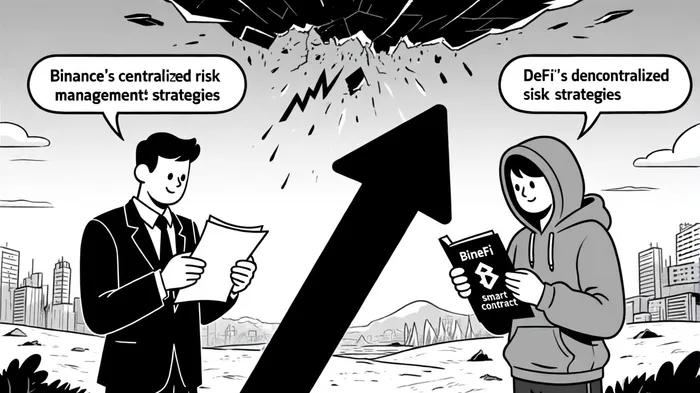
Binance's Centralized Response: Compensation and Risk Mitigation
Binance's immediate response to the crisis included activating its Secure Asset Fund for Users (SAFU) and launching a case-by-case compensation program for losses tied to platform failures. Co-founder Yi He emphasized that compensation would exclude market-driven losses, stating, "We are accountable for system issues, not volatility," as outlined in the compensation plan. The exchange also adjusted risk parameters, such as introducing minimum price thresholds for tokens like USDeUSDe-- and WBETHWBETH--, to stabilize indices during extreme volatility, per Binance's rapid response plan.
However, Binance's centralized model faces inherent limitations. Critics argue that manual interventions-such as adjusting leverage tiers or freezing accounts-can exacerbate liquidity crises, as seen during the ACT token crash, according to a CryptoNews report. Founder Changpeng Zhao acknowledged this, urging investors to adopt "survival-oriented strategies" by diversifying positions and understanding asset risks, as described in his risk management advice. While Binance's SAFU fund provides a safety net, its reliance on centralized governance leaves it vulnerable to regulatory scrutiny and user distrust, as evidenced by freeze accusations during the crash.
DeFi's Resurgence: Decentralized Risk Management and Innovation
In contrast, DeFi platforms have leveraged transparency and automation to rebuild trust post-crash. By late 2024, DeFi lending platforms had accumulated $19.1 billion in open borrows, surpassing centralized finance (CeFi) by 73%, according to a DeFi lending surge. This growth stems from innovations like smart contract audits, decentralized insurance pools, and community-driven governance models. For instance, protocols such as AaveAAVE-- and CompoundCOMP-- now employ real-time monitoring tools and quantum-resistant cryptography to mitigate oracleADA-- manipulation and liquidity risks, as highlighted in the Mastering DeFi guide.
DeFi's risk management strategies prioritize adaptability. Post-2025, institutional participants have adopted three-layer architectures combining neuromorphic processors for real-time analysis and generative simulations to stress-test protocols, as outlined in an Encrypthos guide. These advancements have reduced collateral liquidation incidents by up to 73% during volatile events, according to a Siemens Financial Services case study. However, DeFi's lack of centralized oversight introduces challenges, including regulatory uncertainty and exposure to smart contract bugs. Investors are advised to adopt a 5-layer framework, emphasizing diversification across chains and protocols while maintaining easily liquidatable positions, as recommended in a DeFi risk guide.
Centralized vs. Decentralized: A Risk Management Dilemma
The contrast between Binance's and DeFi's approaches highlights fundamental differences in risk philosophy. Centralized platforms like Binance offer structured safeguards-such as SAFU and regulatory compliance-but rely on trust in a single entity. DeFi, by decentralizing control, reduces counterparty risk but shifts responsibility to users, who must navigate complex on-chain tools and governance processes.
For long-term investors, this dichotomy presents trade-offs. Binance Earn, for example, provides stable yields through custodial services but exposes users to platform-specific risks. DeFi protocols, while offering higher returns via staking and liquidity provision, require technical expertise to manage smart contract vulnerabilities, as discussed in Binance Earn vs DeFi. Emerging hybrid models, such as liquid restaking, aim to bridge this gap by combining the security of centralized custodians with DeFi's composability, according to a quantitative comparison.
Investment Implications: Navigating the Post-Crash Landscape
The 2025 crash accelerated a shift in investor behavior. Binance reported a 46% outflow of Ethereum and 27% of Bitcoin to long-term storage solutions, signaling growing interest in DeFi and self-custody, as detailed in a CEX outflows report. This trend aligns with expert recommendations to prioritize "discipline over hype" and adopt structured risk management.
For institutional investors, the choice between Binance and DeFi hinges on risk tolerance. Binance's centralized model offers institutional-grade liquidity and ease of use, while DeFi's permissionless nature appeals to those seeking autonomy. Retail investors, meanwhile, must weigh the convenience of custodial services against the potential for higher yields in DeFi, albeit with greater complexity.
Conclusion
The $19B crash of 2025 underscored the fragility of centralized systems and the resilience of decentralized alternatives. Binance's compensation strategy, while transparent, highlights the limitations of centralized risk management in extreme volatility. DeFi's resurgence, driven by technological innovation and user-centric governance, offers a compelling counterpoint-but not without its own challenges. For investors, the path forward lies in understanding these paradigms and adopting strategies that balance security, yield, and adaptability. As the crypto ecosystem evolves, the interplay between centralized and decentralized finance will shape the next chapter of digital asset investing.






Comentarios
Aún no hay comentarios