
Binance BTC Deposit Surge and the Implications for Market Sentiment and Buying Power
The surge in BitcoinBTC-- (BTC) deposits on Binance during Q4 2025 has underscored a pivotal shift in market dynamics, reflecting both institutional and retail confidence in the cryptocurrency while exposing systemic vulnerabilities tied to volatility and leveraged positioning. As the world's largest crypto exchange by trading volume, Binance's role in facilitating capital flows has become a barometer for broader market sentiment. However, the interplay between deposit trends, leveraged trading, and Bitcoin's inherent volatility has created a complex landscape with significant implications for buying power and systemic risk.
Institutional and Retail Drivers of the Deposit Surge
The Q4 2025 deposit surge on Binance was fueled by a confluence of institutional and retail factors. According to SSGA, institutional adoption of Bitcoin reached a critical inflection point, with 68% of institutional investors either invested in or planning to invest in Bitcoin exchange-traded products (ETPs). This trend was amplified by the approval of spot Bitcoin ETFs and other regulatory milestones, which normalized digital asset allocations for institutional portfolios. According to SSGA, the U.S. Bitcoin ETF market alone grew 45% to $103 billion in assets under management, with institutional participation rising to 24.5%.
Retail investors also played a key role, driven by historical Q4 performance patterns and macroeconomic tailwinds. Historical Q4 returns show Bitcoin has delivered an average Q4 return of 79% since 2013, and expectations for continued growth were bolstered by Federal Reserve rate cuts and Bitcoin's perceived role as a hedge against currency devaluation. These factors contributed to Binance's total product trading volume reaching $34 trillion in 2025, with a 125% surge in retail-driven volume and a 21% year-on-year increase in institutional trading according to Onesafe.
Volatility-Driven Capital Flows and Buying Power
Bitcoin's settlement volume in Q4 2025 reached $6.9 trillion, a figure rivaling major payment processors like Visa and Mastercard. However, this growth occurred amid extreme price volatility, with intraday swings exceeding $3,000 during the quarter according to Binance. Such volatility created a dual-edged dynamic: while sharp price swings attracted speculative capital, they also amplified risks for leveraged positions.
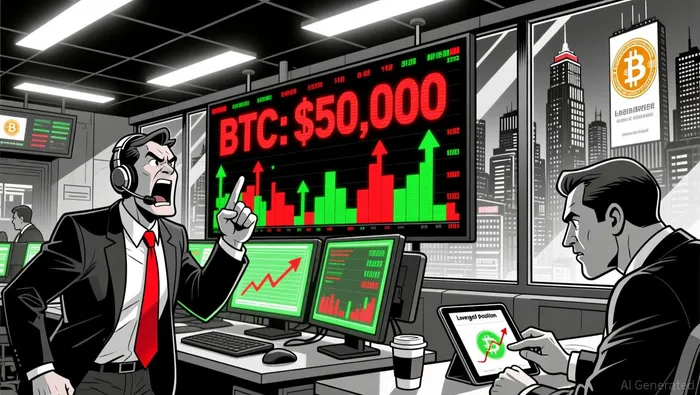
The interplay between volatility and buying power became evident in Binance's derivatives market, which captured 30% of global crypto derivatives trading volume in 2025. Derivatives trading surged to $86 trillion annually, with perpetual futures accounting for 78% of total volume according to Bitget. This concentration of leverage-exacerbated by macroeconomic pressures like U.S. Federal Reserve tightening and U.S.-China trade tensions-led to a 14% drop in Bitcoin's price on October 10, 2025, triggering cascading liquidations according to Bitget.
Leveraged Positioning Risks and Systemic Vulnerabilities
The Q4 2025 period exposed the fragility of leveraged positioning on platforms like Binance. According to Bitget, leverage ratios soared to unsustainable levels, with some traders employing 1,001:1 leverage. This extreme leverage, combined with Bitcoin's sharp price declines-falling below $100,000 in late 2025-triggered $20 billion in liquidations during November alone. Binance itself faced $499.89 million in Bitcoin long position losses in a single day, as margin calls and automated stop-loss mechanisms intensified volatility according to Bitget.
The feedback loop created by leveraged positions and perpetual futures highlighted systemic risks. Liquidations drove prices lower, which in turn triggered more liquidations, creating a self-reinforcing cycle according to Bitget. This dynamic was compounded by the high concentration of derivatives trading on a few major exchanges, with Binance's dominance exposing the market to liquidity risks. For instance, according to CryptoRank, $117 million in crypto futures were liquidated in a single hour during Q4 2025, underscoring the fragility of the ecosystem.
Implications for Market Stability and Investor Strategy
The Q4 2025 experience underscores the need for caution in leveraged trading environments. While Bitcoin's settlement volume demonstrated robust buying power, the volatility-driven liquidations revealed vulnerabilities in the derivatives market. Institutional investors, now more entrenched in the space, may mitigate some risks through diversified strategies such as Bitcoin lending and staking. However, retail investors remain exposed to the same volatility, particularly as leverage ratios continue to rise.
Looking ahead, Bitcoin's volatility is projected to decline, with 30-day realized volatility expected to fall below 25% by Q4 2026. This could stabilize leveraged positioning and reduce systemic risks. Meanwhile, privacy-focused assets like ZcashZEC-- (ZEC) emerged as a buffer against volatility, outperforming high-beta assets like Bitcoin due to their practical use cases and diversification appeal according to Grayscale.
Conclusion
Binance's BTCBTC-- deposit surge in Q4 2025 reflects a maturing digital asset market, driven by institutional adoption and retail optimism. However, the interplay between volatility, leveraged positioning, and derivatives trading has exposed systemic risks that could undermine long-term stability. Investors must balance the allure of high returns with the realities of extreme leverage and market concentration. As regulatory frameworks evolve and volatility normalizes, the path forward will require a nuanced approach to capital allocation-one that prioritizes resilience over speculation.






Comentarios
Aún no hay comentarios