
Binance Alpha's BOS Listing as a Strategic Early-Stage Crypto Play
Binance Alpha's Listing Criteria: Innovation and Retail Accessibility
Binance Alpha's 2025 criteria prioritize projects with cutting-edge technology and real-world utility. For instance, Orochi (ON), a zero-knowledge-based data infrastructure project, was listed despite notNOT-- having issued its native token yet, according to Coinfomania according to Coinfomania. Similarly, Bluwhale (BLUAI), a blockchain-based AI project, debuted alongside a 50x leveraged perpetual futures contract, underscoring the platform's appetite for speculative yet technically sound assets, per Binance's Bluwhale announcement Binance's Bluwhale listing. These examples highlight Binance Alpha's willingness to support projects that align with emerging trends like privacy-centric infrastructure and cross-chain interoperability.
The platform's emphasis on retail accessibility is equally notable. By listing over 331 tokens in 2025, Binance Alpha has diversified its offerings, enabling smaller investors to participate in high-growth opportunities, as noted in the earlier Coinotag coverage of the platform's volume peak a Coinotag report. This strategy aligns with broader market dynamics, as retail participation has historically driven liquidity and volatility in early-stage tokens.
BitcoinOS (BOS): A Technological Leap for Bitcoin
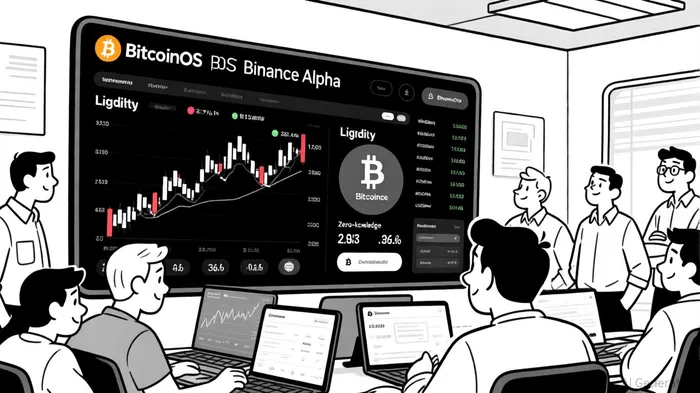
BitcoinOS (BOS) represents a novel approach to Bitcoin's scalability and programmability. Unlike layer-2 solutions, BOS functions as a smart contract operating system that enhances Bitcoin's capabilities without altering its core consensus; see BitcoinOS's market page for token details BitcoinOS on CoinGecko. Its BitSNARK technology leverages zero-knowledge proofs to verify off-chain computations directly on BitcoinBTC--, enabling decentralized finance (DeFi) applications and cross-rollup asset transfers via the Grail protocol (BitcoinOS on CoinGecko).
The project's recent $10 million funding round, led by Greenfield Capital and FalconX, further validates its institutional appeal, as reported by Yahoo Finance a Yahoo Finance report. This capital infusion aims to expand BOS's institutional Bitcoin finance tools and developer protocols, addressing a critical gap in Bitcoin's ecosystem. For Binance Alpha users, the October 29 listing offers an airdrop opportunity, with qualified participants able to claim tokens using Alpha points, according to LookonChain a LookonChain post. Such incentives amplify early adoption, a key metric for Binance's due diligence process.
Historical Performance: Lessons from Binance Alpha Listings
To contextualize BOS's potential, it's instructive to examine the performance of similar tokens. Bluwhale (BLUAI), listed on October 21, 2025, opened at $0.03 with a $37.66 million market capitalization (Binance's Bluwhale listing). Eligible users received 1,600 tokens via airdrop, translating to approximately $48 in earnings per participant, based on LookonChain's breakdown a LookonChain post. While BLUAI's short-term volatility remains unquantified, its leveraged futures contract suggests Binance's confidence in its speculative appeal.
Orochi (ON), another zero-knowledge-focused project, exemplifies Binance Alpha's interest in privacy-centric infrastructure (Coinfomania). Though pre-token, its listing on both Alpha and Futures platforms indicates a strategic bet on long-term technological adoption. These cases underscore the dual nature of early-stage tokens: high upside potential coupled with significant volatility.
Binance's Due Diligence: Rigor and Risk Mitigation
Binance Alpha's evaluation process for projects like BOS involves a multi-faceted approach. Non-circulating projects are assessed on fundamentals, tokenomics, technical risk, and team credibility, per Binance's listing criteria Binance listing criteria. Circulating projects face scrutiny on liquidity depth, trading volume, and price stability. For BOS, this likely includes stress-testing its BitSNARK technology and evaluating the Grail protocol's interoperability with existing Bitcoin infrastructure.
The platform also mandates compliance with regulatory frameworks and transparent token distribution schedules (Binance listing criteria). Ongoing monitoring ensures projects maintain performance benchmarks, with underperforming assets facing delisting. This rigorous process adds a layer of credibility but does not eliminate inherent risks, such as regulatory shifts or technological failures.
Risks and Rewards: A Calculated Gamble
Investing in early-stage tokens like BOS carries dual-edged risks. On one hand, BOS's integration with Bitcoin's security model and institutional backing could drive adoption in Bitcoin finance (BTCFi). On the other, its newness exposes it to execution risks-such as smart contract vulnerabilities-and regulatory scrutiny, particularly in jurisdictions skeptical of Bitcoin layer-2 innovations.
Retail investors must also contend with liquidity challenges. While Binance Alpha's 2025 growth has improved market depth for emerging tokens, early-stage assets often exhibit wide bid-ask spreads and low trading volumes, as observed when Binance Alpha listed Common (COMMON) a Coinotag report. This can amplify losses during market downturns.
Conclusion: Strategic Allocation in a High-Volatility Arena
Binance Alpha's BOS listing encapsulates the allure and peril of early-stage crypto investing. For risk-tolerant investors, BOS's technological innovation and institutional backing present a compelling case, particularly for those bullish on Bitcoin's expansion into DeFi and cross-chain use cases. However, the absence of historical performance data and the project's nascent stage necessitate cautious allocation.
As Binance Alpha continues to shape the early-stage crypto landscape, projects like BOS will remain both a testament to blockchain's innovation and a reminder of the sector's inherent volatility.






Comentarios
Aún no hay comentarios