
Binance's $400M 'Together Initiative': A Strategic Lifeline for Crypto Liquidity?
In October 2025, Binance unveiled its $400 million "Together Initiative," a bold attempt to stabilize a crypto market reeling from one of its most severe crashes. The initiative, announced amid $19 billion in forced liquidations over two days, according to an ICObench report, targets both retail and institutional liquidity challenges. By offering $300 million in token vouchers to retail users and $100 million in low-interest loans to institutional partners, Binance aims to restore confidence and prevent further liquidity shocks. This analysis explores the strategic implications of the initiative, its potential to reshape market dynamics, and the broader questions it raises about centralized exchanges' role in systemic risk mitigation.
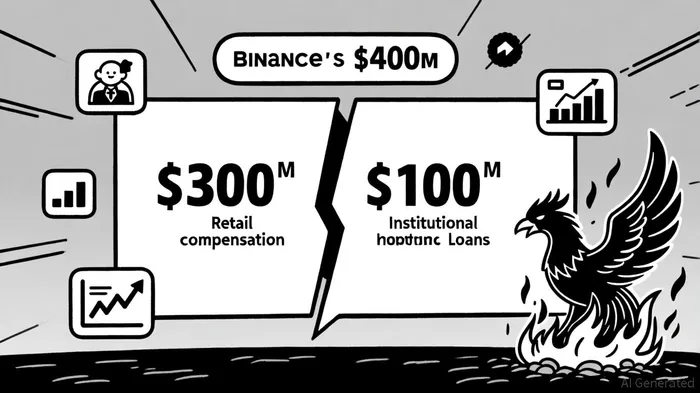
Retail Liquidity: A Direct Replenishment Strategy
The retail component of the initiative focuses on users who suffered forced liquidations between October 10–11, 2025. Eligible participants—those who lost at least $50, or 30% of their net assets based on a snapshot from October 9—will receive USDCUSDC-- vouchers ranging from $4 to $6,000, according to a FinanceFeeds report. This direct compensation addresses immediate liquidity needs for retail traders, many of whom may have been driven out of the market by margin calls.
According to a Cointelegraph report, this approach could incentivize users to return to Binance, potentially boosting trading volume and market depth. However, the effectiveness hinges on whether the vouchers translate into renewed participation. For instance, a user who lost 30% of their portfolio might reinvest the $6,000 voucher, but only if they perceive the market as stable enough to justify the risk. Binance's emphasis on "rebuilding trust," according to a BlockNews report, suggests the exchange is betting on psychological recovery as much as financial support.
Institutional Liquidity: Stabilizing the Backbone of Markets
The $100 million low-interest loan facility for institutions is a more nuanced intervention. By providing liquidity to key market participants—such as liquidity providers and institutional traders—Binance aims to prevent cascading failures that could exacerbate volatility, according to an OpenTools article. This aligns with the exchange's July 2025 launch of its Institutional Loans program, which allows verified corporate clients to borrow up to 10 million USDC/USDT with 4x leverage, as detailed in a Coin Republic report. The pooled collateral model, which aggregates assets across multiple sub-accounts, enhances borrowing power while minimizing manual fund consolidation, according to a TopTech report.
Analysts argue that this dual approach—retail compensation and institutional liquidity support—could stabilize the broader ecosystem. As noted by OpenTools.ai, Binance's initiative sets a precedent for centralized exchanges to act as "systemic stabilizers" during crises. However, the success of the institutional loans depends on their terms. For example, the absence of haircut ratios for major tokens like BTC and ETH, a BitJournal report notes, reduces borrowing costs, but the low-interest rate itself must be attractive enough to entice institutions to utilize the facility.
Strategic Implications: Confidence vs.
Systemic Risk
The "Together Initiative" is not without controversy. Binance explicitly disclaims liability for user losses, according to a CoinGabbar report, framing the effort as a "proactive" measure rather than an admission of fault. This distinction is critical: while the initiative may restore short-term confidence, it does not address underlying issues like leverage overuse or regulatory scrutiny.
For retail liquidity, the program's impact could be temporary. If the market rebounds, the vouchers might act as a catalyst for renewed trading activity. However, if volatility persists, users may remain cautious. For institutions, the loans could provide a buffer against margin shortfalls, but they also risk creating moral hazard—encouraging excessive leverage if traders perceive Binance as a safety net, as highlighted in a BeInCrypto report.
Broader Market Trends: Centralized vs.
Decentralized Liquidity
The initiative also highlights a broader shift in liquidity dynamics. While Binance's efforts focus on centralized exchanges (CEX), recent data shows decentralized exchanges (DEXs) have seen surges in volume during crises, a trend discussed by OpenTools.ai. This raises questions about whether CEXs like Binance can retain their dominance if users increasingly seek decentralized alternatives. The "Together Initiative" may delay this transition by reinforcing trust in centralized infrastructure, but it does not eliminate the structural appeal of DEXs.
Conclusion: A Stopgap or a Blueprint?
Binance's $400M initiative is a strategic gamble. For retail liquidity, it offers a direct but limited lifeline; for institutions, it provides a tool to navigate volatility. However, the long-term success of the program depends on two factors: transparent execution and sustained market stability. If Binance can demonstrate that its measures prevent further collapses, the initiative could become a blueprint for crisis management in crypto. If not, it may serve as a reminder that liquidity interventions alone cannot fix systemic fragility.






Comentarios
Aún no hay comentarios