
Binance's $3.2B Stablecoin Inflow: A Macro-Driven Liquidity Shift and Institutional Opportunity
In October 2025, Binance recorded a record $3.2 billion inflow of stablecoins ahead of the U.S. CPI report, signaling a pivotal shift in macro-driven liquidity dynamics within the crypto market[1]. This surge, occurring alongside similar inflows of $1.82 billion in August and $2 billion before the FOMC meeting in September[3], underscores a strategic repositioning by traders and institutions. These movements reflect notNOT-- just speculative activity but a calculated response to macroeconomic uncertainty, regulatory tailwinds, and the growing institutionalization of stablecoin usage.
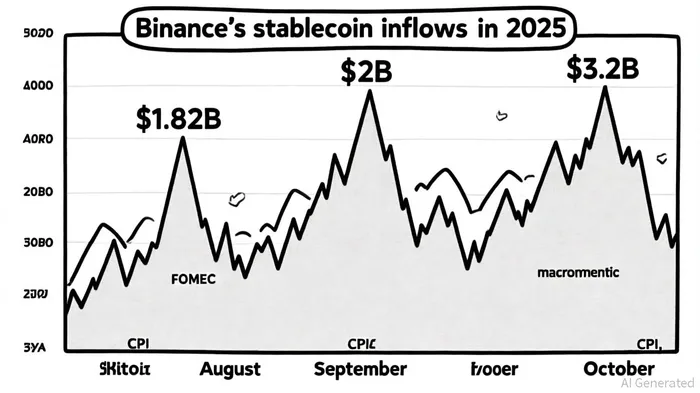
Macro-Driven Liquidity Shifts and Market Positioning
Stablecoin inflows to Binance have historically preceded BitcoinBTC-- price recoveries and increased market volatility[3]. The October $3.2B inflow, driven primarily by ERC-20 tokens like USDTUSDT-- and USDC[1], coincided with Bitcoin trading below $110,000 amid whale-driven sell-offs[5]. This pattern suggests traders are using stablecoins as a liquidity buffer to capitalize on anticipated volatility from the CPI report-a key Fed policy indicator.
Data from the Bank for International Settlements (BIS) further contextualizes this trend: stablecoin inflows have been shown to reduce short-term U.S. Treasury yields by 2–2.5 basis points within 10 days, while outflows raise yields by 6–8 basis points[3]. This inverse relationship highlights how stablecoins are now influencing traditional financial markets, acting as a proxy for risk-on/risk-off sentiment. For institutional investors, this creates a dual opportunity: leveraging stablecoins to hedge against macroeconomic shocks while positioning for asset reallocation during market bottoms.
Institutional Strategies and Regulatory Legitimacy
The surge in stablecoin inflows is not merely retail-driven. Institutional adoption has accelerated in 2025, with 45% of USDCUSDC-- supply held in wallets exceeding $1 million in balances[4]. Regulated entities are increasingly treating stablecoins as infrastructure, deploying them for yield generation, treasury stacking, and cross-border settlements. For example, hedge funds now allocate 5–20% of their net asset value to stablecoin yield strategies, while platforms like AaveAAVE-- capture 41.2% of institutional lending deployments[1].
Regulatory frameworks like the EU's MiCAR and the U.S. GENIUS Act have further legitimized stablecoin usage, reducing compliance risks for institutional players[5]. This has led to a 56.7% market share for USDC in institutional portfolios, driven by its transparency and compliance credentials[2]. As a result, stablecoins are no longer just liquidity tools-they are becoming core components of global financial infrastructure, with PayPal, Stripe, and Visa integrating them into payment solutions[3].
Strategic Implications for Capital Reallocation
For investors, the $3.2B inflow ahead of the CPI report signals a potential inflection point. Historical data shows that such inflows often precede Bitcoin price recoveries by 2–4 weeks[3]. Institutions are likely using stablecoins to accumulate dry powder, ready to deploy into risk-on assets as volatility peaks. This pattern mirrors 2023's market cycles, where stablecoin inflows into Binance correlated with 15–20% Bitcoin rebounds within 30 days[5].
Moreover, the concentration of stablecoin balances in high-net-worth wallets introduces systemic risks. A sudden redemption wave could destabilize DeFi protocols or trigger cascading liquidations. However, this also creates arbitrage opportunities for savvy investors who can anticipate liquidity shifts and position accordingly.
Conclusion: A Call to Action for Institutional Investors
Binance's stablecoin inflows in 2025 are a macroeconomic barometer, reflecting both market sentiment and institutional strategy. For investors, the key takeaway is clear: stablecoins are no longer peripheral to crypto markets-they are central to liquidity management, asset reallocation, and volatility signaling. As regulatory clarity and institutional adoption converge, stablecoins will continue to serve as a bridge between traditional finance and digital assets.
The $3.2B inflow ahead of the CPI report is not an anomaly but a harbinger of deeper structural shifts. Investors who recognize this trend and align their strategies with macro-driven liquidity flows will be well-positioned to capitalize on the next phase of crypto's evolution.






Comentarios
Aún no hay comentarios