
Binance's 2025 Growth as a Barometer for Institutional Crypto Adoption
In 2025, Binance emerged as a pivotal force in bridging the gap between decentralized finance and institutional markets. Its strategic advancements in infrastructure and compliance have not only solidified its position as a global crypto leader but also served as a litmus test for the broader adoption of digital assets by traditional financial actors. By dissecting Binance's 2025 milestones-ranging from regulatory alignment to institutional-grade tools-we can discern how crypto infrastructure maturation and scalable compliance frameworks are catalyzing trust among institutional investors.
Infrastructure Maturation: A Foundation for Trust
Binance's 2025 infrastructure upgrades were anchored in its pursuit of regulatory legitimacy. The platform became the first global crypto exchange to secure full authorization under the Abu Dhabi Global Market's (ADGM) Financial Services Regulatory Authority (FSRA) framework. This milestone was not merely symbolic; it aligned Binance's operations with traditional financial standards, enabling it to serve institutional clients under a regulated umbrella. By year-end, Binance had surpassed 300 million registered users, a testament to its scalability and the growing acceptance of crypto as a mainstream asset class.
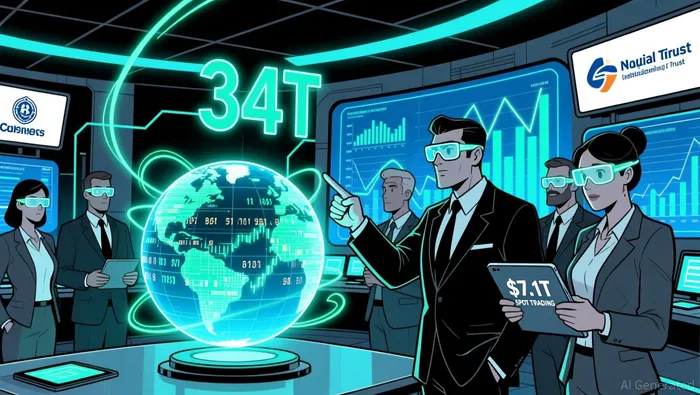
Trading volume metrics further underscored Binance's role as a liquidity backbone. The platform processed $34 trillion in total trading volume in 2025, with spot trading alone exceeding $7.1 trillion. For institutions, this liquidity depth is critical-it reduces slippage, enhances price discovery, and supports large-volume transactions without destabilizing markets. Binance's infrastructure, therefore, is no longer just a trading venue but a foundational layer for institutional-grade crypto activity.
Scalable Compliance: Mitigating Risk at Scale
Institutional adoption hinges on robust compliance frameworks. Binance's 2025 compliance initiatives were designed to address this need. The exchange redesigned its Enhanced Due Diligence (EDD) processes to streamline user verification while maintaining security. This balance is vital for institutions, which require rapid onboarding without compromising regulatory adherence.
The results were measurable: Binance's systems prevented $6.69 billion in potential fraud and scam losses for 5.4 million users in 2025. Such outcomes demonstrate the platform's ability to scale risk mitigation-a non-negotiable requirement for institutional players. Additionally, Binance introduced advanced transaction monitoring systems and automated reporting tools, enabling real-time compliance with anti-money laundering (AML) and know-your-customer (KYC) regulations. These tools not only reduce operational burdens for institutions but also align with global regulatory expectations, fostering trust in Binance's ecosystem.
Institutional-Grade Services: Custody, APIs, and Collateral Innovation
Binance's 2025 institutional offerings extended beyond compliance. The platform launched custody solutions tailored for institutional portfolios, including multi-signature wallets and thresholdT-- signature cryptography (MPC) to secure large holdings. These innovations addressed a key institutional pain point: the need for enterprise-grade security without sacrificing accessibility.
API tools also saw significant enhancements. Binance's institutional APIs provided hedge funds and asset managers with real-time market data, algorithmic trading capabilities, and liquidity aggregation across global exchanges. By reducing slippage and improving execution efficiency, these tools made crypto trading more viable for institutions accustomed to traditional markets.
Collateral innovation further solidified Binance's institutional appeal. The integration of tokenized funds, such as BlackRock's BUIDL Fund, allowed institutions to use crypto as collateral for off-exchange transactions. This modular approach-enabling white-label rails through Crypto-as-a-Service- allowed regulated firms to offer digital assets without overhauling their existing infrastructure. Such solutions lower entry barriers, accelerating mainstream adoption.
Partnerships and Regulatory Alignment: A Dual-Track Strategy
Binance's 2025 growth was underpinned by strategic partnerships and regulatory alignment. Its ADGM authorization was complemented by collaborations with traditional financial players, such as BlackRock, to tokenize real-world assets. These partnerships signaled to institutions that Binance was not just a crypto-native entity but a bridge to traditional finance.
Regulatory alignment also extended to global standards. Binance's compliance program achieved milestones in KYC/AML controls and risk management protocols, aligning with the expectations of jurisdictions like the EU and the U.S. This alignment is critical for institutions, which operate under stringent cross-border regulatory frameworks. By proactively adapting to these standards, Binance positioned itself as a trusted infrastructure provider for institutional crypto activity.
Conclusion: Binance as a Barometer for the Future
Binance's 2025 trajectory reflects a broader trend: the maturation of crypto infrastructure and compliance frameworks is unlocking institutional adoption. Its achievements-regulatory authorization, scalable compliance, institutional-grade tools, and strategic partnerships-demonstrate that crypto can meet the demands of traditional finance. For investors, Binance's growth is not just a success story but a barometer of the sector's readiness for mainstream integration. As institutions continue to seek secure, compliant, and scalable solutions, Binance's role as a foundational infrastructure provider will likely remain central to the evolution of global finance.







Comentarios
Aún no hay comentarios