
Binance's $2.1B Stablecoin Surge: A Strategic Opportunity in Post-Fed Rate Cut Crypto Liquidity
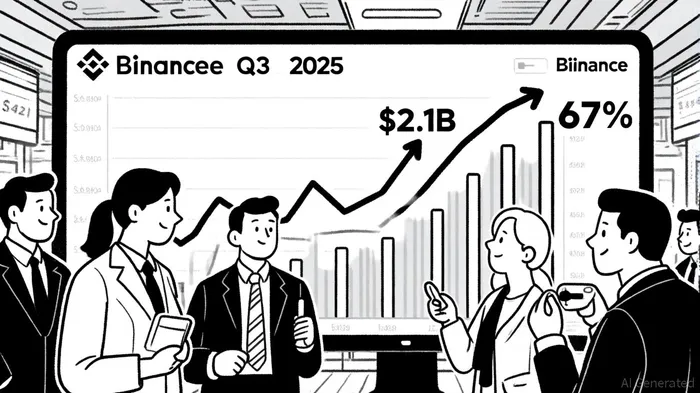
The September 2025 Federal Reserve rate cut has catalyzed a seismic shift in crypto liquidity dynamics, with Binance emerging as the central hub for institutional-grade capital allocation. The exchange's $2.1 billion stablecoin inflow surge ahead of the Fed's decision—largely in USDTUSDT-- and USDC—reflects a strategic repositioning by traders and institutions seeking to capitalize on macroeconomic volatility[2]. This surge is notNOT-- merely a short-term liquidity event but a harbinger of broader structural trends reshaping decentralized finance (DeFi) and stablecoin-driven markets.
Binance's Dominance in Stablecoin Liquidity: A Strategic Moat
Binance's capture of 67% of exchange-based stablecoin liquidity in Q3 2025—equivalent to $44.2 billion out of a $68 billion total market—underscores its role as the de facto infrastructure for global crypto capital flows[4]. This dominance is underpinned by three pillars:
1. Zero-Fee Trading Pairs: Early integration of stablecoins like FDUSDFDUSD-- and TUSDTUSD-- as zero-fee trading pairs has attracted both retail and institutional users, reducing transaction costs and boosting liquidity depth[4].
2. Regulatory Clarity: The U.S. Stablecoin Act and the EU's MiCA framework have provided a legal foundation for institutional participation, with Binance leveraging these developments to onboard regulated entities[3].
3. Cross-Chain Infrastructure: Binance's Layer-2 solutions and cross-chain bridges enable seamless arbitrage and yield farming across EthereumETH--, SolanaSOL--, and BNBBNB-- Chain, amplifying capital efficiency[1].
The $2.1 billion inflow surge ahead of the Fed rate cut exemplifies how Binance's infrastructure aligns with institutional needs. Traders are hoarding stablecoins as “dry powder” to deploy into crypto assets if the Fed's dovish pivot triggers a market rally[2]. This behavior mirrors traditional finance's “cash-to-equity” playbook but with the added flexibility of blockchain-based execution.
Post-Fed Rate Cut: DeFi as the New Yield Frontier
The Fed's 25-basis-point rate cut has compressed traditional yields to 3–3.25%, making DeFi's market-driven returns increasingly attractive. Institutions are now allocating capital to strategies that exploit this spread:
- Yield Farming: Platforms like AaveAAVE-- V3 and PendlePENDLE-- Finance offer stablecoin yields up to 13.58% APY, dwarfing traditional savings accounts[4]. Binance Institutional's Web3 wallet and tokenized RWA products (e.g., USTC-backed treasuries) provide institutional-grade access to these opportunities[1].
- Arbitrage: Binance's deep liquidity pools and automated bots enable high-frequency arbitrage across spot and futures markets. For instance, futures funding rate arbitrage has become a staple for institutions leveraging Binance's API-driven tools[2].
- Cross-Border Settlements: Stablecoins are displacing legacy systems in B2B transactions. With Q1 2025 stablecoin settlement volumes hitting $27.6 trillion—surpassing VisaV-- and Mastercard—Binance's role as a settlement infrastructure provider is critical[4].
Goldman Sachs' institutional DeFi strategy, which blends risk-first protocol selection with dynamic rebalancing algorithms, highlights the sophistication of these allocations. By limiting exposure to any single protocol to 2% of a portfolio and using the Kelly Criterion adjusted for DeFi risks, institutions are mitigating volatility while capturing yield differentials[1].
Strategic Implications for Institutional Investors
The post-Fed rate cut environment presents three key opportunities:
1. Leveraged Yield Farming: Institutions are borrowing against stablecoin holdings to amplify capital in protocols like SparkSPK-- and UniswapUNI-- V3, achieving leveraged APYs of up to 17%[1].
2. Regulatory Arbitrage: The U.S. Stablecoin Act's removal of barriers for interest-bearing stablecoins has enabled institutions to exploit cross-jurisdictional yield gaps, particularly between U.S. and EU markets[3].
3. Tokenized Real-World Assets (RWA): Binance's tokenized U.S. Treasury bills and corporate bonds offer yields of 4.2%—a compelling alternative to cash in a low-rate environment[1].
However, risks persist. Regulatory uncertainty, smart contract vulnerabilities, and liquidity crunches in illiquid protocols remain hurdles. Institutions are addressing these through quantum audit trails, multi-signature governance, and real-time compliance reporting[4].
Conclusion: Binance as the On-Ramp to the Future
Binance's $2.1 billion stablecoin surge is a microcosm of the broader shift toward DeFi and stablecoin-driven capital allocation. As the Fed's easing cycle continues, the exchange's infrastructure—coupled with regulatory tailwinds—positions it as a critical on-ramp for institutional investors seeking yield, liquidity, and global settlement efficiency. For those who recognize this transition early, the rewards could be substantial.






Comentarios
Aún no hay comentarios