
Binance's $19B Liquidation Crisis: Institutional Trust and the Future of Crypto Risk Management
The October 2025 crypto market crash, triggered by former U.S. President Donald Trump's 100% tariff announcement on Chinese imports, exposed systemic vulnerabilities in leveraged trading ecosystems. Over $19 billion in positions were liquidated in 24 hours, with Binance-the world's largest exchange-reporting $2.39 billion in losses, according to a BlockInsider report. This event, the largest in crypto history, has forced a critical reevaluation of risk management frameworks and institutional trust in centralized exchanges.
The Catalyst: Geopolitical Shocks and Depegged Collateral
The crisis began when Binance's unified margin system faced a cascading collapse due to the sudden depegging of stablecoins like USDeUSDe-- and WBETHWBETH--, according to a CoinEdition analysis. As global trade tensions escalated, leveraged long positions across BitcoinBTC--, EthereumETH--, and altcoins were wiped out, with over 1.6 million traders affected, the BlockInsider report said. The depegging of collateral assets exacerbated losses, as live spot prices were used for margin calculations, triggering a feedback loop of forced liquidations, the CoinEdition analysis explains.
Binance's response included a 72-hour compensation plan for affected users, covering losses tied to technical issues but excluding market volatility, per a Binance announcement. The exchange also announced adjustments to price index weights and minimum price thresholds for depegged tokens in the BlockInsider report. While these measures aimed to stabilize the platform, critics highlighted structural flaws in Binance's margin system, where mixed collateral types (e.g., staking derivatives and stablecoins) amplified risk during downturns, as outlined in the CoinEdition analysis.
Institutional Trust: A Fragile Rebuilding Effort
Institutional investors, who have increasingly allocated capital to crypto, reacted cautiously to the crisis. Binance's post-event measures-such as introducing Institutional Loans (allowing $10 million stablecoin borrowing with 4x leverage) and Fund Accounts for omnibus custody-were designed to restore confidence, according to a Silicon Review article. These tools, modeled after traditional finance, aim to address operational challenges in crypto fund management while enhancing transparency through net asset value (NAV) tracking, the Silicon Review article notes.
However, trust remains fragile. Binance US, under new leadership, has restructured to focus exclusively on institutional clients following a $4.3 billion DOJ settlement, the Silicon Review article reports. This shift reflects broader regulatory pressures, including the U.S. GENIUS Act and EU MiCA, which demand stricter compliance frameworks. Analysts note that while Binance's liquidity dominance (spot volume exceeding $50 billion daily) remains a strength, its risk management practices must evolve to meet institutional-grade standards, a CryptoRobotics analysis argues.
Risk Management Effectiveness: A Mixed Record
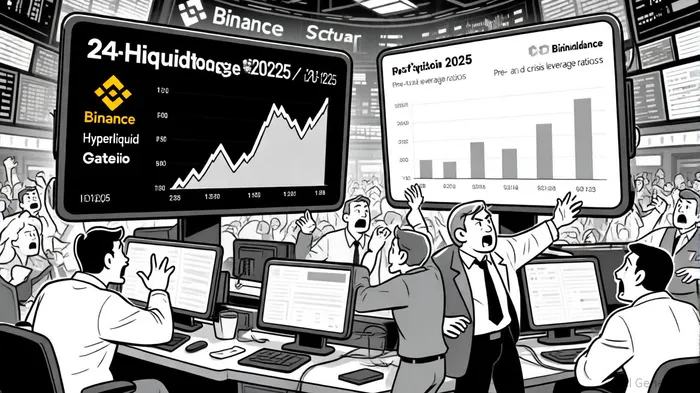
Binance's pre-crisis adjustments-such as lowering leverage tiers for BTC and ETH and recalibrating collateral ratios-helped mitigate losses during the October crash, according to the Binance announcement. The exchange's futures insurance fund absorbed $188 million in losses, preventing negative balances for traders, the BlockInsider report indicated. Additionally, Binance's conservative leverage ratio (13.5 in 2025, compared to 18+ for competitors like Gate.io) provided a buffer against systemic collapse, the CryptoRobotics analysis observed.
Yet, the event exposed gaps in the industry's risk infrastructure. For instance, Hyperliquid processed record volumes without downtime, contrasting with Binance's frozen accounts and failed stop-loss orders, as discussed in the CoinEdition analysis. This disparity has reignited debates about the resilience of centralized versus decentralized trading systems under extreme volatility, the CoinEdition analysis adds.
Regulatory and Industry Responses: A Path Forward?
Regulators have intensified scrutiny of crypto exchanges. The U.S. DOJ's settlement with Binance US and the EU's MiCA framework signal a shift toward stricter oversight, the Silicon Review article notes. Meanwhile, industry players are calling for standardized risk controls, such as multi-party computation for key management and real-time liquidity monitoring, recommended in the CryptoRobotics analysis.
Binance's CEO, Changpeng Zhao, has emphasized the need for self-education and risk-aware strategies among investors, the CryptoRobotics analysis reports. However, the lack of full transparency-Binance has yet to release detailed liquidation data-has fueled mistrust, as the CoinEdition analysis highlights. Analysts argue that without open disclosure of systemic risks, institutional adoption will remain constrained, the CryptoRobotics analysis concludes.
Conclusion: Stability Through Institutionalization
The October 2025 liquidation event serves as a wake-up call for the crypto industry. While Binance's risk management measures have shown partial effectiveness, the crisis underscores the need for institutional-grade infrastructure, including robust custody solutions, dynamic liquidity protocols, and transparent reporting. For exchanges to regain trust, they must align with regulatory expectations and adopt practices that prioritize long-term stability over short-term growth.
As the market matures, the balance between innovation and risk mitigation will define the next phase of crypto's evolution. Institutions, regulators, and platforms like Binance must collaborate to build a resilient ecosystem-one where leveraged trading is both accessible and secure.






Comentarios
Aún no hay comentarios