
Why Billionaire Stan Druckenmiller's Shift to MercadoLibre Signals a High-Conviction Opportunity in Overlooked LatAm Growth
's recent 9% increase in his MercadoLibreMELI-- (MELI) stake-now 3.5% of his portfolio-has sent a clear signal to the market: the billionaire is doubling down on a contrarian bet in Latin America's underpenetrated digital ecosystem according to analysis. While many investors remain fixated on U.S. tech giants, Druckenmiller is betting on MercadoLibre's unique position as the region's dominant e-commerce and fintech platform, a business model that combines explosive growth with a defensible network effect.
The Ecosystem Play: Commerce, Fintech, and Financial Inclusion
MercadoLibre's strength lies in its ability to weave together commerce, payments, and financial services into a single, self-reinforcing ecosystem. With 100 million unique buyers , the company is not just selling goods-it's building the digital infrastructure of Latin America. MercadoPago, its fintech arm, in payments in 2024 and has extended credit to 22 million small businesses in Brazil alone. This expansion into financial services is critical: as higher-margin fintech revenue grows, so do profit margins, creating a flywheel effect that few competitors can replicate.
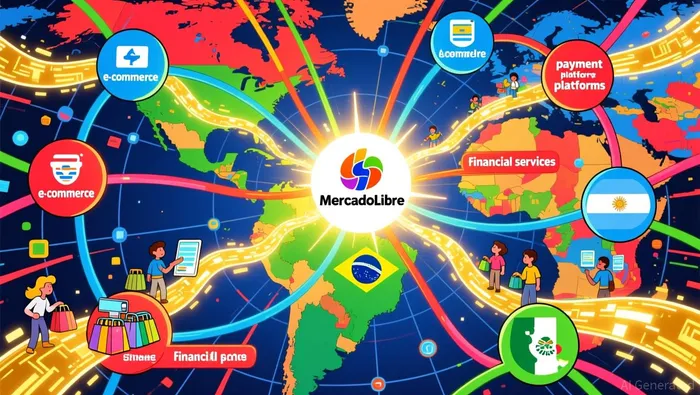 The region's underpenetrated markets are the key to this growth. E-commerce in Latin America remains a fraction of its U.S. or Asian counterparts, hampered by logistical challenges and economic disparities. Yet, MercadoLibre is turning these obstacles into opportunities. For example, in Argentina-a country where over 60% of adults lack a credit card-the company launched a new credit product in Q3 2025. By addressing financial exclusion, MercadoLibre isn't just capturing market share; it's accelerating the region's digital transformation.
Q3 2025: A Masterclass in Strategic Execution
MercadoLibre's Q3 2025 results underscore why Druckenmiller is bullish. , marking the 27th consecutive quarter of growth above 30%. Brazil, Mexico, and Argentina drove much of this momentum: , , respectively. Strategic investments, such as free shipping in Brazil, paid off handsomely, with unit shipping costs dropping 8% QoQ.
The fintech segment, meanwhile, according to investor reports. This isn't just growth-it's a shift toward a more diversified, resilient business model. As MercadoLibre CEO noted in the earnings call, "We're not just an e-commerce company anymore; we're a financial services platform with a commerce engine." According to the earnings transcript.
Contrarian Value: Buying the Dip in a Long-Run Play
Despite its dominance, MercadoLibre remains a contrarian pick. Analysts have trimmed price targets-UBS cut its target from $3,000 to $2,800, according to market data. The skepticism stems from short-term risks: FX volatility could pressure reported earnings, and regulatory scrutiny of fintech products lingers. Yet, these challenges pale against the company's long-term potential.
MercadoLibre's ecosystem is a moat, not a margin play. Its logistics network, , has expanded delivery density and slashed unit shipping costs in Brazil and Mexico. Meanwhile, advertising revenue grew 63% YoY in Q3 2025, driven by the company's ability to monetize first-party data-a rarity in e-commerce. over the next three years, a figure that could accelerate as fintech revenue scales.
The Druckenmiller Thesis: A $500 Billion Bet
Druckenmiller's move reflects a conviction that MercadoLibre could reach a $500 billion market cap in a decade according to investment analysis. This isn't hyperbole-it's math. , MercadoLibre is capturing market share at a rate that defies traditional valuation metrics. The company's mission to digitize Latin America isn't just aspirational; according to market forecasts.
Of course, this isn't without risk. Argentina's macroeconomic turmoil and Brazil's regulatory environment could disrupt short-term growth. But for investors with a 10-year horizon, these are noise. MercadoLibre's ecosystem-anchored by MercadoPago's financial inclusion and Mercado Envios' logistics-creates a durable competitive advantage.
Conclusion: A Contrarian's Dream
Stan Druckenmiller's latest bet is a masterclass in contrarian investing. While the market debates price targets and short-term margins, he's buying into a company that's building the digital backbone of Latin America. , MercadoLibre offers a rare combination of ecosystem dominance, underpenetrated markets, and long-term growth. In a world of crowded U.S. tech bets, this is the kind of opportunity that separates the bold from the meek.







Comentarios
Aún no hay comentarios