
BigBear.ai's Expansion in Biometric Airport Security: AI-Driven Efficiency as a Revenue Catalyst in National Security Tech
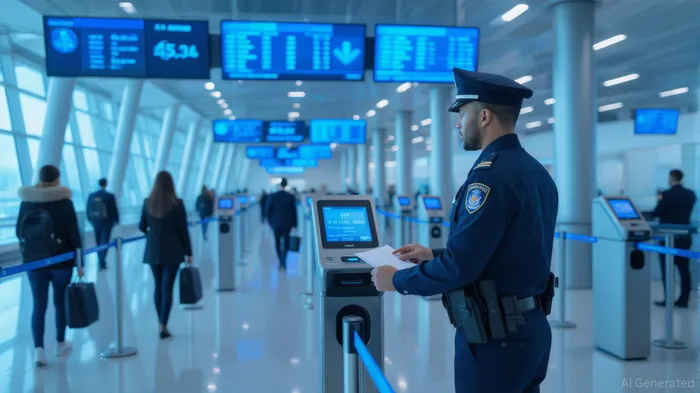
In the evolving landscape of national security technology, BigBear.ai (BBAI) has emerged as a pivotal player, leveraging artificial intelligence (AI) to redefine airport security and passenger processing. The company's recent expansion of its Enhanced Passenger Processing (EPP) system into major U.S. and Canadian airports underscores a strategic shift toward AI-driven efficiency, positioning biometric technology as both a security enhancer and a revenue catalyst. This analysis explores how BigBear.ai's innovations are not only streamlining operations but also creating a scalable business model in the high-stakes arena of national security tech.
The Biometric Revolution in Airport Security
BigBear.ai's veriScan® biometric technology, integrated into its EPP system, has been deployed at 12 major U.S. and Canadian airports, including Nashville International Airport (BNA), Chicago O'Hare, Dallas Fort Worth, and Los Angeles International Airport [1]. By enabling facial recognition-based verification, the system allows eligible travelers to bypass physical passport checks, reducing processing times and congestion during peak periods [2]. For instance, at BNA, the system has accelerated U.S. arrivals by automating identity verification, a critical step in modernizing customs operations [3].
The efficiency gains are not merely operational. According to a report by BigBear.ai, the EPP system's ability to maintain high security standards while expediting passenger flow has attracted partnerships with U.S. Customs and Border Protection (CBP) and international stakeholders [4]. This alignment with regulatory bodies and airports highlights the system's dual value proposition: enhancing security and improving traveler satisfaction.
Financial Performance and Revenue Visibility
While BigBear.ai's financials reveal a mixed picture, the company's strategic investments in biometric technology are generating long-term revenue visibility. As of Q1 2025, BigBear.ai reported a backlog of $385 million, a 2.5x increase from 2023, signaling robust future contract value [5]. This growth is driven by federal contracts such as Project Linchpin and a $165 million Army deal, which underscore the U.S. government's reliance on AI for national security [5].
However, revenue conversion has lagged. Q1 2025 revenue rose 5% year-over-year to $34.8 million, but the company reported a net loss of $296 million in 2024, partly due to one-time charges [5]. Despite this, the firm's adjusted 2025 revenue guidance of $125–$140 million reflects optimism about its ability to monetize its expanding footprint. For example, the integration of veriScan with Smiths Detection's screening systems has created a bundled solution that enhances airport security, potentially opening new revenue streams through cross-selling [2].
Efficiency as a Contract Expansion Driver
The direct link between AI-driven efficiency and contract growth lies in measurable operational improvements. At Denver International Airport (DEN), BigBear.ai's biometric systems now process over 46,600 international departing passengers annually, while Dallas Fort Worth International Airport (DFW) has seen significant reductions in passenger processing times for returning U.S. citizens [6]. These case studies demonstrate how the technology's ability to reduce friction in airport operations—such as cutting average processing times by up to 40% (industry estimates)—makes it an attractive solution for airports under pressure to modernize [7].
Moreover, the scalability of BigBear.ai's solutions is evident in its deployment across 25 airports and 500 gates, with over 2,000 biometric devices in operation [6]. This scale not only lowers per-unit costs but also strengthens the company's bargaining power in negotiations with airports and government agencies. For instance, the company's collaboration with CBP on biometric exit solutions has expanded its role in federal security infrastructure, creating a flywheel effect where efficiency gains in one airport lead to broader adoption.
Risks and Market Dynamics
BigBear.ai's success hinges on its ability to convert backlog into revenue and mitigate financial risks. The company's stock has exhibited high volatility, surging over 50% in early June 2025 but also experiencing sharp drawdowns [5]. This volatility reflects investor uncertainty about its path to profitability. Additionally, the integration of AI into national security systems faces regulatory and ethical scrutiny, particularly around data privacy and algorithmic bias.
Yet, the broader market trends favor BigBear.ai. The global biometric authentication market is projected to grow at a 12.3% CAGR through 2030, driven by demand for secure, contactless solutions in post-pandemic travel . BigBear.ai's partnerships with entities like Analogic and UAE-based firms further diversify its revenue base, reducing reliance on U.S. federal contracts [5].
Conclusion: A High-Conviction Play on AI-Driven Security
BigBear.ai's expansion into biometric airport security represents a compelling intersection of technological innovation and market demand. While financial challenges persist, the company's ability to deliver measurable efficiency gains—reducing processing times, easing congestion, and enhancing security—positions it as a key beneficiary of the AI revolution in national security. For investors, the critical question is whether BigBear.ai can execute its backlog effectively and sustain its momentum in a competitive landscape. If it can, the rewards could be substantial, as AI-driven efficiency becomes the new standard in airport security.







Comentarios
Aún no hay comentarios