
Big Tech's Regulatory Crossroads: Navigating EU Antitrust Pressures and Strategic Adaptation
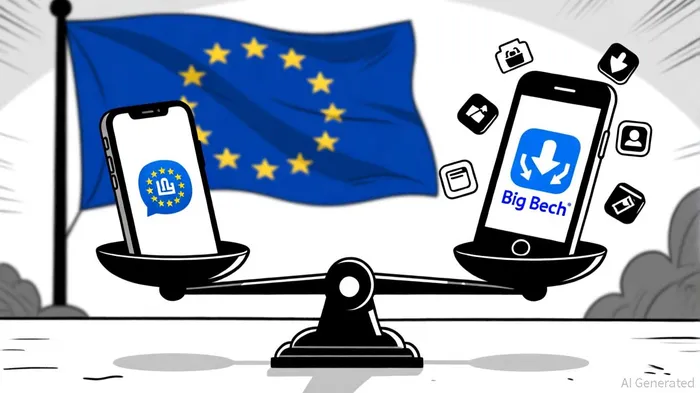
The European Union's Digital Markets Act (DMA), enacted in 2022, has redefined the regulatory landscape for Big Tech, imposing stringent antitrust obligations on firms deemed “gatekeepers.” Alphabet, AppleAAPL--, AmazonAMZN--, MetaMETA--, and MicrosoftMSFT-- now face unprecedented scrutiny, with enforcement actions intensifying in 2024–2025. For investors, the question is no longer whether these companies will face penalties but how they will adapt strategically to survive—and thrive—under this new regime.
The DMA's Enforcement Surge: A New Era of Accountability
According to a report by The Verge, the EU has levied landmark fines against Apple and Meta, totaling €700 million, for violating DMA provisions[1]. Apple was penalized €500 million for anti-steering practices in its App Store, which restricted developers from directing users to alternative payment systems[1]. Meta faced a €200 million fine for its “pay or consent” ad model, which failed to provide meaningful alternatives to personalized advertising[1]. These actions underscore the EU's commitment to dismantling monopolistic behaviors, with penalties reaching up to 10% of global turnover for non-compliance[3].
Google, meanwhile, has been accused of favoring its own Shopping, Hotels, and Flights services in search results, prompting investigations into self-preferencing[1]. The European Commission's April 2025 annual report highlighted ongoing coordination with national authorities to ensure consistent enforcement, signaling a long-term regulatory strategy[1].
Strategic Corporate Responses: Compliance vs. Innovation
Faced with these pressures, Big Tech firms are adopting dual strategies: compliance with DMA mandates and innovation to offset revenue losses. Apple, for instance, has opened its iOS ecosystem to alternative app stores and allowed users to uninstall pre-installed apps like Edge and Bing[1]. While these changes dilute its control over the App Store, Apple has offset potential revenue declines by opening its mobile payments system to rivals, potentially fostering new partnerships[1].
Meta's response has been more defensive. The company revised its ad model to comply with the DMA but has faced criticism for offering a “watered-down” alternative to personalized ads[1]. Meanwhile, Google has yet to fully resolve its self-preferencing allegations, with U.S. authorities recently condemning EU fines as “economic extortion”[2]. This geopolitical tension complicates Google's ability to negotiate regulatory terms, forcing it to balance compliance with U.S. lobbying efforts.
Investor Implications: Short-Term Pain, Long-Term Resilience?
For investors, the DMA's impact is a double-edged sword. Short-term costs are evident: fines, compliance overhauls, and lost revenue from restricted business practices. However, long-term resilience hinges on how effectively these firms can innovate within the new constraints.
Apple's recent moves to open its ecosystem, for example, could catalyze third-party app store growth, potentially creating new revenue streams through transaction fees or data-sharing partnerships. Similarly, Meta's pivot to privacy-focused advertising models, though less profitable, may attract users wary of data exploitation—a demographic increasingly valued in the post-cookie era[1].
A critical risk lies in regulatory fatigue. As the EU expands investigations to other gatekeepers, including Amazon and Microsoft, the cumulative cost of compliance could strain profit margins. Yet, companies that treat the DMA as an opportunity—rather than a threat—may emerge stronger. Microsoft's decision to allow EU users to uninstall Edge and Bing, for instance, aligns with its broader strategy to position Windows as a neutral platform[1], potentially enhancing its appeal to enterprise clients.





Comentarios
Aún no hay comentarios