
Big-Box Retail Resilience Amid Inflation and Tariffs: Why Walmart and Target Outperform Small Businesses in 2025
Walmart's Strategic Edge: Scale, Supply Chains, and Pricing Power
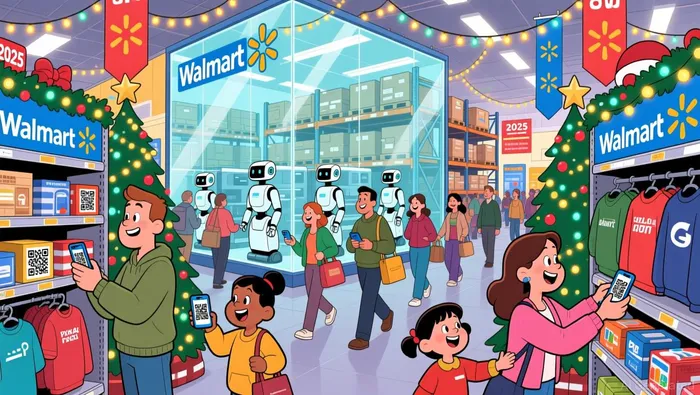
Walmart's performance during the 2025 holiday season exemplifies the power of operational scale. The company reported a 4.5% year-over-year increase in U.S. sales during its third-quarter earnings period (October 31), with annual net sales growth projected between 4.8% and 5.1%. This resilience stems from its ability to absorb and strategically pass on costs from tariffs on imported goods. By leveraging its vast supply chain network and long-term vendor negotiations, Walmart has maintained competitive pricing on essential holiday items-such as toys and seasonal décor-despite a 15-20% surge in import costs for these categories.
According to a report by Bloomberg, Walmart's economies of scale allow it to offset inflationary pressures more effectively than smaller competitors. For instance, the retailer has introduced affordable meal bundles and expanded its private-label offerings to retain price-sensitive customers, a strategy that aligns with the spending habits of lower-income shoppers who now account for a larger share of holiday traffic. Meanwhile, its e-commerce infrastructure, bolstered by investments in logistics and automation, has enabled it to capture market share from both traditional rivals and small businesses struggling with last-mile delivery costs.
Target's Struggles: A Cautionary Tale for Mid-Sized Retailers
In contrast, TargetTGT-- has faced a more turbulent holiday season. The retailer reported weaker-than-expected sales in November 2025 and slashed its full-year profit outlook, citing challenges in managing tariff-driven cost inflation and internal operational inefficiencies. While Target has attempted to counter rising prices with aggressive discounting-reducing costs on 3,000 holiday items-its smaller supply chain and narrower profit margins have limited its ability to absorb shocks compared to Walmart according to analysis.
Analysts attribute Target's struggles to its reliance on imported goods for high-margin categories like home décor and electronics, sectors directly impacted by U.S. tariff policies. As stated by a Commercial Observer analysis, the retailer's attempts to balance affordability with profitability have been complicated by a bifurcated consumer market, where price-sensitive shoppers gravitate toward off-price rivals while luxury-focused competitors retain affluent customers. This dynamic has left Target in a precarious middle ground, vulnerable to both macroeconomic shifts and competitive pressures.
Small Businesses: The Invisible Victims of Structural Disadvantage
Small businesses, meanwhile, face an existential challenge in this environment. Unlike Walmart or Target, they lack the supply chain agility to renegotiate contracts with suppliers or the financial cushion to absorb tariff-induced cost increases according to analysis. A QZ report highlights that small retailers often pay 10-15% higher prices for imported goods due to limited bargaining power, forcing them to raise consumer prices at a time when holiday spending is already declining by 10% year-over-year.
Compounding these issues is the rise of big-box discounting strategies. Walmart's "Everyday Low Price" model and Target's promotional campaigns have siphoned traffic away from small businesses, particularly in lower-income markets where price sensitivity is highest according to analysis. According to industry experts, small retailers also bear the brunt of higher labor and logistics costs, as they lack the automation and centralized distribution networks that large chains use to optimize expenses according to analysis.
Investment Implications: A Tale of Two Retail Models
The 2025 holiday season reaffirms the structural advantages of big-box retailers in inflationary environments. Walmart's ability to leverage scale, supply chain flexibility, and pricing discipline positions it as a defensive play in a volatile market, while Target's struggles highlight the risks of mid-sized retail models with limited operational leverage. For small businesses, the path to resilience remains uncertain without significant policy support or innovative cost-saving measures.
As the National Retail Federation projects total holiday sales to exceed $1 trillion, investors should prioritize retailers with robust supply chain infrastructure and pricing power. In an era of persistent inflation and trade uncertainty, the ability to navigate these challenges will separate market leaders from laggards-a reality Walmart has mastered and one Target must urgently address.







Comentarios
Aún no hay comentarios