
Bhutan's Ethereum-Based Digital ID System and Its Implications for Blockchain Infrastructure Investment
The Rise of Blockchain-Driven National Transformation
Bhutan's migration of its National Digital Identity (NDI) system to the EthereumETH-- blockchain marks a watershed moment in global digital governance. By anchoring its national ID on Ethereum, Bhutan has become the first country to leverage a public blockchain for self-sovereign identity (SSI), enabling 800,000 citizens to control their digital credentials while ensuring privacy through zero-knowledge proofs, according to a Grand View Research report. This strategic shift, completed after earlier experiments with Hyperledger Indy and Polygon, underscores Ethereum's role as a scalable, secure infrastructure for decentralized identity systems, as noted in a Fortune Business Insights report.
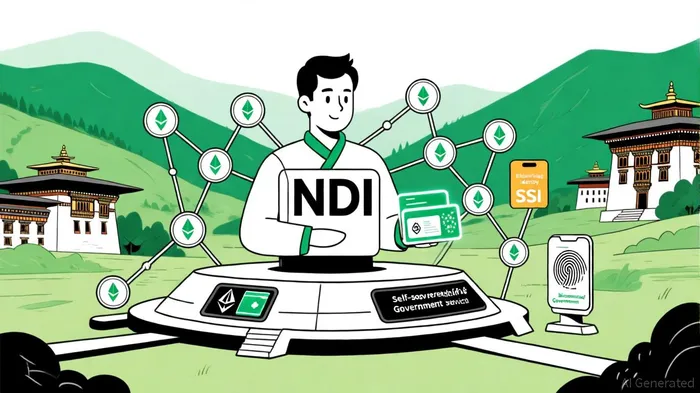
The NDI's integration with 40+ government and private services-including healthcare, banking, and telecom-demonstrates the practicality of blockchain in streamlining digital interactions. Recent upgrades, such as biometric liveness verification and peer-to-peer chat, further enhance security and user experience, as reported by Biometric Update. By showcasing these capabilities at the World Bank's Global Digital Summit in 2025, Bhutan has positioned itself as a model for nations seeking to balance privacy, transparency, and efficiency in digital transformation, according to a DHI news release.
Institutional Adoption and Market Dynamics
Bhutan's initiative aligns with a broader surge in institutional interest in blockchain infrastructure. The global blockchain technology market, valued at $31.28 billion in 2024, is projected to reach $1,431.54 billion by 2030, driven by demand for secure, decentralized solutions, according to Grand View Research. Ethereum-based services, in particular, are gaining traction as institutional investors allocate over 5% of assets under management to digital assets in 2025, per a Coinbase survey. Platforms like AaveAAVE-- and CompoundCOMP-- are expanding their DeFi offerings, while stablecoin legislation in July 2025 has reinforced confidence in blockchain as a backbone for financial infrastructure, as discussed in a Forbes column.
Key players are emerging to address scalability challenges. Ethereum 2.0's upgrades, coupled with blockchain-as-a-service solutions highlighted by Fortune Business Insights, are enabling SMEs to adopt decentralized identity verification and secure transactions. Meanwhile, companies like Galaxy and Solmate are bridging traditional finance with digital assets, with Solmate's $300 million private placement highlighting the growing capital influx into validator infrastructure and Solana-based treasuries, as detailed in an OKX feature.
Implications for Ethereum-Based Services and Scalability Solutions
Bhutan's success story validates Ethereum's potential to underpin national systems, creating a compelling investment case for related ecosystems. The migration of 234,000 IDs as of March 2025, reported by a Kanalcoin report, signals growing trust in blockchain for large-scale identity management, a sector projected to grow from $47.36 billion in 2025 to $100+ billion by 2033, according to an Accio report. This trend is likely to accelerate as other nations adopt similar models, driven by regulatory demands and cybersecurity needs.
Scalability solutions, such as Ethereum's Layer 2 protocols and cross-chain bridges, will be critical in supporting this growth. For instance, Ethereum's zero-knowledge proofs-central to Bhutan's NDI-offer a blueprint for privacy-preserving verification in sectors like e-voting and land registration, as covered in a Cryptopolitan piece. Additionally, the rise of institutional-grade custodians and market-makers is addressing risk management concerns, making digital asset treasuries more accessible to corporations, as examined in a DLA Piper analysis.
Conclusion: A New Era for Blockchain Infrastructure
Bhutan's Ethereum-based NDI system exemplifies how blockchain can drive national transformation while unlocking new markets for Ethereum-based services. As institutional adoption accelerates and scalability solutions mature, investors should prioritize ecosystems that address interoperability, privacy, and regulatory compliance. The confluence of macroeconomic factors-rising inflation, digital asset diversification, and the need for resilient infrastructure-positions blockchain as a cornerstone of the next-generation financial and governance systems.





Comentarios
Aún no hay comentarios