
Bhutan's Bitcoin-Backed Gelephu Mindfulness City: A Strategic Bet on Sovereign Crypto Reserves and Long-Term Value Creation
Bhutan, the enigmatic Himalayan nation known for its Gross National Happiness philosophy, has emerged as an unlikely pioneer in sovereign digital asset allocation. By committing 10,000 BitcoinBTC-- (approximately USD 1 billion) to fund the development of Gelephu Mindfulness City (GMC), Bhutan is redefining how emerging markets can leverage blockchain technology to build economic resilience and innovation. This bold move, announced in 2025, positions Bitcoin not as a speculative asset but as a cornerstone of long-term national development.
A Sovereign Bitcoin Framework for Economic Resilience
Bhutan's Bitcoin-backed strategy is rooted in a dual mandate: capital preservation and yield generation. The 10,000 Bitcoin pledge is structured as a strategic reserve, designed to fund GMC's infrastructure, education, and sustainability initiatives over decades. Unlike traditional sovereign wealth funds, Bhutan's approach integrates risk-managed yield mechanisms, including long-term holding, collateralization of Bitcoin reserves, and treasury strategies that balance growth with stability. This framework mirrors the principles of "productive asset allocation", where digital assets are not hoarded but deployed to generate compounding value for public goods.
The economic rationale is compelling. 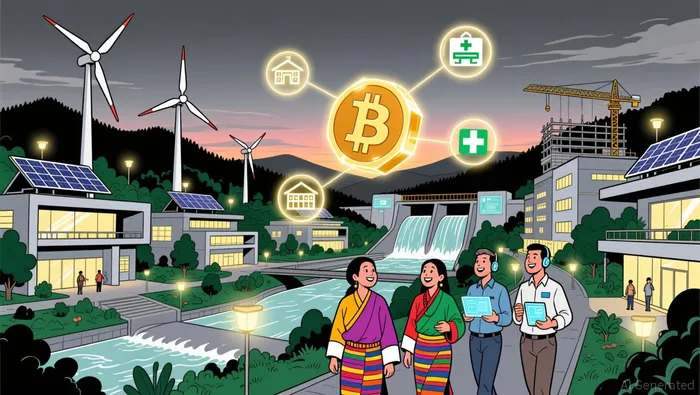 By leveraging its abundant hydropower for Bitcoin mining, Bhutan has already generated over 13,000 Bitcoin, with 11,400 BTC valued at $1.4 billion by 2025-nearly 40% of its GDP. This surplus energy, previously underutilized, now fuels a green mining ecosystem that aligns with Bhutan's environmental commitments while monetizing its natural resources according to analysis. The government's decision to allocate Bitcoin to GMC reflects a forward-looking vision: transforming a speculative asset into a tool for intergenerational equity.
Risk-Managed Innovation: Governance and Partnerships
Bhutan's success hinges on its governance model. The Royal Monetary Authority of Bhutan (RMA) and Gelephu Mindfulness City (GMC) oversee Bitcoin operations, restricting mining and exchanges to GMC-registered entities to ensure regulatory control. This centralized approach mitigates risks associated with public trading while fostering institutional adoption. For instance, Bhutan's national cryptocurrency tourism payment system, launched in May 2025, allows tourists to pay for services using over 100 cryptocurrencies, facilitated by partnerships with Binance Pay and DK Bank. Such initiatives not only diversify revenue streams but also position Bhutan as a testbed for blockchain-driven economic models.
Strategic alliances further amplify Bhutan's impact. A recent Memorandum of Understanding with Cumberland DRW aims to optimize Bitcoin reserve management in GMC, exploring stablecoins and AI computing applications. These partnerships underscore Bhutan's commitment to leveraging global expertise while retaining sovereignty over its digital assets. Additionally, the launch of TER, a gold-backed digital token on the SolanaSOL-- blockchain, bridges traditional value stores with decentralized finance, creating a hybrid ecosystem that appeals to both institutional and retail investors.
Broader Implications for Emerging Markets
Bhutan's experiment offers a blueprint for emerging markets seeking to harness digital assets for resilience. By integrating Bitcoin into its economic resilience framework, Bhutan has demonstrated how sovereign reserves can be diversified against macroeconomic shocks. For example, its $40 million IDA Climate and Disaster Resilience Development Policy Financing with a Catastrophe Deferred Drawdown Option (Cat DDO) ensures immediate access to funds during crises, complementing Bitcoin's role as a long-term store of value. This dual-layer strategy-combining digital assets with traditional risk management-could inspire other nations to adopt similar models according to experts.
Moreover, Bhutan's focus on youth employment and education in blockchain technology addresses a critical gap in emerging markets. Bitcoin mining has already created jobs and trained workers in GMC, reducing reliance on volatile sectors like tourism and agriculture. By treating GMC as a "company with citizens as shareholders," Bhutan fosters inclusive growth, aligning economic development with its cultural ethos of collective well-being according to analysis.
Conclusion: A New Paradigm for Sovereign Digital Assets
Bhutan's Bitcoin-backed Gelephu Mindfulness City represents more than a technological leap-it is a paradigm shift in how nations approach digital asset allocation. By prioritizing long-term value creation, governance, and sustainability, Bhutan has positioned itself at the intersection of tradition and innovation. For investors, this initiative highlights the potential of sovereign crypto reserves to drive economic resilience in emerging markets, offering a compelling case study in the strategic use of blockchain for national development.
As the world grapples with economic uncertainty, Bhutan's experiment serves as a reminder: the future of finance is not just about speculation, but about building systems that endure.






Comentarios
Aún no hay comentarios