
BHP's Profit Decline and Iron Ore Market Dynamics: Assessing Long-Term Resilience in a Shifting Commodity Landscape
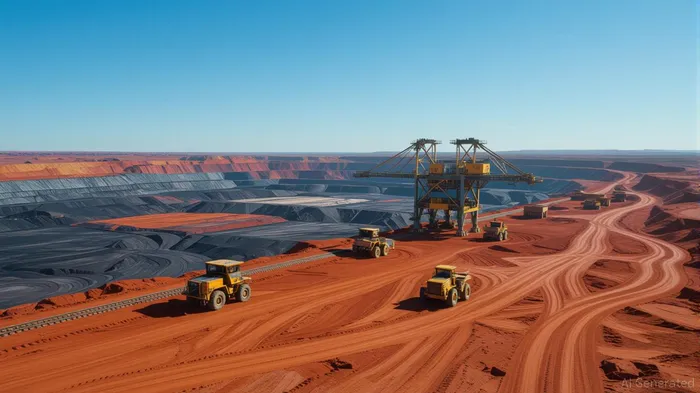
The recent 26% year-on-year decline in BHPBHP-- Group's underlying attributable profit for FY2025 has sparked concerns about the mining giant's exposure to cyclical commodity markets. However, a deeper analysis of the iron ore sector's structural dynamics and BHP's strategic positioning reveals a compelling case for long-term resilience. While near-term headwinds—driven by falling iron ore prices and oversupply risks—loom large, BHP's cost discipline, operational flexibility, and proactive engagement with decarbonization trends position it to outperform peers as the market rebalances.
The Iron Ore Downturn: A Cyclical Correction, Not a Structural Collapse
BHP's Q2 2025 earnings report highlighted a 19% decline in the average realized price for iron ore, the company's core revenue driver. This follows a multi-year downward trend, with prices averaging $107.81 per ton by July 2025, down from a peak of $223.94 in 2021. The primary culprit? A flattening demand curve in China, which accounts for 75% of global seaborne iron ore imports. Despite stable annual steel output (around 1 billion tons), China's steel production dipped to a seven-month low in July 2025 due to weak construction demand and adverse weather.
Yet, BHP's cost advantage remains a critical buffer. At $17.29 per ton, its cash costs are far below the benchmark price of $101.63 per ton, giving it pricing resilience even in a weak market. This low-cost position is further bolstered by BHP's Pilbara operations, which saw a 14.2% quarter-over-quarter increase in iron ore production to 77.48 million tonnes. Such operational resilience underscores BHP's ability to maintain cash flow despite volatile pricing.
Structural Shifts in Iron Ore Demand: Decarbonization and Diversification
The global steel industry is undergoing a profound transformation as decarbonization pressures intensify. Traditional blast furnace-based steelmaking, which relies heavily on coal and low-grade iron ore, is being phased out in favor of cleaner alternatives like electric arc furnaces (EAFs) and hydrogen-based direct reduced iron (H2-DRI). These technologies require higher-grade iron ore or direct reduction pellets, creating a new demand profile for premium-quality ore.
BHP is well-positioned to capitalize on this shift. Its Pilbara operations already produce high-grade iron ore, aligning with the industry's transition toward lower-emission production methods. Meanwhile, China's push to peak steel production by 2030 and increase scrap steel use to 320 million tonnes by 2025 will further drive demand for high-grade ore. India, another key growth market, is projected to quadruple its steel demand over the next quarter-century, offering BHP a long-term tailwind.
However, the path is not without risks. The Simandou project in Guinea, expected to add 120 million tonnes of annual supply, and output increases from ValeVALE-- and other producers threaten to exacerbate oversupply. BHP's strategic response? A disciplined approach to capital allocation and a focus on operational efficiency. By increasing iron ore output to 305 million tonnes annually while maintaining cost discipline, BHP aims to outcompete higher-cost producers and retain market share.
Decarbonization Partnerships: BHP's Strategic Edge
While BHP has not yet launched hydrogen-based steel production initiatives, it is actively investing in complementary decarbonization technologies. The company leads a global consortium evaluating carbon capture, utilization, and storage (CCUS) hubs in Asia, partnering with steelmakers like ArcelorMittalMT-- Nippon Steel India and JSW Steel. This initiative, expected to conclude by 2026, aims to develop large-scale CCUS projects that reduce emissions from existing blast furnace operations—a critical near-term solution for an industry still reliant on carbon-intensive methods.
Additionally, BHP's pilot project with China's HBIS Group Co., Ltd. explores carbon capture and utilization technologies, including slag mineralization and biological CO₂ conversion. These efforts align with BHP's Climate Transition Action Plan, which targets a 30% reduction in emissions intensity by 2030. By supporting its customers' decarbonization goals, BHP is future-proofing its iron ore business against regulatory and market pressures.
Financial Resilience and Valuation Metrics
BHP's robust balance sheet further strengthens its long-term outlook. With a current ratio of 1.70, a debt-to-equity ratio of 0.44, and $10.36 billion in free cash flow, the company has ample liquidity to navigate downturns and fund strategic investments. Its trailing P/E ratio of 11.99 and EV/EBITDA ratio of 5.94 suggest the stock is undervalued relative to historical averages and industry peers.
Investment Implications
While short-term bearish sentiment persists—driven by U.S. tariff threats and China's economic slowdown—BHP's long-term fundamentals remain intact. The company's low-cost production, operational resilience, and proactive engagement with decarbonization trends position it to outperform in a rebalancing market. Investors should monitor key catalysts:
1. Iron Ore Pricing Recovery: A rebound in prices to $120–$140 per ton would significantly boost BHP's margins.
2. CCUS Commercialization: Successful deployment of carbon capture projects could unlock new revenue streams and regulatory advantages.
3. Emerging Market Demand: Growth in India and Southeast Asia will drive long-term iron ore demand, offsetting declines in China.
In conclusion, BHP's profit decline reflects cyclical headwinds rather than structural weakness. For investors with a multi-year horizon, the current valuation offers an attractive entry point to a company poised to thrive in a decarbonizing, resource-constrained world.





Comentarios
Aún no hay comentarios