
BHP's Profit Decline Amid Iron Ore Downturn: A Tactical Buying Opportunity in a Resilient Commodity Sector?
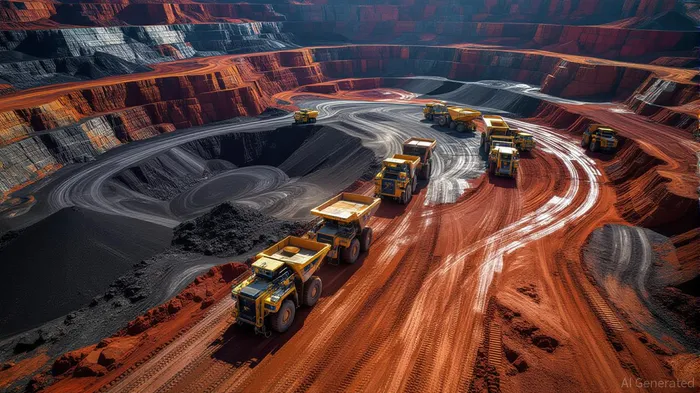
The global iron ore market in 2025 is a study in contradictions: a sector essential to industrialization and decarbonization, yet plagued by oversupply, geopolitical tensions, and shifting demand patterns. For BHP GroupBHP-- (ASX:BHP), the world's largest diversified miner, these dynamics have translated into a profit decline in Q2 2025. However, beneath the headline numbers lies a company with a disciplined cost structure, strategic capital allocation, and a long-term vision that positions it to outperform in a cyclical market. This article evaluates whether BHP's current challenges represent a tactical buying opportunity for investors willing to look beyond short-term volatility.
Market Dynamics: A Perfect Storm for Iron Ore
The iron ore market in 2025 is defined by three key forces:
1. Oversupply: Australia and Brazil, the top two producers, have expanded capacity at a faster rate than demand growth. BHP's own production of 263 million tonnes in FY2025 (surpassing its 255–265 million tonne guidance) reflects the sector's overcapacity.
2. China's Shifting Demand: While China remains the largest consumer, its domestic demand has weakened due to a property sector slump and steel production cuts. However, export-led steel production has offset some of this decline, with Chinese steel exports rising 6.3% in early 2025.
3. Policy-Driven Disruption: Environmental regulations, such as the EU's Carbon Border Adjustment Mechanism (CBAM), are accelerating the shift to low-carbon steelmaking. This favors high-grade iron ore (65% Fe) over the traditional 62% Fe benchmark, creating a mismatch for producers like BHPBHP--, which has a smaller proportion of high-grade ore in its portfolio.
Iron ore prices in Q2 2025 averaged $96–$105/ton, reflecting localized demand pressures and supply-side disruptions. show a volatile but broadly sideways trend, with seasonal spikes in Asia-Pacific markets.
BHP's Performance: Resilience in the Face of Headwinds
Despite these challenges, BHP's operational performance in FY2025 was robust:
- Production Overperformance: BHP mined 263 million tonnes of iron ore, exceeding its guidance range. The Samarco mine in Brazil, a 30 million tonne/year operation, ramped up to 6.4 million tonnes in FY2025, up 34% year-on-year.
- Cost Discipline: Unit costs at major assets fell 4.7% year-on-year, with Escondida (copper) achieving an 18% reduction. WAIO maintained its position as the lowest-cost major iron ore producer.
- Capital Allocation: BHP spent $9.8 billion on capital and exploration in FY2025, including a $2.1 billion investment in the Vicuña joint venture (Argentina) and the Jansen potash project in Canada.
However, profitability was impacted by:
- Price Compression: Iron ore prices fell below $100/ton in Q2 2025, squeezing margins.
- Logistical Bottlenecks: Rising coking coal prices and U.S. tariff threats on Chinese steel exports added uncertainty.
- Product Mix Constraints: Iron ore lumps (31% of sales) and fines (69% of sales) showed little diversification, limiting upside potential in a high-grade ore-driven market.
Strategic Resilience: BHP's Long-Term Playbook
BHP's response to the iron ore downturn highlights its strategic agility:
1. Cost Management: The company achieved $1.5 billion in sustainable cost savings in FY2025 through automation (e.g., autonomous haulage systems), predictive maintenance, and energy transition initiatives.
2. Capital Discipline: BHP's $11 billion annual capex plan for 2026–2027 focuses on high-impact projects like the Jansen potash mine (first production by mid-2027) and the Vicuña copper deposit (one of the largest discoveries in 30 years).
3. Sustainability Alignment: BHP's 30% operational emissions reduction target by FY30 aligns with green steel trends, even as it navigates the current demand mismatch for high-grade ore.
4. Balance Sheet Strength: Net debt of $12.9 billion at FY2025's end remains within the revised $10–$20 billion target range, providing flexibility for dividends and growth.
Investment Thesis: Cyclical Downturn or Tactical Entry Point?
BHP's Q2 2025 profit decline is a symptom of broader market imbalances, not a reflection of operational failure. The company's ability to exceed production guidance while maintaining cost discipline underscores its resilience. For investors, the key question is whether the current valuation offers a margin of safety.
Risks to Consider:
- Demand Volatility: China's property sector weakness and global decarbonization timelines could delay recovery.
- Price Compression: Oversupply may keep iron ore prices depressed until 2026–2027.
- Policy Uncertainty: Trade wars and green steel mandates could disrupt supply chains.
Catalysts for Recovery:
- Infrastructure Spending: Global initiatives like China's Belt and Road and the U.S. Infrastructure Investment and Jobs Act will drive long-term demand.
- High-Grade Ore Transition: BHP's investments in high-grade ore processing (e.g., Samarco's ramp-up) position it to benefit from green steel trends.
- Dividend Resilience: Despite a 20% dividend cut in FY2025, BHP's payout ratio remains conservative, supporting future increases as prices recover.
shows a 15% decline year-to-date, aligning with iron ore price trends but leaving the stock trading at a 10% discount to its 5-year average P/E ratio.
Conclusion: A Buy for the Long-Term Investor
BHP's profit decline is a cyclical headwind, not a structural flaw. The company's cost efficiency, capital discipline, and alignment with decarbonization trends make it a compelling long-term play. While near-term volatility is inevitable, the iron ore market is poised for a recovery as supply-demand imbalances correct by 2026–2027. Investors with a 3–5 year horizon should consider BHP as a tactical buy, particularly at current valuations.
Investment Advice:
- Position Size: Allocate 5–7% of a diversified portfolio to BHP, given its exposure to a cyclical sector.
- Entry Point: Target a price below $45/share (as of July 2025) to capitalize on the discount to intrinsic value.
- Exit Strategy: Monitor iron ore prices and BHP's FY2026 production guidance. Sell if prices remain below $90/ton for six consecutive months.
In a world of resource nationalism and green transitions, BHP's strategic resilience offers a rare combination of defensive qualities and growth potential. For patient investors, the current downturn may be the best opportunity to buy in years.





Comentarios
Aún no hay comentarios