
Bharti Airtel and Google's AI Hub in Visakhapatnam: A Strategic Catalyst for India's Digital Economy
India's digital transformation is accelerating, driven by strategic investments in infrastructure and artificial intelligence (AI). At the forefront of this shift is the landmark partnership between Bharti Airtel and GoogleGOOGL--, which aims to establish India's first AI hub in Visakhapatnam, Andhra Pradesh. With a projected $15 billion investment over five years (2026–2030), this initiative is poised to redefine the country's digital backbone, positioning it as a global leader in AI-driven innovation while unlocking significant economic value.
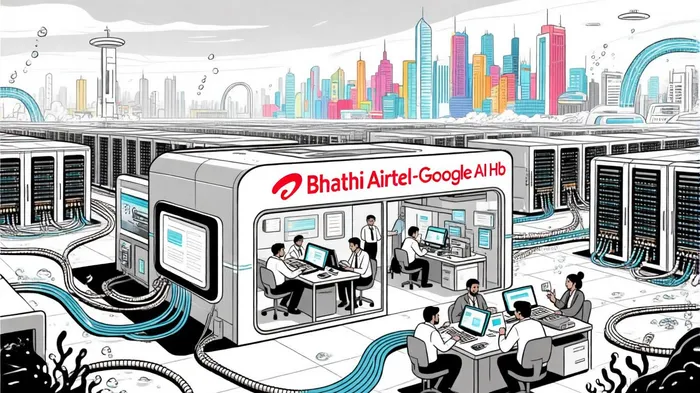
Strategic Infrastructure: Building the Foundation for AI-Driven Growth
The collaboration centers on creating a gigawatt-scale data center, a robust subsea network, and clean energy infrastructure to handle India's most demanding AI workloads. A critical component is the development of a Cable Landing Station (CLS) in Visakhapatnam to host Google's international subsea cables, enhancing global connectivity and data capacity for Indian businesses, as reported by Daily Kiran. This infrastructure will not only support AI adoption across sectors like education, healthcare, and manufacturing but also strengthen India's digital resilience.
The project's scale is unprecedented. By integrating high-capacity, low-latency fiber networks with AI-ready data centers, the hub will address the growing demand for computational power, a bottleneck for AI adoption in emerging markets. Gopal Vittal of Bharti Airtel emphasized that this partnership marks a "defining moment" for India's digital future, with Visakhapatnam emerging as a global AI hub.
Economic Impact: A Boon for India's Digital Ecosystem
The economic implications of this partnership are profound. India's telecom market is projected to grow at a 9.4% CAGR, reaching $83.34 billion by 2030. Bharti Airtel's Q3 FY25 results, which showed a 14.3% year-over-year revenue increase, underscore the company's financial strength to drive such ambitious projects. The AI hub is expected to catalyze this growth by enabling AI adoption for over 2,000 large enterprises and one million emerging businesses, tapping into a public cloud market forecasted to reach $17.8 billion by 2027.
Moreover, the initiative aligns with India's broader digital ambitions. 5G technology alone is projected to add $450 billion to the Indian economy between 2023 and 2040. By leveraging Google's cloud and GenAI solutions, Bharti Airtel aims to enhance customer experiences across mobile, broadband, and digital TV services while streamlining internal operations. The development of AI/ML solutions trained on Airtel's vast datasets-ranging from geospatial analytics to consumer behavior forecasting-further amplifies the project's potential to drive innovation, Business Today reported.
A Sovereign AI Cloud and Global Connectivity
A notable aspect of the partnership is the creation of a sovereign AI cloud tailored for government organizations, set to launch in the coming months. This move addresses critical data sovereignty concerns, enabling secure AI deployment for public sector applications. Meanwhile, the subsea cable infrastructure will bolster India's global connectivity, reducing latency and enhancing data transfer speeds for businesses reliant on international markets, the Times of India reported.
Thomas Kurian of Google Cloud highlighted that the initiative aligns with India's AI mission by delivering cutting-edge infrastructure and next-generation services to power inclusive growth, CNBC-TV18 reported. The collaboration also includes a managed services center in Pune, staffed with over 300 experts trained in Google Cloud services, ensuring scalable AI deployment across the country, Business Today reported.
Conclusion: A Win-Win for Investors and the Indian Economy
The Bharti Airtel-Google AI Hub represents a strategic convergence of infrastructure, innovation, and economic growth. For investors, the project underscores Bharti Airtel's leadership in India's digital transformation, supported by its strong financial performance and strategic partnerships. The $15 billion investment not only positions the company to capture a significant share of the AI and cloud markets but also aligns with India's national goals of digital inclusivity and technological self-reliance.
As India races to become a global AI leader, this partnership exemplifies how infrastructure-led growth can unlock transformative opportunities. With Visakhapatnam at the epicenter of this revolution, the economic and technological dividends are poised to ripple across the nation-and beyond.





Comentarios
Aún no hay comentarios