
Betting Against the Crowd: Why OPEC+ Moves and Geopolitics Favor Contrarian Oil Plays
The oil market is bracing for a summer of volatility. OPEC+'s decision to boost output by 411,000 barrels per day (b/d) in July 2025, coupled with Russia's recent supply flexibility, has fueled short-term price pressure. Brent crude dropped to $62.61/bbl ahead of the announcement, with traders betting on oversupply. Yet beneath the surface, contrarian opportunities are emerging. A blend of underappreciated demand resilience—driven by U.S. summer driving season and China's rare earth deal—and geopolitical risks could set the stage for a sharp rebound. For investors willing to look beyond the noise, high-margin oil equities and out-of-the-money call options offer asymmetric risk/reward profiles.
The Near-Term Bear Case: OPEC+ Hikes and Russian Flexibility
OPEC+'s gradual reversal of its 2.2 million b/d voluntary cuts, starting in April 2025, has already added 1.2 million b/d to global supply by July. Russia, despite sanctions, continues to adjust its exports, with May 2025 crude and product exports falling to 7.3 million b/d—a 380,000 b/d year-on-year decline but still above pre-invasion levels. The group's flexibility clause—allowing pauses or reversals of hikes—hints at a tactical approach to stabilize prices.
Yet the market's focus remains on short-term oversupply. The International Energy Agency (IEA) notes global inventories rose for the third straight month in May, while U.S. strategic reserves remain elevated. This has fueled bearish sentiment, with traders pricing in a potential $60/bbl floor.
The Contrarian Case: Demand Resilience and Hidden Catalysts
1. U.S. Summer Driving Season and Refinery Dynamics
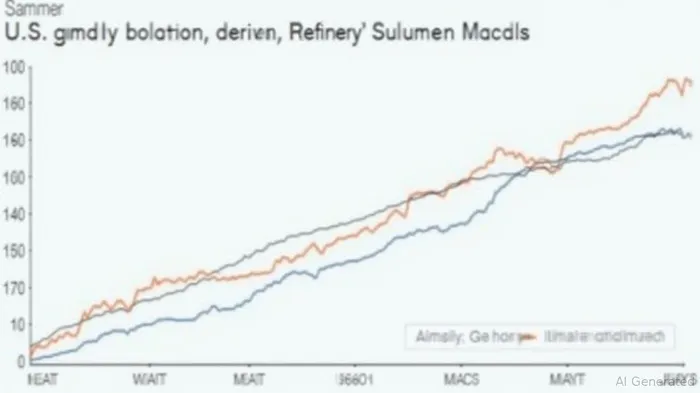
The peak demand season is underway, with gasoline inventories already tightening. Refinery utilization in the U.S. Gulf Coast is near 90%, and margins for gasoline production have rebounded to $15/bbl—a sign refineries are maximizing output. Should geopolitical risks (more on this below) disrupt supply chains, this could quickly translate to price spikes.
2. China's Rare Earth Deal: A Stealth Demand Boost
The June 2025 U.S.-China rare earth agreement, ending China's April export restrictions, is a critical but underappreciated factor. Rare earth elements (REEs) are vital for EV motors, wind turbines, and electronics. By stabilizing REE prices (down 15-20% from peak levels), the deal reduces production bottlenecks in energy-intensive sectors. A resurgent EV market—already seeing 2025 deliveries up 40% YoY in China—could boost oil demand indirectly by accelerating infrastructure projects and industrial activity.
3. Geopolitical Risks: The Wild Card
The real catalyst for a price rebound lies in supply-side risks. The Russia-Ukraine war shows no sign of abating, and Iran's nuclear talks remain stalled. A closure of the Strait of Hormuz—a route for 25% of global oil—could send Brent to $80+/bbl overnight. Even a minor disruption, like sabotage of pipelines in the Black Sea, could tighten markets.
Russia's own supply flexibility is also a double-edged sword. While it can cut output to defend prices, its overproduction since January 2024 (requiring compensatory cuts) creates a compliance risk that could limit future hikes.
Investment Strategy: High-Margin Plays and Volatility Instruments
The contrarian playbook here is twofold:
A. High-Margin Oil Equities
Focus on companies with low breakeven points and exposure to premium crude. Pioneer Natural Resources (PXD), for example, produces Eagle Ford shale oil at $35/bbl breakeven—well below current prices. Its 2025 production growth of 5-7% (despite OPEC+ cuts) signals resilience. Similarly, CNOOC (CEO) benefits from China's energy security push and ties to the rare earth deal's industrial demand.
B. Out-of-the-Money Call Options
To capture upside from geopolitical shocks without high upfront risk, consider out-of-the-money (OTM) call options on oil ETFs like USO. For instance, a July 2025 $75 strike call could offer 4x leverage if Hormuz tensions push prices past $80/bbl. The cost is minimal relative to the potential reward.
Risk Management: Anchoring to Fundamentals
The key risk is a demand collapse from a global recession or OPEC+ overcompliance. Monitor refinery margins and China's crude imports closely—both dipped in May 2025 but remain above 2024 lows. Diversify with natural gas plays (e.g., Cheniere Energy (LNG)) to hedge against energy price volatility.
Conclusion: A Volatility-Driven Opportunity
The oil market is a contrarian's playground. Near-term oversupply fears are overdone, while demand resilience and geopolitical risks remain undervalued. Positioning in high-margin equities and OTM options offers a path to profit from the eventual price rebound—without overexposure to short-term dips. As the saying goes: “Be fearful when others are greedy, and greedy when others are fearful.”
Investment advice: Always consult a financial advisor before making decisions. Past performance does not guarantee future results.







Comentarios
Aún no hay comentarios