
Berkshire Hathaway's Transition of Power and Its Implications for Long-Term Investors
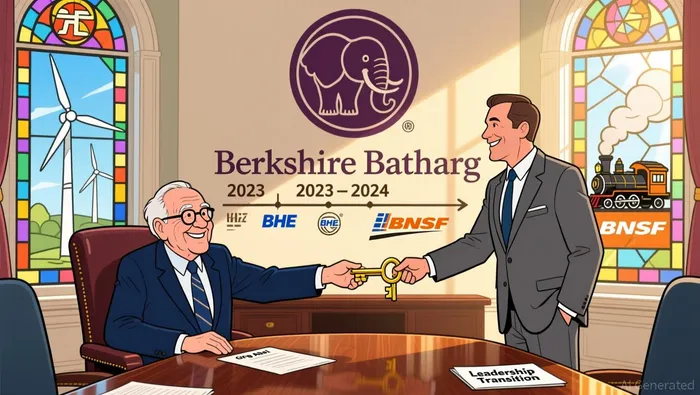
The leadership transition at BerkshireBRK.B-- Hathaway, culminating in Warren Buffett's step down as CEO and Greg Abel's ascension to the role on January 1, 2026, marks a pivotal moment for one of the world's most iconic investment vehicles. While Buffett's legacy of disciplined capital allocation and decentralized management has defined Berkshire for decades, the post-Buffett era raises critical questions about continuity, operational resilience, and strategic adaptability. For long-term investors, the challenge lies in balancing the risks of leadership change with the enduring strengths of Berkshire's business model.
Leadership Transition: Continuity or Disruption?
Berkshire's leadership overhaul is characterized by internal promotions and a deliberate emphasis on continuity. Greg Abel, who has overseen non-insurance operations since 2018, is widely regarded as Buffett's most capable successor. His track record in transforming Berkshire Hathaway Energy (BHE) into a global energy powerhouse-through strategic acquisitions like PacifiCorp and AltaLink-demonstrates his operational rigor and capital allocation discipline according to reports. Abel's leadership is expected to retain the decentralized structure Buffett championed while introducing a more formalized corporate framework as analysts note.
However, the transition is not without turbulence. The departure of key figures like Todd Combs, who joined JPMorgan Chase to lead its Security and Resiliency Initiative, and the planned retirement of CFO Marc Hamburg in 2027, signal potential gaps in institutional knowledge according to analysts. Analysts warn that these changes could amplify "succession risk," particularly as Berkshire navigates a shifting economic landscape as research shows.
 Market Reactions: Investor Sentiment and Strategic Risks
The market's response to the transition has been mixed. Berkshire's Class B shares, which hit an all-time high in May 2025, fell by 11.5% through June 8, 2025, reflecting investor unease over the loss of the "Buffett premium"-the implicit trust Buffett's leadership inspired according to market analysis. This decline has been interpreted by some as a correction of overvaluation rather than a structural concern as data indicates.
Analysts remain divided. Keefe, Bruyette & Woods downgraded Berkshire's Class A shares to "underperform," citing headwinds such as GEICO's peaking underwriting margins, declining reinsurance pricing, and tariff pressures on BNSF Railway according to financial reports. Conversely, proponents argue that Abel's operational discipline and Berkshire's $170 billion cash reserve provide a buffer against volatility as market observers point out. The company's diversified portfolio-spanning railroads, utilities, and insurance-remains a cornerstone of its resilience as industry analysis confirms.
Abel's Leadership: A New Chapter for Berkshire
Greg Abel's leadership style, while distinct from Buffett's hands-off approach, aligns with Berkshire's core principles. As a trained accountant and former BHE CEO, Abel is expected to adopt a more active management approach, modernizing legacy businesses while maintaining operational efficiency according to industry sources. His focus on capital allocation is critical, given Berkshire's $334 billion cash reserve-a sum Buffett himself found challenging to deploy as financial analysis reveals. Abel may explore new avenues, including technology and renewable energy, as evidenced by recent investments in Alphabet and Amazon as investment reports show.
Subsidiary performance under Abel's stewardship offers mixed signals. BNSF Railway, for instance, reported a 1% revenue increase in Q1 2025, driven by higher consumer products volumes, though industrial products revenue declined due to weather and demand shifts. See's Candies, a Buffett-era acquisition, continues to generate robust returns, with 2024 pre-tax profits of $82 million on $383 million in sales as quarterly results show. In contrast, Fruit of the Loom faced revenue declines attributed to broader economic factors as financial data indicates. These outcomes underscore the importance of Abel's ability to balance growth and stability across Berkshire's sprawling portfolio.
Strategic Risks and Opportunities
The post-Buffett era introduces several risks for long-term investors. First, the departure of Buffett's charismatic leadership may erode the "Buffett premium," particularly in a market increasingly favoring tech and risk-on assets as market analysis suggests. Second, the transition could test Berkshire's decentralized culture, which has historically relied on autonomous managers rather than centralized oversight as industry reports indicate. Third, managing the $334 billion cash reserve effectively will be a defining challenge, as Buffett's era of large-scale acquisitions (e.g., Precision Castparts, Iscar) may not be easily replicated as financial experts note.
Yet, opportunities abound. Abel's operational expertise and Berkshire's capital discipline position the company to navigate macroeconomic headwinds. The recent trimming of its DaVita stake to comply with ownership caps, for example, reflects the same operational rigor that has defined Buffett's tenure as financial analysts report. Moreover, Berkshire's energy subsidiaries, now under Abel's direct oversight, are well-positioned to benefit from the global shift toward renewable infrastructure as industry analysis shows.
Conclusion: Balancing Continuity and Change
For long-term investors, Berkshire's transition is less about disruption and more about adaptation. While the departure of Buffett introduces uncertainty, the internal promotion of Abel and the retention of key operational principles suggest continuity in strategic direction. The risks-succession challenges, market volatility, and cash deployment-are real but manageable given Berkshire's resilient business model and Abel's proven leadership.
As the company moves into the post-Buffett era, the focus will shift from Buffett's genius to the durability of his system. If Abel can uphold the principles of disciplined capital allocation, decentralized management, and long-term value creation, Berkshire's legacy may endure for decades to come.





Comentarios
Aún no hay comentarios