
Berkshire Hathaway's Strategic Portfolio Shifts and What They Mean for Value Investors
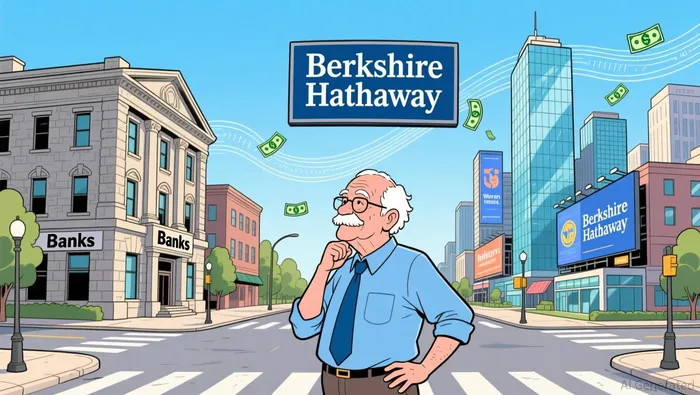
Warren Buffett's Berkshire Hathaway has long been a bellwether for value investing, with its portfolio decisions often signaling broader economic and market trends. In Q3 2025, the conglomerate's 13F filing revealed a striking realignment of its holdings, marked by significant divestments in the banking sector and a bold foray into consumer and technology stocks. These moves, while seemingly disparate, reflect a strategic recalibration rooted in Buffett's evolving risk calculus and his enduring focus on long-term value creation. For value investors, the implications are profound, offering insights into how Berkshire navigates macroeconomic uncertainties and capitalizes on structural shifts in the market.
Buffett's Skepticism Toward Banks: Profit-Taking or a Broader Reassessment?
Berkshire's Q3 2025 filing highlighted a 45% reduction in its stake in Bank of AmericaBAC--, with nearly 465 million shares sold since July 2024 according to Nasdaq reporting. This move, coupled with a 15% trimming of its AppleAAPL-- position (which remains its largest equity holding), underscores a cautious stance toward sectors sensitive to interest rate cycles. According to CNBC analysis, the divestments are attributed to "profit-taking and anticipation of potential interest rate cuts impacting the bank's performance".
Buffett's skepticism toward the banking sector is not new. As noted in a 2025 Business Insider analysis, he has consistently warned against the risks of political entanglements in corporate strategy, particularly in finance. During Berkshire's 2022 annual meeting, Buffett emphasized that political statements by business leaders could provoke public backlash, a caution he contrasts with Elon Musk's high-profile political stances. This aversion to volatility-both economic and reputational-appears to underpin Berkshire's recent banking sector exits.
Emerging Exposure to Consumer and Tech Sectors: A New Frontier
While Berkshire has scaled back on banks, it has simultaneously deepened its commitment to consumer and technology stocks. The most notable addition in Q3 2025 was a $4.9 billion investment in Alphabet (Google's parent company), acquiring 17.8 million Class A shares. This move, though delayed by eight years from Buffett's initial acknowledgment of Alphabet's potential, signals a recognition of the tech sector's enduring dominance in the digital economy.
The consumer sector has also drawn Berkshire's attention. The company has steadily increased its stake in Domino's Pizza, accumulating an 8.7% ownership over five consecutive quarters. Buffett's rationale, as articulated in a 2025 letter, hinges on the "durable competitive advantages and strong growth potential" of companies that thrive in innovation-driven markets according to Seeking Alpha. For value investors, this pivot highlights Berkshire's willingness to adapt to shifting consumer behaviors and technological disruptions, even as it maintains its core principles of long-term value creation.
Strategic Rationale: Balancing Caution and Opportunity
Berkshire's portfolio shifts reflect a nuanced approach to risk management. The banking sector, historically a cornerstone of its holdings, faces headwinds from regulatory pressures and interest rate volatility. By reducing exposure, Buffett appears to be hedging against macroeconomic uncertainties, a strategy that aligns with his emphasis on "margin of safety" in value investing.
Conversely, the consumer and tech sectors offer growth avenues insulated from traditional cyclical risks. Alphabet's dominance in digital advertising and AI, coupled with Domino's Pizza's global expansion, aligns with Buffett's preference for "economic moats"-companies with sustainable competitive advantages. As he noted in a 2019 letter, "The consumer and technology sectors represent fertile ground for compounding value over time-particularly when managed by skilled and ethical leaders". This philosophy, though applied to new sectors, remains consistent with Berkshire's historical playbook.
Implications for Value Investors
For investors, Berkshire's moves offer a dual lesson. First, the divestments underscore the importance of reevaluating sector allocations in response to macroeconomic signals. Banks, once a safe haven for Buffett, now appear overexposed to rate-driven volatility. Second, the tech and consumer investments highlight the value of identifying companies with scalable, innovation-driven business models. These sectors, while traditionally associated with growth investing, now exhibit characteristics that align with value principles-strong cash flows, low debt, and pricing power.
However, challenges remain. The delayed entry into Alphabet raises questions about Berkshire's agility in capitalizing on high-growth opportunities. Additionally, the lack of direct commentary from Buffett in 2025 letters or earnings calls leaves some ambiguity about the depth of his conviction in these sectors. Investors must weigh these factors against Berkshire's track record of disciplined capital allocation.
Conclusion
Berkshire Hathaway's Q3 2025 portfolio shifts encapsulate a strategic pivot toward resilience and adaptability. By exiting volatile banking assets and embracing consumer and tech leaders, Buffett is recalibrating Berkshire's risk profile while staying true to its core tenets. For value investors, the message is clear: the future of value investing lies not in rigid adherence to traditional sectors but in the ability to identify and capitalize on structural trends. As Buffett once said, "The world changes, and so must we"-a sentiment that resonates deeply in today's dynamic markets.







Comentarios
Aún no hay comentarios