
Is Berkshire Hathaway Stock a Buy Now in a Post-Buffett Era?
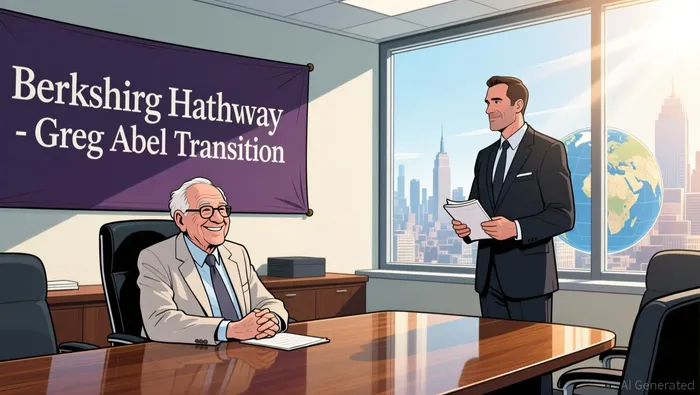
Berkshire Hathaway's leadership transition from Warren Buffett to Greg Abel marks a pivotal moment for the conglomerate. As investors weigh the stock's future prospects, the question of whether Berkshire remains a compelling buy hinges on two critical factors: the effectiveness of its post-Buffett management transition and its ability to sustain long-term value creation.
A Leadership Transition Rooted in Continuity and Strategic Reinvention
Greg Abel, set to assume the CEO role on January 1, 2026, has spent decades mastering Berkshire's non-insurance operations, including BNSF Railway, Berkshire Hathaway Energy, and industrial divisions according to Reuters. His deep operational expertise and alignment with Buffett's decentralized management philosophy position him as a natural successor. However, the transition is not without risks. The departure of key figures like Todd Combs (now at JPMorgan Chase) and the planned retirement of CFO Marc Hamburg in 2027 have prompted reshuffling, with Nancy Pierce (new CEO of Geico) and Adam Johnson (leading consumer products) stepping into prominent roles. These changes reflect a deliberate effort to balance continuity with modernization, as noted by Bloomberg, which highlights Abel's commitment to preserving Berkshire's culture while introducing a more hands-on leadership approach.
The appointment of Michael O'Sullivan as general counsel further signals a shift toward formalized governance, moving away from the famously informal "Berkshire way." While this could enhance transparency, it also raises questions about whether the company's unique decentralized model will retain its agility.
Financial Performance and Market Reactions: Strengths and Uncertainties
Berkshire's third-quarter 2025 earnings underscore its operational resilience, with operating earnings hitting $30.8 billion and a record $176 billion in insurance float according to Wealth Advisor. The $382 billion cash reserve provides flexibility but also presents challenges in deploying capital effectively in a high-valuation market as reported by The Fool. Despite these strengths, the stock has lagged the S&P 500 in 2025, with some analysts attributing this to investor unease over the leadership transition according to QuiverQuant.
Abel's leadership style-emphasizing cost efficiency and operational excellence-could address these concerns. As Reuters notes, his background in utility and infrastructure operations may drive growth in non-insurance sectors, which accounted for 60% of Berkshire's operating earnings in 2025. However, his lack of experience in insurance underwriting remains a potential vulnerability.
Expert Perspectives: Risks and Resilience
Analysts remain divided on the long-term implications of the transition. A report by Kingswell highlights that Berkshire's decentralized structure, where subsidiary managers operate with autonomy, has historically enabled exceptional returns with a 60-year average of nearly 20% compound annual growth. This model, now transitioning to Abel, relies on trust in his ability to maintain strategic discipline while adapting to evolving market dynamics.
Warren Buffett's continued role as chairman and his recent decision to gift $1.3 billion in shares to family foundations-explicitly endorsing Abel-have bolstered confidence among some investors according to Discovery Alert. Yet, as Forbes observes, the absence of a clear dividend policy and the company's reluctance to provide detailed financial disclosures could deter risk-averse investors seeking more conventional corporate governance according to Forbes.
Conclusion: A Buy with Caution
Berkshire Hathaway's post-Buffett era presents both opportunities and uncertainties. Greg Abel's operational acumen and the company's vast cash reserves offer a strong foundation for long-term value creation. However, the success of this transition will depend on his ability to navigate the insurance segment's complexities, deploy capital effectively, and maintain investor trust in a more structured corporate environment.
For investors with a long-term horizon, Berkshire remains a compelling buy, particularly given its diversified portfolio and proven resilience. Yet, those prioritizing short-term stability or transparency may need to monitor the company's strategic shifts closely. As the market watches Abel's first steps, the next 12–18 months will be critical in determining whether Berkshire's legacy endures-or evolves-under new leadership.







Comentarios
Aún no hay comentarios