
Berkshire Hathaway's Post-Buffett Transition and Market Positioning
A Leadership Shift with Built-In Continuity
Warren Buffett's retirement, decades in the making, ensures that Greg Abel inherits a company with a well-defined operational framework. Abel, who has overseen energy and utility operations for Berkshire, has been deeply involved in strategic planning and shareholder communications. His appointment as CEO, alongside taking over the annual letter to shareholders and leading the 2026 Omaha meeting, signals a deliberate effort to maintain continuity, according to an earnings preview. Buffett's continued role as board president adds a layer of institutional memory, mitigating concerns about abrupt strategic shifts.
However, the transition is not without risks. While Abel's familiarity with Buffett's principles is a strength, his leadership will be tested by external pressures, including inflationary headwinds and regulatory scrutiny of conglomerate structures. Analysts at KBW recently issued a KBW downgrade, citing uncertainties around the transition and the company's underperformance relative to the S&P 500 in 2025.
Financial Resilience: A Fortress of Cash and Conservative Metrics
Berkshire's Q3 2025 results underscore its financial durability. Operating earnings surged 33.6% year-over-year to $13.49 billion, with total revenue reaching $94.97 billion-a 2.1% increase from the prior year, as detailed in Q3 operating earnings. The company's cash reserves hit a record $381.67 billion, a figure that dwarfs its peers and provides ample flexibility for acquisitions, dividends, or navigating downturns.
Valuation metrics, however, tell a more nuanced story. Berkshire's price-to-earnings (P/E) ratio of 16.42 and price-to-sales ratio of 2.79 suggest a premium valuation relative to earnings and revenue, according to a valuation preview. While these metrics reflect confidence in the company's long-term cash-generating capabilities, they also highlight a disconnect with broader market trends. In 2025, Berkshire's stock rose just 5%, lagging the S&P 500's 17% gain. This underperformance has fueled debates about whether the market is overcorrecting for transition risks or undervaluing Berkshire's operational depth.
Market Positioning: A Conglomerate in a Fragmented Era
Berkshire's peer comparisons reveal both strengths and vulnerabilities. In the insurance sector, Linde (LIN) and Vulcan Materials (VMC) offer contrasting benchmarks. Linde, with a P/E ratio of 40x and robust operating margins of 26.88%, exemplifies high-growth potential but carries higher debt loads, as noted in a Linde forecast. Vulcan Materials, despite a premium valuation, faces slower earnings growth (3.8% in 2025) and questions about the sustainability of its projected $1.5 billion earnings by 2028.
In the broader conglomerate space, AbbVie (ABBV) and Medallion Financial (MFIN) highlight divergent strategies. AbbVie's Q3 results showed strong revenue growth in immunology and neuroscience segments, yet its reliance on blockbuster drugs like Humira remains a vulnerability. Medallion Financial, meanwhile, demonstrated solid net interest income but faced non-recurring charges and flat loan growth.
Berkshire's conservative debt-to-equity ratio of 0.19 and current ratio of 7.72 position it as a low-risk counterbalance to these peers. Its diversified portfolio-spanning insurance, energy, railroads, and equities-provides resilience against sector-specific downturns. Yet, the company's underperformance in insurance underwriting (due to rising competition and Geico's margin pressures) was highlighted in a Seeking Alpha piece on weaker insurance pricing, suggesting that even Berkshire is not immune to macroeconomic shifts.
Investor Sentiment: Cautious Optimism and Lingering Doubts
Investor sentiment remains split. On one hand, Buffett's endorsement of Abel and the company's record cash reserves bolster confidence. On the other, the KBW downgrade and mixed analyst projections reflect concerns about long-term adaptability. Abel's emphasis on continuity-reiterating Buffett's "economic moats" and disciplined capital allocation-has reassured some, but others question whether Berkshire can evolve its investment strategy in a post-quantitative easing world, as discussed in a five-year outlook.
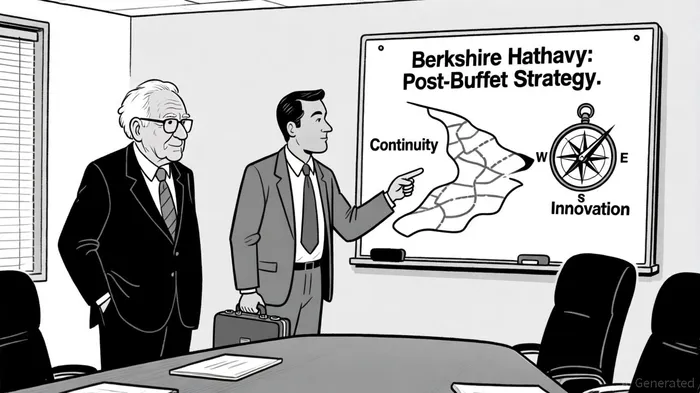
The key challenge for Abel will be balancing Buffett's legacy with innovation. While abrupt changes are unlikely, gradual shifts in portfolio composition or capital deployment could redefine Berkshire's market positioning. For instance, the pending acquisition of Occidental Chemical-a $60 billion deal-could signal a more aggressive approach to industrial expansion, a move that has been debated alongside recent commentary on weaker insurance pricing.
Conclusion: A Fortress with a Question Mark
Berkshire Hathaway's post-Buffett transition is a study in contrasts. The company's financial fortress-$381.67 billion in cash, conservative leverage, and diversified operations-provides a strong foundation for resilience. Yet, its valuation premium and underperformance against the S&P 500 in 2025 highlight risks tied to leadership continuity and market expectations.
For investors, the critical question is whether Abel can replicate Buffett's alchemy of patience and precision. While the immediate outlook is stable, the long-term trajectory will depend on his ability to adapt Berkshire's playbook to a world increasingly defined by technological disruption and regulatory complexity. For now, the market appears to be hedging its bets: valuing Berkshire's fortress-like balance sheet while discounting its growth potential.






Comentarios
Aún no hay comentarios