
How Berkshire Hathaway's Post-Buffett Leadership Changes Impact Its Capital Allocation Strategy
Berkshire Hathaway's leadership transition from Warren Buffett to Greg Abel marks a pivotal moment in the company's history. As Buffett steps down as CEO by January 1, 2026, the conglomerate is undergoing a structural and cultural shift that could redefine its approach to capital allocation. This transition, coupled with the appointment of new executives like Charles Chang as CFO and the formalization of governance roles such as in-house general counsel, signals a departure from the "Berkshire way" of decentralized, opaque management toward a more institutionalized model. The question for investors is whether these changes will preserve Buffett's disciplined capital allocation ethos or introduce new risks and opportunities.
Governance Evolution: From Informality to Institutionalization
Berkshire's governance has long been defined by Buffett's hands-off, trust-based leadership. However, the post-Buffett era is introducing a more structured framework. For instance, the appointment of Michael O'Sullivan as the company's first general counsel in 2025 reflects a move toward conventional corporate governance. Similarly, the restructuring of operational divisions-such as Adam Johnson's role as President for Consumer Products and Greg Abel's direct oversight of non-insurance subsidiaries like BNSF and Berkshire Hathaway Energy-highlights a shift toward centralized accountability.
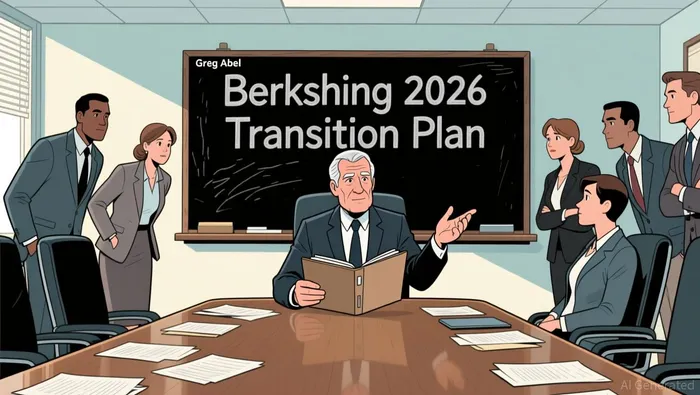 This evolution is not without precedent. Buffett himself emphasized the importance of succession planning, grooming leaders like Abel and Chang over decades. Abel, who has overseen non-insurance operations since 2018, brings deep operational expertise, while Chang's background in accounting and energy-sector finance positions him to manage Berkshire's complex financial landscape according to analysts. Yet, the departure of key figures like Todd Combs to JPMorgan Chase and the retirement of long-serving CFO Marc Hamburg in 2027 underscore the challenges of maintaining continuity.
Capital Allocation Under Greg Abel: A New Era?
Abel's leadership will be tested by his stewardship of Berkshire's $382 billion cash reserve, a figure that has drawn scrutiny as the company navigates a slowing economy and elevated valuations. Unlike Buffett, who prioritized large, transformative acquisitions (e.g., Precision Castparts, Iscar), Abel may adopt a more hands-on approach to improve operating efficiencies and identify strategic growth opportunities according to Bloomberg. Analysts speculate that he could explore a more formal capital allocation strategy, including the possibility of paying dividends-a move not seen since 1967 according to market analysis.
However, Abel's lack of experience managing Berkshire's $280 billion stock portfolio, now shared with Ted Weschler, raises questions about his ability to replicate Buffett's investment prowess according to Morningstar. The transition also introduces governance risks: a Bloomberg report notes that diluting Berkshire's capital allocation discipline or chasing Wall Street's quarterly narratives could erode its long-term premium.
Investment Continuity: Balancing Legacy and Innovation
Despite these shifts, Berkshire's core principles-disciplined capital allocation and long-term value creation-appear intact. The leadership reshuffle emphasizes internal promotions and a gradual transition, ensuring that Abel and Chang inherit a culture steeped in Buffett's philosophy. For example, Abel has publicly committed to preserving Berkshire's decentralized structure while introducing "operational clarity" according to Yahoo Finance.
Yet, the formalization of governance roles, such as the general counsel position, may influence decision-making. A Reuters analysis suggests that increased institutional oversight could refine Berkshire's operational discipline but might also slow its agility in high-conviction bets. Investors will need to weigh these trade-offs against the company's historical resilience.
Conclusion: A Test of Adaptability
Berkshire's post-Buffett leadership changes represent both a risk and an opportunity. While the new governance model introduces transparency and institutional rigor, it also faces the challenge of maintaining the entrepreneurial spirit that defined Buffett's era. Abel and Chang's success will hinge on their ability to balance innovation with continuity, deploying capital effectively without compromising Berkshire's legacy. As the transition unfolds, investors should monitor key metrics: the deployment of cash reserves, the performance of non-insurance operations, and the company's approach to dividends or share repurchases.
For now, the market seems cautiously optimistic. A Bloomberg feature notes that Abel's leadership is seen as a "necessary step" to ensure Berkshire's adaptability in a rapidly evolving economic landscape. Whether this optimism proves justified will depend on how well the new regime navigates the delicate balance between institutionalization and the timeless principles of value investing.







Comentarios
Aún no hay comentarios