
Berkshire Hathaway's Historic Underperformance and the Shift to AI-Driven Markets
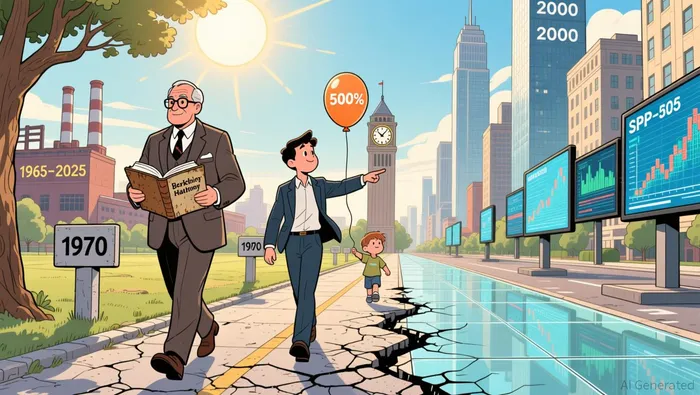
For decades, Berkshire Hathaway has been a poster child for long-term value investing, with Warren Buffett's disciplined approach to capital allocation and market concentration cementing its reputation as a blue-chip stalwart. From 1965 to 2024, the conglomerate's stock returned a staggering 5,502,284%, vastly outpacing the S&P 500's 39,054% total return over the same period according to a chart. A $1,000 investment in 1964 would have grown to $55 million by 2024, a testament to the power of compounding and Buffett's ability to identify undervalued assets as data shows. However, in recent years, Berkshire's performance has diverged sharply from its historical trajectory. Since 2020, the S&P 500 has outperformed Berkshire in several key periods, with the gap widening further in 2025 following Buffett's surprise retirement announcement according to analysis. This raises a critical question: How is a company that once defined long-term value investing adapting to a market increasingly dominated by speculative, AI-driven growth?
The Long-Term Edge and Its Limits
Berkshire's historical outperformance is rooted in its ability to compound capital at extraordinary rates. From 1965 to 2021, the company delivered a compounded annual return of 20.1%, compared to 10.5% for the S&P 500 with dividends according to performance data. This dominance was underpinned by Buffett's focus on durable businesses with strong moats, such as Coca-Cola and American Express, as well as his willingness to take concentrated bets during market downturns. For instance, during the 2008 financial crisis, Berkshire's -2.97% loss in 2022 contrasted sharply with the S&P 500's -23.14% decline according to real returns data, showcasing its resilience in volatile environments.
Yet, even Buffett's legacy has not been immune to structural shifts. Over the past decade, Berkshire's annual compounded return has averaged 11.8%, lagging the S&P 500's 12.0% according to financial reports. This narrowing gap reflects a broader market transformation: the rise of high-growth technology stocks, particularly those leveraging artificial intelligence, which have redefined investor expectations. The S&P 500's 26.3% return in 2023, for example, far outstripped Berkshire's 15.8% gain according to financial analysis, a trend that accelerated in 2025 as AI-driven equities surged.
Structural Challenges in a New Era
Berkshire's recent underperformance is not merely a function of market conditions but also a result of structural constraints. First, its massive cash position-$347.7 billion as of 2025-has limited its ability to deploy capital effectively in a market where smaller, high-growth investments dominate returns according to market analysis. Unlike the S&P 500, which includes a broad array of fast-moving tech stocks, Berkshire's portfolio remains heavily weighted toward traditional industries like insurance, utilities, and manufacturing. This mismatch has left it exposed to a market where AI and generative AI startups are redefining competitive advantages.
Second, the transition of leadership from Buffett to Greg Abel has introduced uncertainty. The so-called "Buffett Premium"-a valuation discount investors historically accepted for Berkshire's long-term strategy-has eroded as markets reassess the company's future trajectory according to market analysis. According to a report by Bloomberg, Berkshire's underperformance against the S&P 500 widened by 25 percentage points in the quarter following Buffett's retirement announcement in May 2025 according to financial analysis. This volatility underscores the market's skepticism about whether Abel can replicate Buffett's success in a rapidly evolving economic landscape.
Value vs. Speculation: A Tension in Modern Investing
The tension between long-term value investing and speculative growth is now more pronounced than ever. Berkshire's underperformance since 2020 coincides with a tech-driven bull market, where companies like NVIDIA and Microsoft have surged on AI-related optimism. In contrast, Berkshire's value-oriented strategy-focused on stable cash flows and conservative balance sheets-has struggled to keep pace. For example, in 2021, Berkshire matched the S&P 500's 20.27% return according to performance comparison, but by 2025, the S&P 500 had surged 23.08% compared to Berkshire's 12.05% gain according to market analysis. This divergence highlights a fundamental shift: investors are now willing to pay premium valuations for companies with perceived AI-driven growth potential, even if those valuations lack immediate profitability.
Critics argue that this speculative fervor is unsustainable, but the data tells a different story. From 2019 to 2021, the S&P 500 returned nearly 90%, while Berkshire posted gains of just under 50% according to investment analysis. Similarly, in the past 12 months as of November 2025, the S&P 500's 15% return far outpaced Berkshire's 9% according to performance data. These figures suggest that the market's appetite for growth-particularly in AI-has created a new benchmark for returns, one that even a company as storied as Berkshire may struggle to meet.
Implications for Investors
For long-term investors, Berkshire's underperformance raises difficult questions. Is the company's value-oriented strategy still viable in a market where growth is increasingly decoupled from traditional metrics like earnings and cash flow? Or is this a temporary setback, with Berkshire's disciplined approach eventually reasserting itself as AI-driven hype cycles mature?
The answer likely lies in a nuanced understanding of market dynamics. While Berkshire's historical record demonstrates the power of compounding and concentrated bets, its current challenges reflect the limitations of a strategy designed for a different era. As AI reshapes industries, investors must weigh the allure of speculative growth against the enduring appeal of stable, cash-generative businesses. For now, the S&P 500's dominance suggests that the market has not yet priced in the long-term risks of AI-driven speculation. However, history has shown that markets often correct themselves, and Berkshire's cash reserves and strategic flexibility could position it to capitalize on future dislocations.
In the post-Buffett era, Berkshire's ability to adapt will be its greatest test. Whether it can bridge the gap between value and growth-or whether the AI-driven market will continue to outpace its traditional approach-remains an open question. For investors, the lesson is clear: in a world of rapid technological change, even the most storied strategies must evolve to stay relevant.







Comentarios
Aún no hay comentarios