
Berkshire Backs OXY's Net-Zero Oil Gambit as J.P. Morgan Flags $60/b Barrel Outlook
The investment case for Occidental PetroleumOXY-- must be evaluated against a commodity cycle that is structurally bearish for oil prices. The macro backdrop is defined by a persistent supply-overhanging market, softening demand fundamentals, and a broader shift in financial conditions that favors lower real interest rates and a weaker dollar. This environment sets a lower price ceiling for the industry, making OXY's strategy of generating resilient cash flow and capturing transition premiums a critical test of its execution.
The immediate forecast points to a significant correction. J.P. Morgan Global Research sees Brent crude averaging around $60/bbl in 2026, a bearish call underpinned by soft supply-demand fundamentals. The bank notes that an oil surplus was visible in January data and is likely to persist, requiring production cuts to prevent excessive inventory accumulation. This view contrasts sharply with the recent spike to $94 per barrel following Middle East tensions, a move analysts expect to normalize. The current price action is a classic volatility event, not a sustainable new trend. The medium-term outlook confirms the downward pressure, with forecasts seeing Brent falling below $80/b in the third quarter of 2026 and averaging $64/b in 2027. This trajectory suggests the recent geopolitical pop is a temporary disruption to a longer-term downtrend.
This structural environment is not a one-off cycle but a reflection of deeper imbalances. Global oil supply is set to outpace demand growth, even as world demand expands. At the same time, the energy transition and evolving trade flows, such as Russian barrels being redirected away from India, are reshaping the market's long-term equilibrium. For OccidentalOXY--, this means its value proposition hinges on navigating a commodity cycle where the average price is materially lower than the peaks of the past decade. The company's ability to generate strong cash flow from its assets, particularly its carbon capture and enhanced oil recovery operations, will be paramount in this lower-price environment. The market is effectively pricing in a new normal, and OXY's strategy is being tested against it.
OXY's Strategic Moat: EOR, Carbon Capture, and the 'Net-Zero Oil' Concept
Occidental Petroleum is building a unique value engine by merging its decades of operational expertise with a forward-looking carbon capture strategy. This combination aims to create a defensible position in the energy transition, where its assets can generate cash flow while also capturing a premium for lower-carbon production. The core of this moat is its leadership in CO₂ Enhanced Oil Recovery (EOR) within the Permian Basin.
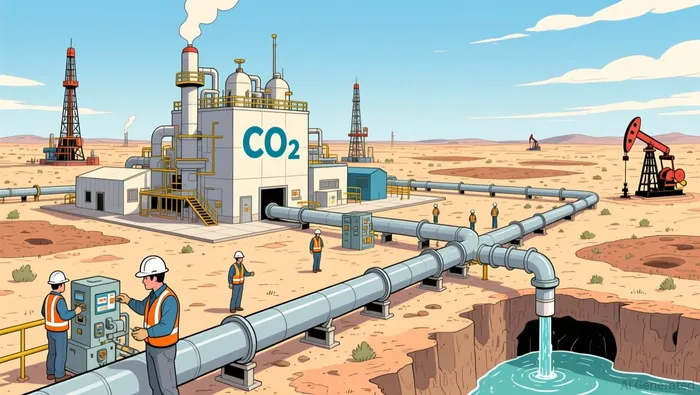
The company's EOR operation is a massive, integrated system built over more than 50 years. It leverages extensive infrastructure including 13 processing and recycling plants and has the capacity to store up to 20 million metric tons of CO₂ per year. This isn't just a side project; it's a foundational business that allows OXYOXY-- to capture and permanently sequester carbon while simultaneously boosting oil recovery by 10 to 25 percent in targeted fields. This dual benefit-increasing reserves and managing emissions-creates a powerful operational synergy that few other oil companies can match.
This legacy infrastructure now serves as the critical link for a new, high-profile initiative: the $1.3 billion Stratos Direct Air Capture (DAC) project. The facility, currently under construction with 1,200 workers, is on target to begin operations this summer. When complete, it will be the largest operating DAC plant in the world, capturing 500,000 metric tons of carbon dioxide from the air annually. The strategic brilliance lies in pairing this new capture technology with the existing Permian EOR network. The captured CO₂ can be piped directly to oil fields, where it will be injected to drive production and permanently stored underground.
The goal is to monetize this entire system as "net-zero oil." By combining captured atmospheric carbon with its own operational emissions reductions, OXY aims to remove an amount of CO₂ equivalent to that emitted during the production and consumption of its products. This forward-thinking methodology, as the company frames it, provides a critical bridge as we transition to a low-carbon economy. It offers a pathway to meet the projected demand for liquid fuels in hard-to-abate sectors, even as global oil demand is expected to fall by up to half by 2050.
This integrated CCUS capability-carbon capture, utilization, and storage-paired with its Permian assets, creates a unique and defensible business model. It provides a tangible mechanism to secure long-term contracts with customers seeking lower-carbon feedstocks and fuels. More broadly, it opens a potential revenue stream from carbon credits and premium pricing, directly linking the company's physical assets to the financial value of decarbonization. In a structural commodity downturn, this moat is designed to protect cash flow and create a new source of competitive advantage.
Financial Resilience and the High-Valuation Trade-Off
The market's verdict on Occidental's strategy is clear in its price action. The stock has rallied 58.85% year-to-date, trading near its 52-week high of $66. This surge reflects strong investor confidence in the company's ability to generate cash flow and deliver returns, even as the broader commodity cycle pressures oil prices. The rally is underpinned by a tangible improvement in the balance sheet and a capital return policy that signals management's belief in the company's future cash generation.
A key pillar of this confidence is the company's commitment to shareholders. Occidental maintains a dividend payout ratio of 56.7% TTM, supported by a 28-year consecutive dividend history. This sustainable policy, which has seen recent increases, provides a tangible return to investors while preserving ample capital for reinvestment in its carbon capture and EOR projects. The financial strength to support this is evident in robust cash flow, which has allowed the company to reach its near-term debt reduction target and now focus more capital on shareholder rewards.
The depth of conviction is perhaps best illustrated by Berkshire Hathaway's continued accumulation. The conglomerate recently made another calculated buy, nudging its stake closer to 29% of the company. This is not a speculative bet but a strategic, long-term commitment that signals deep confidence in Occidental's operational moat and its path to resilient cash flow in a lower-price environment.
Yet this optimism is priced in. The stock trades at a premium valuation, with a PE TTM of 39.3. This multiple reflects the market's premium for OXY's unique "net-zero oil" narrative and its perceived financial resilience. In a structural commodity downturn, this high valuation creates a trade-off. It demands flawless execution on both the operational front-maintaining margins and cash flow-and the strategic front-successfully monetizing its carbon capture assets. Any stumble in these areas could quickly reset expectations, as the stock's recent volatility shows. For now, the market is paying up for the story, but the story must continue to deliver.
Forward-Looking Catalysts and Cyclical Risks
The investment thesis for Occidental Petroleum now hinges on a series of near-term catalysts and the management of persistent cyclical risks. The company's unique value proposition-combining operational cash flow with a nascent carbon business-will be validated or challenged by specific events in the coming quarters.
The most immediate catalyst is the operational launch of the Stratos Direct Air Capture plant. Executives have stated the project is on target to begin operations in the summer of 2025. The successful ramp-up of this facility, which will capture 500,000 metric tons of CO₂ annually, is critical. It will test the company's ability to execute on a major capital project and, more importantly, demonstrate the commercial viability of its carbon capture technology. The subsequent monetization of the captured carbon-whether through long-term contracts with industrial emitters or the sale of carbon credits-will provide the first tangible financial proof of concept for OXY's "net-zero oil" strategy. This is the bridge from a promising narrative to a new revenue stream.
At the same time, the company must navigate a significant bearish headwind: the forecast for oil prices. J.P. Morgan Global Research sees Brent crude averaging around $60/bbl in 2026, a level that would pressure cash flow from its core oil and gas operations. While OXY's cost discipline and EOR efficiency are designed to provide a buffer, a faster-than-expected materialization of this low-price environment would strain its ability to fund both its dividend and its ambitious carbon investments. The market's high valuation already prices in success; any shortfall in operational cash flow would quickly test that premium.
The third key watchpoint is the policy environment. The economics of OXY's carbon capture business are directly tied to the pace of U.S. and global policy development around carbon capture and storage (CCUS) incentives. The company's own materials highlight that implementation of CCUS, paired with proactive policies, can deliver large-scale solutions. Incentives like the 45Q tax credit in the U.S. are crucial for making DAC projects financially viable. Delays or reductions in these policy supports would directly increase the cost of OXY's carbon business, potentially undermining the premium it seeks to capture. Conversely, stronger policy backing could accelerate the monetization of its carbon assets.
In essence, the next 12 months will be a test of execution against a backdrop of structural pressure. The Stratos plant must deliver on its promise, the oil price must hold above the bearish forecast, and the policy tailwinds must remain strong. Success on all fronts is required to turn the "net-zero oil" model into a resilient, diversified profit engine.





Comentarios
Aún no hay comentarios