
Benzinga's Bet on the AI Data Infrastructure Layer
The financial data industry is on the cusp of a fundamental S-curve shift. For decades, the stack was built on content layers-news wires, analyst reports, and market commentary. Now, the paradigm is moving toward infrastructure. The exponential growth of artificial intelligence is forcing a redefinition of value, where the raw material for the new intelligence is not just information, but high-quality, real-time data. This is the strategic inflection point Benzinga is attempting to navigate.
The market's trajectory confirms this is a paradigm shift. The global AI in finance market is projected to grow at a 30.6% CAGR to reach $190.33 billion by 2030. This isn't just incremental growth; it's the adoption curve of a new operating system for capital markets. In this new stack, proprietary data is the critical input, the first-principles layer upon which all AI models are trained and run. Benzinga's recent partnership with Perplexity is a direct attempt to embed itself into this foundational layer.
The collaboration aims to move Benzinga from a content provider to a data infrastructure partner. By delivering its real-time financial data and insights directly into Perplexity's AI platform, Benzinga is targeting a fundamental shift. This isn't about selling news articles; it's about becoming the trusted data feed that powers AI-driven answers. The goal is to make Benzinga's datasets-covering news, analyst ratings, earnings, and price movements-a seamless, source-linked component of conversational intelligence. In practice, this means Perplexity users get institutional-grade context without leaving their chat interface.
This move is a classic play for the infrastructure layer. It aligns Benzinga with the exponential growth of the AI-finance market, positioning it to capture value as the foundational input for a new generation of financial tools. Yet, the execution risk is high. Transitioning from a content brand to a data platform requires a different sales model, deeper technical integration, and a shift in customer relationships. The partnership is a promising start, but its success will depend on Benzinga's ability to scale this integration and prove its data is the indispensable fuel for AI's next wave.
Assessing the Data Moat and Adoption Curve
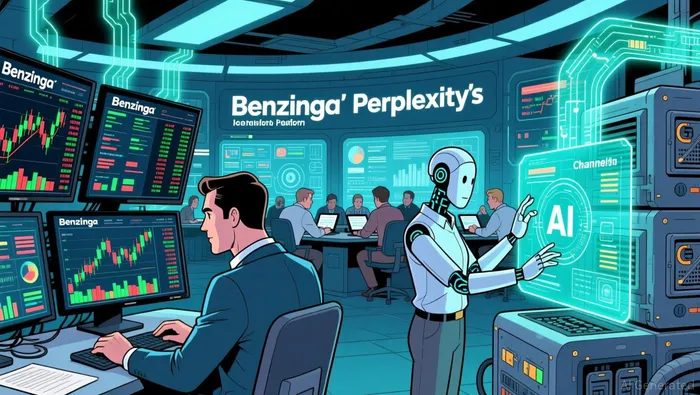
The strength of Benzinga's new strategy hinges on the quality and exclusivity of its core asset: real-time financial data. Its proprietary trading signals and continuous market data processing form the potential basis of a durable data moat. These signals are not generic alerts; they are automated, algorithm-driven notifications for price movements, volume spikes, and options activity across a wide range of assets. This creates a high-frequency, institutional-grade data feed that is difficult for competitors to replicate at scale. In the AI paradigm, this is the fundamental input layer-the raw material that trains and powers intelligent systems. The durability of Benzinga's moat will be tested by its ability to maintain data quality, speed, and exclusivity as AI models demand ever-larger and more nuanced datasets.
This data asset is already being productized. Benzinga's newly launched Benzinga AI feature is a direct output of its proprietary market data. Unlike generic AI tools, this assistant is trained on market data and trading patterns to provide specialized, actionable insights. It represents a classic vertical integration play: the company is using its own data to build a higher-value product that monetizes its institutional-grade insights. The success of this tool will signal whether Benzinga can successfully transition from a data provider to a platform that sells intelligence, not just information. Its ability to answer complex, strategy-based queries-like identifying stocks aligned with Warren Buffett's philosophy-demonstrates the potential for deep, sticky user engagement.
Yet, the critical metric for exponential traction is not internal product adoption, but the success of its strategic integration. The partnership with Perplexity is the linchpin. The company's goal is to make its data a fundamental input layer for a major AI platform. The adoption curve will be visible in Perplexity's user growth and engagement. If Perplexity's user base expands rapidly and traders consistently rely on Benzinga's data for financial answers, it will validate the infrastructure play. The integration must move beyond a simple data feed to become an indispensable, source-linked component of the AI experience. For now, the partnership is announced but not yet operational; the real test is in the numbers that will follow its launch.
Financial Capacity and the Monetization Gap
The strategic pivot to AI infrastructure requires significant capital, and Benzinga's financial runway is now under the microscope. The stock's recent performance tells a clear story of market skepticism. Over the past five days, the share price has fallen 9.8%, and it is down 5.5% year-to-date. This underperformance reflects investor caution as the company shifts from a content model to a higher-risk data platform play. The market is recalibrating, demanding proof that this new infrastructure bet can generate returns.
The company's valuation metrics suggest the market is already pricing in this transition. With a trailing P/E of 31.1 and a price-to-sales ratio of 8.6, Benzinga trades at a premium to many traditional media companies. This premium is based on its growth story, which includes a 120-day rolling annual return of 49.2%. Yet, this growth may be decelerating as the company pivots. The recent price decline indicates that the market is questioning whether this historical momentum can continue into the new, capital-intensive phase of building AI data rails.
This sets up a classic monetization lag. The broader market is already experiencing this gap. As JPMorgan notes, while CEOs expected generative AI to boost revenue, only about one-third reported meaningful gains by the end of 2025. The market is shifting from adoption hype to ROI discipline. For Benzinga, the critical question is whether its Perplexity partnership and proprietary data moat can close this gap faster than the industry average. The company must demonstrate that its data infrastructure can translate into tangible, recurring revenue streams to justify its current valuation and fund future investments.
The bottom line is that Benzinga has the financial capacity to fund its bet, but the market is now demanding a clearer path to monetization. The stock's recent weakness is a warning sign that investors are no longer rewarding belief alone. The company's ability to scale its data partnerships and productize its insights will determine if it can navigate this monetization lag and turn its infrastructure play into a durable earnings engine.
Catalysts, Risks, and the Path to Exponential Growth
The path from announcement to exponential growth is now defined by a few critical milestones. The primary catalyst is the operational success of the Perplexity partnership. This is the make-or-break test for Benzinga's infrastructure thesis. The company's goal is to move its data from a content feed to a fundamental input layer within a major AI platform. The adoption metrics that will validate this are not internal, but Perplexity's user growth and engagement. If Perplexity's user base expands rapidly and traders consistently rely on Benzinga's data for financial answers, it will signal that Benzinga's datasets are becoming indispensable rails for the new AI paradigm. The partnership was announced in December, but the real validation begins with its integration and the resulting user behavior.
A key risk to the exponential growth narrative is execution. Benzinga must successfully scale its AI product suite beyond the initial Benzinga AI feature. The company needs to demonstrate it can productize its proprietary data moat into a range of high-value, recurring services. The more immediate threat, however, is being marginalized by more vertically integrated AI platforms. As AI models demand ever-larger datasets, giants could choose to build their own data layers rather than partner with third parties. Benzinga's strategy is to be the trusted, specialized data provider, but it must prove its data is uniquely valuable and difficult to replicate. The risk is that its partnership becomes a minor add-on, not a core component.
The commercial viability of the new strategy will be revealed in upcoming earnings reports. Investors should watch for two critical metrics: revenue growth acceleration and customer acquisition costs. The stock's recent weakness-down 9.8% over five days and 5.5% year-to-date-shows the market is demanding proof of monetization. If revenue growth decelerates or customer acquisition costs rise sharply, it will signal the infrastructure bet is not yet translating into a scalable business. Conversely, accelerating revenue and efficient customer growth would confirm the market is adopting the new model. The bottom line is that Benzinga has the data and the vision, but its exponential trajectory depends on executing this partnership and productizing its assets before the AI landscape shifts again.







Comentarios
Aún no hay comentarios