
Benzinga's 2025 Performance: A Catalyst for a Re-rating?
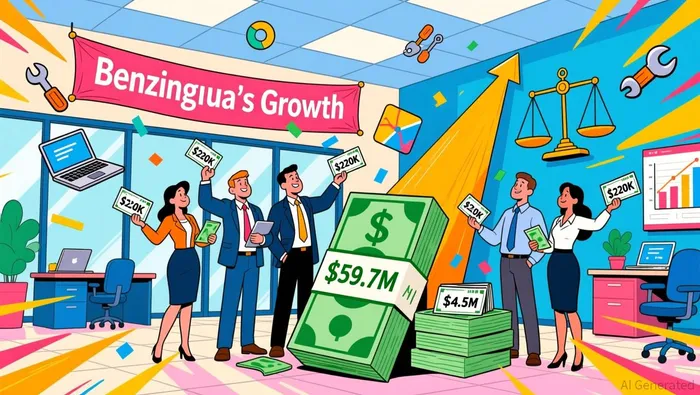
The specific catalyst is clear: Benzinga has just posted a record year. The company's estimated annual revenue hit $59.7 million, a significant scale for a media and data provider. This performance, achieved with a workforce of 271 employees, translates to a revenue per employee of roughly $220,375. For context, that output per worker is a fraction of the levels seen at giants like Morningstar but is a solid benchmark for a mid-sized, growth-focused firm.
The immediate question this creates is one of valuation. The company has raised a total of $4.5 million in funding to date. That capital stack, while providing runway, is dwarfed by the revenue scale it has helped generate. The market now has to decide: does the stock price reflect this operational scale and the growth trajectory that produced it? The record 2025 results set a new baseline. Any future earnings or guidance must now be measured against this higher bar. This isn't just a story of past success; it's a setup for a valuation re-rating, or a potential re-rating if the market deems the current price too low relative to this demonstrated capability.
Valuation Context: Market Positioning vs. Scale
The market's pricing of Benzinga's scale is a key question. The company's estimated annual revenue of $59.7 million is a significant operational benchmark. Yet, its revenue per employee of roughly $220,375 tells a story of efficient scaling. This figure is a fraction of the output seen at giants like Morningstar, but it's a solid base for a growth-stage firm.
Compare that to Hyperfine, a company in a different sector but one that has recently shown explosive growth. Hyperfine's latest quarterly run-rate is about $5.3 million. While Benzinga's annual revenue is larger, the comparison highlights the capital intensity of scaling. Benzinga has raised a total of $4.5 million in funding to date. Hyperfine, in contrast, exited 2025 with approximately $35 million of cash and cash equivalents. This capital contrast is stark.
The implication is that the market may not yet be pricing in the growth acceleration implied by Benzinga's scale. The company has demonstrated it can generate substantial revenue with a lean team and a relatively small capital base. This efficiency suggests a potential for high-margin expansion as it leverages its platform. The market's current valuation appears to focus on the company's size and funding history, not the future earnings power unlocked by that operational model. For an event-driven investor, this gap between demonstrated scale and market pricing creates the setup for a re-rating if the growth trajectory becomes clearer.
Catalysts and Risks: The Path to Sustained Growth
The path forward for Hyperfine is now defined by a clear set of near-term catalysts and a primary financial risk. The company's record quarterly revenue of approximately $5.3 million and its sequential growth of 54% are the immediate proof points. The primary catalyst for the stock is whether management can maintain this acceleration into 2026. The upcoming earnings call in March will be the first major test, where the company is expected to provide its full-year 2025 results and a forward outlook. Any guidance that confirms the 54% sequential growth rate is sustainable will be a powerful bullish signal.
The key risk to this thesis is the sustainability of its cash burn reduction. The company's net cash burn for the fourth quarter was approximately $5.7 million, down 30% year-over-year. This efficiency is critical for preserving its cash and cash equivalents of approximately $35.1 million. Any widening of that quarterly burn rate, perhaps due to accelerated sales investments or R&D spending, would directly pressure that cash cushion. The market will be watching for signs that the burn trajectory is flattening or improving further, as a return to higher burn would shorten the runway and increase financial pressure.
Beyond the numbers, two specific watch items could act as discrete catalysts. First, any updates on FDA clearance for the Swoop® system or its next-generation software, Optive AI, would de-risk the commercial path. Second, announcements of new commercial partnerships, particularly in the neurology office or international markets where the company is seeing placements, would signal broader market adoption. These events, while not immediate financial catalysts, provide qualitative validation of the growth model. For now, the stock's movement hinges on the company's ability to execute on its financial targets and demonstrate that its impressive revenue growth is translating into a durable, cash-efficient business.







Comentarios
Aún no hay comentarios