
Bellway p.l.c.: Assessing Q4 2025 Earnings and Strategic Momentum for Housing Market Recovery
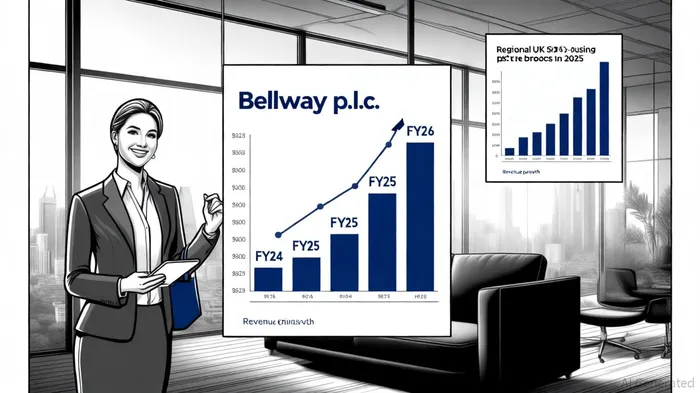
The UK housing market's post-recession recovery has taken center stage in 2025, with Bellway p.l.c. emerging as a standout performer. The housebuilder's Q4 2025 results, released on 14 October 2025, underscore its strategic agility and value-driven growth model in a sector marked by uneven regional dynamics and lingering affordability challenges. With housing completions surging 14.3% to 8,749 units and revenue climbing 16.9% to £2.78 billion, Bellway's financials reflect a company capitalizing on structural market tailwinds while navigating headwinds like elevated interest rates and planning bottlenecks, according to the full-year results.
Financial Performance: Profitability and Margin Expansion
Bellway's Q4 results highlight a disciplined approach to cost management and pricing power. Underlying operating profit jumped 27.5% to £303.5 million, driven by a 19.9% increase in gross profit to £456.8 million, per the strong FY25 results. The company's operating margin expanded to nearly 11%, outpacing industry averages and signaling improved efficiency amid inflationary pressures. This margin expansion is critical, as it positions Bellway to absorb potential cost shocks from materials or labor while maintaining profitability.
The forward order book of 5,285 homes (£1.526 billion value) further reinforces Bellway's near-term visibility, as detailed in the UK Housing Market Update, supported by a robust land bank of 95,000 plots-30,000 with detailed consent. Management's guidance to increase completions to 9,200 units in FY26, coupled with a projected average selling price of £320,000, suggests confidence in sustaining growth. A proposed 29.6% dividend increase to 70.0p per share also underscores the company's commitment to rewarding shareholders amid improving fundamentals, according to the earnings summary. However, historical backtesting of Bellway's earnings releases from 2022 to 2025 reveals a mixed pattern, with average post-earnings returns trending negative over 30-day holding periods and win rates below 30%.
Sector Positioning: Navigating a Fragmented Market
The UK housing market in 2025 remains a patchwork of growth and stagnation. While Northern regions and Scotland have seen double-digit price growth (up to 5.5% annually), London and the South East lag with minimal gains, according to the House Price Index. Bellway's geographic focus on high-growth areas-such as its recent expansion into the North West and Yorkshire-aligns with this trend. Its disciplined land acquisition strategy, which added 8,120 plots in FY25, contrasts with peers who have adopted a more cautious stance amid planning delays, as noted in housing market predictions.
Competitor analysis reveals Bellway's competitive edge. While Taylor Wimpey reported FY24 revenue of £3.4 billion and net income of £219.6 million, and Berkeley Group posted £2.5 billion in FY25 revenue, Bellway's margin expansion and forward order book outpace both, per the Taylor Wimpey profile and the Berkeley profile. This is partly due to its focus on mid-market segments, where demand remains resilient despite broader affordability constraints.
Market Recovery Drivers and Risks
The UK housing market's recovery is underpinned by improving affordability metrics. The house price-to-earnings ratio has fallen to a decade-low of 5.75x, supported by declining mortgage rates and real wage growth, according to Property Market Insights. Bellway's management has noted that stable interest rates and enhanced mortgage availability are fueling customer demand, with private reservations averaging 139 per week, as Bellway reported.
However, structural challenges persist. A shortage of developable land and planning bottlenecks threaten to derail the government's 300,000 homes/year target, with only 39 local authorities on track to meet it, per a housing market overview. Bellway's strong balance sheet-net debt of £8 million and adjusted gearing of 8.5%-provides flexibility to navigate these hurdles, but rising labor costs and material inflation could pressure margins in 2026.
Strategic Outlook: Capital Efficiency and Long-Term Value
Bellway's focus on return on capital employed (ROCE) and capital efficiency sets it apart in a sector grappling with overleveraged peers. Its low gearing and £1.5 billion forward order book enable it to scale output without excessive debt reliance. Analysts at Cushman & Wakefield, in their Residential Forecast, note that Bellway's ROCE trajectory, combined with its disciplined land strategy, positions it to outperform in a market where "quality of execution matters more than ever."
Looking ahead, the company's alignment with government initiatives-such as deposit-assistance schemes and leasehold reforms-could further boost demand. The upcoming Autumn Budget and potential interest rate cuts by the Bank of England (projected to ease rates to 4.25% or lower) may amplify this tailwind, according to a market recovery analysis.
Conclusion: A Buy for Patient Investors
Bellway p.l.c. exemplifies value-driven growth in a fragmented housing market. Its Q4 2025 results, coupled with a forward-looking strategy that balances scale with capital discipline, make it a compelling play for investors betting on the UK's gradual recovery. While risks like interest rate volatility and planning delays remain, Bellway's strong margins, robust order book, and geographic diversification mitigate these concerns. For those seeking exposure to a sector poised for uneven but durable growth, Bellway offers a compelling risk-reward profile.







Comentarios
Aún no hay comentarios