
Belden's Pune Plant 2 Expansion: A Strategic Bet on India's Manufacturing Renaissance
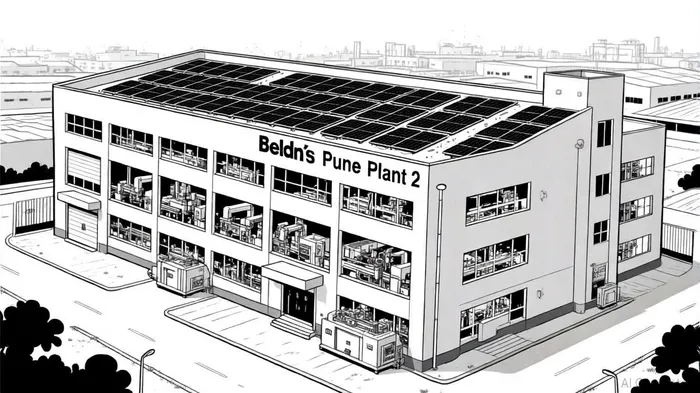
In September 2025, Belden Inc.BDC-- marked a pivotal milestone in its global strategy with the inauguration of its $40 million Pune Plant 2 in India[1]. This expansion, adding 19,000 square meters of advanced manufacturing capacity to complement its 2018 Plant 1, underscores the company's pivot from a product-centric manufacturer to a solutions-driven provider for mission-critical networking and data applications[1]. But beyond Belden's internal transformation lies a broader narrative: the strategic industrial investment in high-growth emerging markets, with India at its epicenter.
Strategic Rationale: Supply Chain Resilience and Policy Synergy
Belden's decision to double down on Pune is not arbitrary. The company's new facility, equipped with automation, smart manufacturing systems, and digital infrastructure, is designed to enhance supply chain resilience and reduce lead times for customers[1]. This aligns with India's national agenda under the “Make in India” campaign and Production-Linked Incentive (PLI) schemes, which aim to localize production and attract foreign capital[1]. By leveraging India's cost-competitive labor force and strategic geographic location, BeldenBDC-- positions itself to capitalize on global supply chain diversification trends, particularly as firms shift production away from China[4].
Moreover, the Pune Plant 2's focus on sustainability—featuring India Green Building Certification and solar energy systems—resonates with India's net-zero goals and growing demand for eco-friendly industrial practices[1]. During construction, the project achieved over 1 million safe working hours, reflecting operational excellence that aligns with global ESG standards[1].
India's Manufacturing Boom: A Macro Perspective
Belden's investment is a microcosm of India's broader industrial ascent. In FY 2024-25, the country's manufacturing output grew by 4.26%, a sharp rise from 1.4% in the previous fiscal year[2]. This growth is fueled by robust performance in sectors like automobiles, pharmaceuticals, and electronics, which are central to India's export strategy[4]. Manufacturing exports have surged at a 15% compound annual growth rate (CAGR) over the past two years, reaching $418 billion in FY22[4].
Government-backed infrastructure projects, including digitalization, industrial corridors, and port modernization, have further catalyzed this growth[1]. India is now projected to become a trillion-dollar manufacturing export hub by FY28, driven by favorable policies and global demand for resilient supply chains[4]. For investors, this represents a structural opportunity: India's manufacturing sector is not just expanding but redefining itself as a global production powerhouse.
Pune: The Industrial Ecosystem of the Future
The choice of Pune as Belden's expansion site is equally strategic. Located 148 km from Mumbai and 135 km from the Jawaharlal Nehru Port Trust, the city offers unparalleled logistical connectivity[3]. Industrial corridors like Mumbai–Pune and Pune–Aurangabad have drawn investments in automotive, IT, and pharmaceuticals, with zones like Chakan (hosting Volkswagen and Mercedes-Benz) and Pimpri-Chinchwad (home to Tata Motors and Bajaj Auto) exemplifying the region's industrial depth[3].
Pune's commercial real estate sector is also booming, with a projected 8% CAGR over the next five years[3]. The rise of e-commerce has spurred demand for smart warehouses, while sustainability trends—such as green industrial spaces—align with Belden's eco-conscious design[3]. By anchoring its operations in Pune, Belden taps into a mature ecosystem that balances scale, innovation, and sustainability.
Challenges and the Road Ahead
Despite these positives, challenges persist. Global supply chain disruptions and currency volatility could temper demand and inflation[3]. However, Belden's long-term vision—rooted in localized production, digital resilience, and ESG alignment—positions it to weather such headwinds. For investors, the company's expansion signals confidence in India's structural growth, even as macroeconomic risks remain.
Conclusion
Belden's Pune Plant 2 is more than a factory—it is a testament to the strategic logic of industrial investment in high-growth emerging markets. By aligning with India's policy-driven manufacturing renaissance, leveraging Pune's industrial ecosystem, and embedding sustainability into its operations, Belden exemplifies how global firms can thrive in a shifting economic landscape. For investors, the lesson is clear: India's manufacturing story is not a fleeting trend but a foundational shift in global industrial dynamics.





Comentarios
Aún no hay comentarios