
Beijing's VAT Cuts: Front-Loading Surge vs. Long-Term Supply Crunch
The specific catalyst is a definitive policy shift from Beijing. On January 9, the Ministry of Finance and the State Taxation Administration announced a phased rollback of VAT export rebates for battery and solar products, with a complete phaseout by 2027. The plan is clear: starting April 1, 2026, the rebate for solar products is canceled outright, while for battery products it is slashed from 9% to 6% for the first half of 2026 before being eliminated entirely by January 1, 2027.
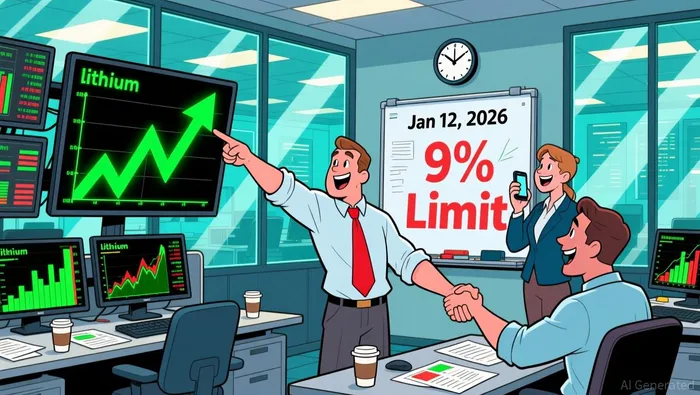
This news triggered an immediate and dramatic market reaction. On January 12, 2026, lithium carbonate futures on the Guangzhou Futures Exchange jumped by the 9% daily trading limit, a surge not seen in over two years. This violent price move signals a severe short-term supply shock, driven by a frantic "export rush" as Chinese manufacturers scramble to ship goods before the new tax regime tightens.
The stock market response, however, was more nuanced. Chinese battery stocks fell on the news, with major players like Contemporary Amperex Technology Co. (CATL) and Gotion High-Tech sliding more than 4% in onshore trading. Analysts interpret this as a knee-jerk reaction, viewing the policy as an early signal of tighter export oversight. Yet, the same catalyst that pressures Chinese equities is boosting raw material producers, with lithium miners like Tianqi Lithium and Ganfeng Lithium seeing their shares surge. This divergence sets up a clear tactical split: a near-term squeeze on supply and costs, versus a longer-term bet on industry consolidation.
Winners & Losers: The Front-Loading Trade Setup
The policy creates a clear, time-bound trading setup. By raising export costs, it incentivizes Chinese manufacturers to front-load shipments into early 2026. This "export rush" will deplete inventories and tighten global supply in the first half of the year, directly supporting lithium prices.
The timeline is critical. For solar products, the rebate is canceled outright on April 1, 2026. For battery products, the rate is slashed from 9% to 6% for the first half of 2026 before being eliminated entirely by January 1, 2027. This gives manufacturers roughly a three-month window to accelerate exports, creating a near-term supply crunch.
The immediate winners are raw material producers and traders who can capitalize on the front-loading surge. The violent price action confirms this: lithium carbonate futures jumped by the 9% daily limit on January 12, a move driven by the scramble to ship before the new tax regime tightens. This sets up a tactical trade where the short-term squeeze on supply supports prices, while the longer-term outlook for industry consolidation remains a separate, slower-moving story.
Valuation & Risk: The Mispricing Setup
The market is pricing in a near-term supply squeeze, but the current lithium price surge may already be an overreaction. The violent 9% daily limit move in futures is a direct response to the front-loading trade, but it could set up a peak that reverses once the initial export rush subsides. The policy creates a clear window, but the market's violent reaction suggests the front-loading effect is being fully priced in, leaving little room for error.
The key risk is the timeline for alternative supply. While the export rush depletes inventories in the first half of 2026, the long-term supply picture depends on new projects coming online. The Jianxiawo mine in China is cited as critical to offsetting the reduction in Chinese exports. If these projects face delays, the supply crunch could persist. If they come online on schedule, the market may quickly reprice the longer-term outlook, which is already one of a narrowing global surplus. According to a recent report, the surplus is expected to shrink to 109,000 metric tons of lithium carbonate equivalent in 2026, down from 141,000 mt in 2025. This underlying tightening supports prices, but it does not negate the near-term volatility from the policy-induced front-loading.
For equity investors, the policy's long-term goal of industry consolidation creates a separate, slower-moving story. It is designed to eliminate less efficient players, which could benefit larger, more efficient manufacturers. Yet, this structural shift does not change the immediate supply crunch. In fact, it may exacerbate near-term competitive pressures on smaller Chinese battery makers who have historically used the higher VAT refund to undercut rivals on pricing. The divergence in stock performance confirms this split: Chinese battery stocks fell on the news as a knee-jerk reaction to tighter oversight, while South Korean materials companies advanced as the policy narrowed the cost advantage of Chinese rivals. The tactical setup is clear: the front-loading trade supports lithium prices now, but the longer-term consolidation story is a separate, less immediate catalyst.
Catalysts & What to Watch
The policy creates a clear timeline, but the market's violent reaction suggests the front-loading effect is being fully priced in. The key is to watch for confirmation that the surge is real and sustainable. The first major data point to monitor is Chinese export data for battery and solar products in Q2 2026. A sustained front-loading surge would show up as a sharp spike in shipments during that quarter, validating the immediate supply crunch thesis. Any weakness in those numbers would signal the rush may have been overblown or that alternative supply is already stepping in.
At the same time, watch the price action in lithium itself. The futures spike to a record high of 156,060 yuan per metric ton on January 12 was the initial shock. The next phase will be stabilization or a reversal. If prices hold near these levels into Q2, it confirms the supply squeeze is real. A sharp drop after the initial spike would suggest the market overreacted to the policy news, and the front-loading trade may be a short-lived event.
Finally, track the progress on alternative lithium supply. The policy-induced crunch will only persist if new projects can't come online to offset the reduction in Chinese exports. The Jianxiawo mine in China is cited as critical. Any delays in its development would prolong the supply tightness. Conversely, on-schedule progress on other global projects would provide a longer-term floor for prices, reducing the volatility from the policy's front-loading window. The bottom line is that the next few months will separate the tactical trade from the structural story.







Comentarios
Aún no hay comentarios