
Beiersdorf's Divergence Between Earnings Growth and Share Price Performance: Mispricing or Structural Warning?
The recent performance of Beiersdorf (WBAG:BEI) has sparked a critical debate among investors: Is the 35% share price decline over the past year, despite 21% earnings per share (EPS) growth, a case of market overreaction-or a red flag signaling deeper structural challenges? To answer this, we must dissect the company's financials, innovation pipeline, and the broader industry dynamics shaping its trajectory in 2025.
The Earnings-Price Disconnect: A Tale of Two Metrics
Beiersdorf's EPS growth of 21% over the past twelve months has outpaced its 5-year average of 8.4%, a feat that should, in theory, buoy investor confidence. Yet its share price has plummeted by 35% during the same period, creating a stark divergence. This disconnect suggests that earnings growth alone is insufficient to justify valuation. The Personal Products industry, which has averaged 4.8% earnings growth, is underperforming relative to the 10-year U.S. Treasury bond, a trend that has dampened appetite for consumer staples stocks. Investors are increasingly wary of companies relying on pricing strategies for growth, as such tactics are seen as unsustainable in a climate of shifting consumer priorities according to market analysis.
Structural Risks: Guidance Cuts and Market Realities
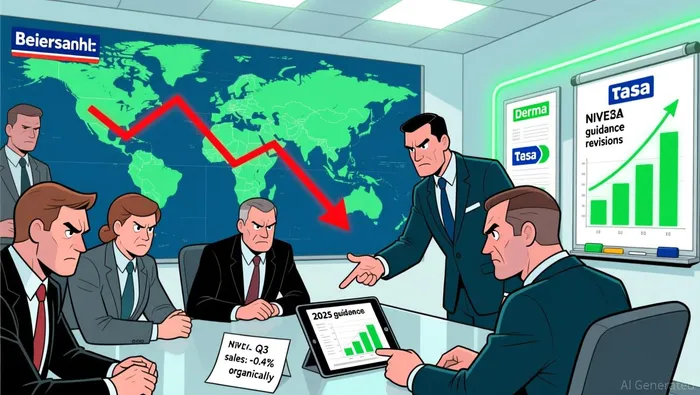 Beiersdorf's recent downward revisions to its 2025 guidance underscore these risks. The company now expects organic sales growth of 3-4% for its Consumer Business Segment, down from 4-6%, and a 2.5% growth rate for NIVEA in the consumer segment. This reflects a challenging market environment, particularly in emerging markets, where NIVEA's Q3 sales declined by 0.4% organically. While the Derma business (Eucerin, Aquaphor) and tesa segment have outperformed, these gains have not offset the NIVEA brand's struggles. Analysts attribute this to evolving consumer behaviors-such as a shift toward clinically backed products and a preference for value-driven purchases-which NIVEA has yet to fully address.
Innovation as a Lifeline: Can New Products Restore Growth?
Beiersdorf's innovation pipeline offers a potential silver lining. The launch of the NIVEA Epigenetics Serum with Epicelline® and other products like the LUMINOUS630® Skin Glow line is positioned to reinvigorate the brand. The CEO has emphasized that these innovations could return NIVEA to a "stronger growth path", a claim supported by Morningstar's fair value estimate of €111, which hinges on the success of these launches. However, the market's skepticism is warranted: Consumer brands must now simplify portfolios, focus on high-growth categories, and align with values like sustainability to differentiate in a crowded retail landscape. Beiersdorf's ability to execute this strategy will determine whether its innovation efforts translate into market share gains.
ROE and Capital Efficiency: A Mixed Picture
Beiersdorf's Return on Equity (ROE) of 11% for the trailing twelve months is in line with the industry average of 12–13%, suggesting moderate capital efficiency. While this stability is reassuring, it also highlights a lack of differentiation in a sector where investors demand premium returns. The company's 22% payout ratio indicates a focus on reinvestment, but with organic sales growth expectations slashed, the effectiveness of these reinvestments remains unproven.
Conclusion: Contrarian Opportunity or Structural Red Flag?
The selloff in Beiersdorf's shares appears to reflect a mix of short-term market pessimism and legitimate structural concerns. On one hand, the company's strong ROE, innovation pipeline, and outperforming Derma segment suggest undervaluation in a sector grappling with broader headwinds. On the other, the persistent underperformance of NIVEA-a brand central to its growth-raises questions about its ability to adapt to consumer trends.
For long-term investors, the key question is whether Beiersdorf can leverage its innovation strategy to regain relevance in a market where only one mass-brand is expected to dominate retail shelves. If the NIVEA relaunches succeed and the company navigates its guidance challenges effectively, this could represent a contrarian opportunity. However, the risks of a prolonged structural slowdown in the Personal Products industry and the company's own execution gaps cannot be ignored.
In the end, Beiersdorf's story is a cautionary tale: Earnings growth is necessary but not sufficient in an era where consumer loyalty is fickle, and differentiation is paramount. The market's verdict will hinge on whether the company can bridge the gap between its financial performance and its ability to resonate with tomorrow's consumers.







Comentarios
Aún no hay comentarios