
The Behavioral Finance of DJT: Trump's Political Influence and the Psychology of Retail Investor Momentum
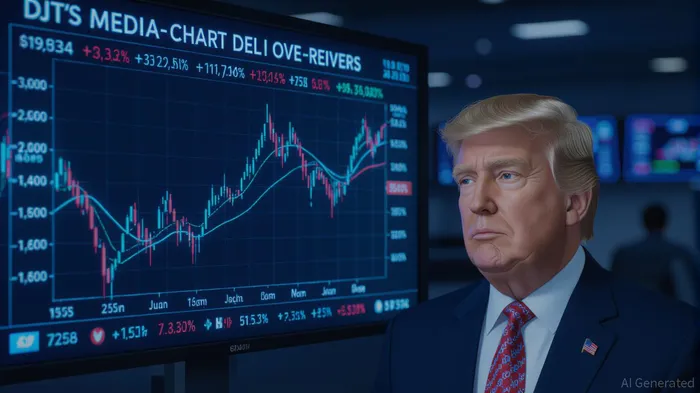
The stock of Donald Trump's media company, DJTDJT--, has become a case study in the intersection of political narratives, retail investor psychology, and market volatility. Since the 2024 U.S. presidential election—where Trump secured a decisive victory—the stock has experienced dramatic swings, driven less by traditional financial metrics and more by speculative fervor tied to Trump's political influence. This article examines how behavioral finance principles explain the surge in DJT, evaluates whether the stock reflects genuine value or speculative hype, and offers strategies for navigating sentiment-driven assets in a post-2024 political climate.
The Behavioral Drivers of DJT's Volatility
DJT's price trajectory from 2024 to 2025 reveals a stock shaped by psychological and emotional forces rather than fundamentals. After hitting a low of $11.23 in May 2025, the stock rebounded to $21.49 by June 2025, only to dip again in August. These movements align with behavioral finance principles such as herd behavior, confirmation bias, and overreaction to news.
Political Narratives as Catalysts:
Trump's election victory in 2024 re-energized investor sentiment, particularly among retail traders. The stock became a proxy for political optimism, with investors anticipating pro-business policies like tax cuts and deregulation. A 2025 study in Finance Research Letters found that DJT's price takes 3–5 days to fully reflect changes in Trump's election odds, lagging behind betting markets like Polymarket. This delay highlights information processing inefficiencies and emotional contagion, where investors react to news not with rational analysis but with preexisting biases.Retail Investor Momentum:
Social media platforms like Reddit's WallStreetBets and TikTok amplified speculation around DJT. The stock's low float (limited public shares) and meme-like status made it susceptible to short squeezes and panic buying. For example, a 49% drop in 2024 was followed by a 90% rebound in 2025, driven by coordinated retail trading. This mirrors the 2021 GameStopGME-- saga, where collective action distorted market prices.Media Feedback Loops:
Every Trump-related event—legal updates, policy announcements, or media appearances—generated media coverage that fueled trading activity. A 2025 paper by Lai notes that social media sentiment now drives 60% of retail trading decisions, with platforms acting as echo chambers for political narratives. This creates a self-reinforcing cycle: media hype → retail buying → price spikes → further media attention.
Speculative Hype vs. Fundamental Value
DJT's valuation remains disconnected from its financial performance. The company reported a $19.2 million loss in Q3 2025, and its enterprise value is inflated relative to revenue. Yet, the stock's price is driven by political sentiment, not earnings. This disconnect is a hallmark of speculative assets, where value is derived from narrative-driven expectations rather than cash flows.
The 2024–2025 period also saw DJT's cumulative abnormal returns (CARs) swing by ±50% in response to discrete events, such as Trump's assassination attempt survival or his appearance on The Joe Rogan Experience. These reactions underscore overreaction bias, where investors overweight emotionally charged news while ignoring long-term fundamentals.
Strategies for Navigating Sentiment-Driven Assets
For investors, DJT exemplifies the risks and opportunities of sentiment-driven markets. Here are three strategies to hedge or capitalize on such assets:
Options as a Hedging Tool:
Given DJT's volatility, options can provide downside protection. A protective put strategy allows investors to lock in a floor price, mitigating losses during sharp declines. Conversely, straddles or strangles can profit from large price swings without predicting direction.Diversification and Position Sizing:
Allocating a small portion of a portfolio to speculative assets like DJT can limit exposure to political and behavioral risks. Diversification across sectors and asset classes (e.g., equities, bonds, commodities) reduces the impact of sentiment-driven volatility.Sentiment Analysis and Contrarian Investing:
Monitoring social media sentiment and retail trading patterns can identify overbought or oversold conditions. For example, extreme bullish sentiment on platforms like RedditRDDT-- often precedes corrections. A contrarian approach—buying during panic dips or selling during euphoric spikes—can exploit behavioral biases.
Conclusion: The Future of Sentiment-Driven Investing
DJT's post-2024 trajectory underscores the growing influence of behavioral finance in modern markets. Political narratives, amplified by social media and retail investor momentum, create assets that are as much about sentiment as they are about economics. While speculative opportunities exist, they come with heightened risks, including regulatory scrutiny and sudden reversals.
For investors, the key lies in balancing emotional responses with disciplined strategies. By understanding the psychological forces at play—confirmation bias, herd behavior, and overreaction—investors can navigate sentiment-driven markets with greater clarity. In a post-2024 climate where political uncertainty remains a constant, behavioral finance offers not just a lens for analysis, but a roadmap for resilience.







Comentarios
Aún no hay comentarios