
e.l.f. Beauty's Q3 2025 Performance: A Miss or a Strategic Reset in a Competitive Personal Care Sector?
The beauty industry's Q3 2025 earnings season has underscored a stark divergence between growth and profitability, with e.l.f. Beauty (ELF) exemplifying the tension between top-line momentum and margin pressures. The company reported a 31% year-over-year surge in net sales to $355.3 million, driven by its digital-first strategy and market share gains in the U.S. and international markets. Yet, this growth came at a cost: adjusted earnings per share (EPS) of 74 cents fell short of expectations, and operating profits plummeted 36% year-over-year. The stock's 38% decline in 2025 has sparked debate over whether this reflects a misstep or a recalibration in a sector grappling with shifting consumer priorities and macroeconomic headwinds.
A Sector in Transition: Value-Driven Growth vs. Margin Compression
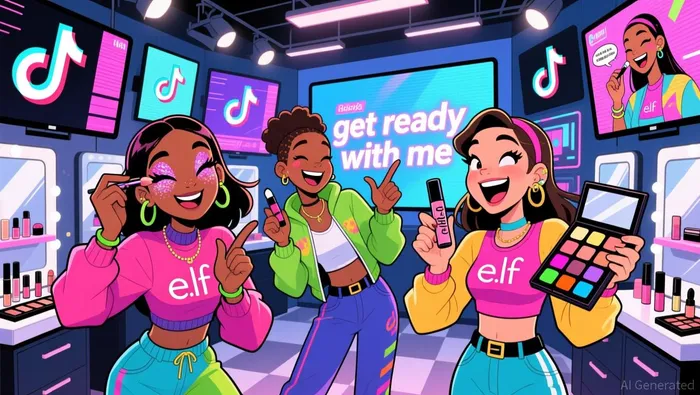
The broader beauty sector is navigating a recalibration. Global beauty sales are projected to grow at 5% annually through 2030, down from 7% in 2022–2024, as inflationary pressures and market saturation temper demand. Consumers, particularly Gen Z, are prioritizing "value" defined by efficacy and sustainability, over price alone. This shift has elevated mass and "masstige" brands like e.l.f., which leverages TikTok-driven virality and affordable, high-performance products to capture a younger demographic.
 However, the sector's margin dynamics tell a different story. e.l.f.'s gross margin of 71% in Q3 2025, bolstered by cost efficiencies and favorable foreign exchange rates, masks underlying fragility. The company's decision to cut full-year revenue guidance to $1.3–$1.31 billion-below its prior $1.32–$1.34 billion target-reflects softer demand in the mass beauty category and economic uncertainty. CEO Tarang Amin acknowledged challenges including "tough prior-year comparisons" and underperforming product launches, yet emphasized e.l.f.'s outperformance relative to the broader category.
Contrarian Case: Valuation Metrics and Strategic Resilience
e.l.f.'s valuation appears stretched relative to peers. Its trailing P/E ratio of 56.63 and forward P/E of 27.72 far exceed the beauty sector average of 8.05, while competitors like Estee Lauder (P/E 34.84) and L'Oréal (P/E 31.91) trade at more conservative multiples according to market data. This premium reflects market optimism about e.l.f.'s growth trajectory but also raises questions about its margin sustainability. The company's EV/EBITDA ratio, though not explicitly disclosed, likely lags behind L'Oréal's 18.87 and the sector average of 14.11, suggesting investors are discounting near-term profitability concerns.
Yet, this divergence could present a contrarian opportunity. e.l.f.'s focus on digital channels-where it dominates via influencer partnerships and social commerce-positions it to capitalize on the sector's $24 billion U.S. skincare market, which is growing at 4–5% annually. Its international expansion, particularly in Latin America and Southeast Asia, also offers untapped potential, with 2025 projections suggesting $1.4–$1.5 billion in revenue. Meanwhile, the company's product pipeline, including the viral Halo Glow Liquid Filter, continues to resonate with Gen Z, a demographic that now accounts for 54% of beauty industry executives' growth strategies.
Sector-Wide Headwinds and Strategic Differentiation
The mass beauty category's struggles are not unique to e.l.f. Prestige brands like Charlotte Tilbury and luxury players are seeing declines, while clinical brands (e.g., CeraVe) gain traction in makeup and skincare. This fragmentation underscores the importance of e.l.f.'s value-driven positioning. Unlike Estee Lauder's "Beauty Reimagined" strategy, which prioritizes margin recovery, e.l.f. is betting on volume growth and digital agility. While this approach risks margin compression, it aligns with Gen Z's preference for accessible, high-performing products-a demographic that now ranks e.l.f. among its top favorites alongside CeraVe and Rare Beauty.
Conclusion: A Strategic Reset, Not a Miss
e.l.f. Beauty's Q3 2025 results reflect the challenges of scaling in a maturing market, but they also highlight the company's strategic resilience. The guidance cut and profit decline are symptoms of a sector-wide slowdown, not a fundamental flaw in its business model. For contrarian investors, the stock's valuation discount-despite its 24th consecutive quarter of sales growth-offers an opportunity to bet on its ability to navigate macroeconomic headwinds while maintaining its digital-first edge. If e.l.f. can stabilize its margins and execute on its international and product innovation goals, the current pessimism may prove to be a buying opportunity in a sector where differentiation is key.







Comentarios
Aún no hay comentarios