
Beam Therapeutics: A Base Editing Breakthrough With Catalysts to Ignite Value
The biotech sector is littered with companies chasing “transformative” therapies, but few have data as compelling as Beam Therapeutics (BEAM). Its lead candidate, BEAM-101, a base-editing therapy for sickle cell disease (SCD), has delivered early clinical results that could redefine treatment paradigms. With a $80 price target from H.C. Wainwright suggesting a 302% upside, investors are now weighing whether Beam's progress justifies a buy ahead of pivotal catalysts in 2025.
The Science of Silence: BEAM-101's Clinical Breakthrough
Sickle cell disease, a genetic disorder affecting millions globally, has long been a clinical dead end. Current treatments, like hydroxyurea or risky stem cell transplants, only manage symptoms. BEAM-101 aims to fix the root cause: editing stem cells to boost fetal hemoglobin (HbF), which suppresses the misshapen sickle hemoglobin (HbS) responsible for pain crises and organ damage.
Recent data from Beam's BEACON Phase 1/2 trial are staggering:
- All 17 patients achieved HbF levels exceeding 60%, with HbS reduced below 40%.
- No vaso-occlusive crises (VOCs)—the hallmark of SCD—were reported post-treatment.
- Rapid engraftment (median 16.5 days for neutrophils, 19.5 for platelets) minimized hospital stays.
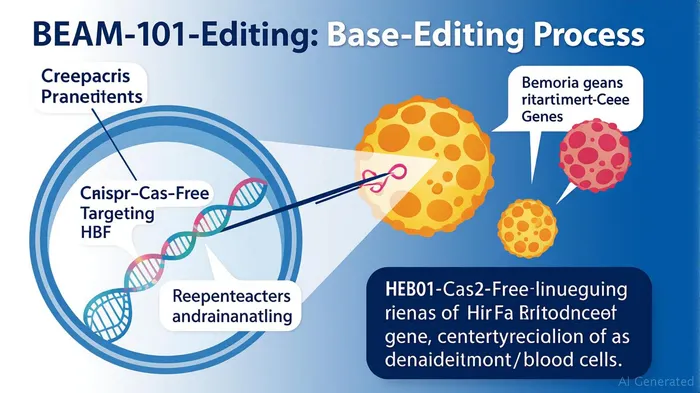
The FDA's orphan drug designation for BEAM-101 in June 2025 adds momentum, offering tax credits and seven years of market exclusivity post-approval. Competitors like bluebird bio (BLUE) and CRISPR Therapeutics (CRSP) are also in the SCD race, but Beam's non-viral delivery and simpler manufacturing (90% automated) could give it an edge in scalability.
Financial Fortitude for the Long Game
Beam's $1.2 billion cash balance as of Q1 2025, bolstered by a $500 million financing round, projects a cash runway through 2028—critical for a company advancing multiple programs. While its Q1 net loss of $109.3 million reflects aggressive R&D spending, the financial buffer allows BeamBEAM-- to avoid dilutive fundraising until key milestones, like FDA approval of BEAM-101 or partnerships, materialize.
Analysts' optimism is clear: The $80 price target from H.C. Wainwright—implying a stock price jump to $80 from ~$20—reflects belief in BEAM-101's potential to capture a $5–10 billion market. Even the consensus $44.58 average target suggests undervaluation.
2025: A Year of Catalysts
Beam's pipeline is dense with near-term catalysts:
1. BEACON Trial Completion (Mid-2025): Dosing of 30 patients will solidify durability and safety data, with updates expected by year-end.
2. ASH 2025 Conference (December): A platform for presenting long-term follow-up data on BEAM-101's efficacy and biomarker improvements.
3. BEAM-302 Advances: The therapy for alpha-1 antitrypsin deficiency (AATD) has already earned FDA's RMAT designation, expediting its path to approval.
4. BEAM-103 Launch (Late 2025): A Phase 1 trial for its ESCAPE monoclonal antibody, which could reduce the need for toxic busulfan conditioning in stem cell transplants—a major safety hurdle.
Risk Factors: A Biotech's Double-Edged Sword
While Beam's progress is impressive, risks remain:
- Clinical Hurdles: While BEAM-101's safety profile is encouraging, one patient's death linked to busulfan (not the therapy itself) underscores the risks of conditioning regimens.
- Regulatory Delays: Even with RMAT and orphan designations, FDA approval timelines are uncertain.
- Competitor Moves: Gene-editing rivals like Intellia (NTLA) and Editas (EDIT) are advancing their own SCD therapies.
Investment Thesis: A High-Reward Buy With Near-Term Catalysts
Beam's stock trades at a $1.7 billion market cap, far below its potential peak if BEAM-101 succeeds. The $80 price target hinges on the FDA approving BEAM-101 by 2026 and the company securing partnerships for its pipeline. With a cash runway through 2028, Beam can execute without capital raises, a rarity in biotech.
Investors seeking high-risk, high-reward exposure to gene editing should consider Beam ahead of its Q4 2025 data readouts. The $20 stock price offers a margin of safety, especially if BEAM-101's durability data at ASH 2025 exceeds expectations.
Final Take: Beam is a pure-play bet on base editing's potential to cure genetic diseases. The $80 PT isn't just a number—it's a reflection of a company that could redefine medicine. For those willing to stomach biotech volatility, Beam is worth a close watch in 2025.





Comentarios
Aún no hay comentarios