
BDCs and the Sustainability of Dividend Yields: Regulatory and Capital Structure Catalysts
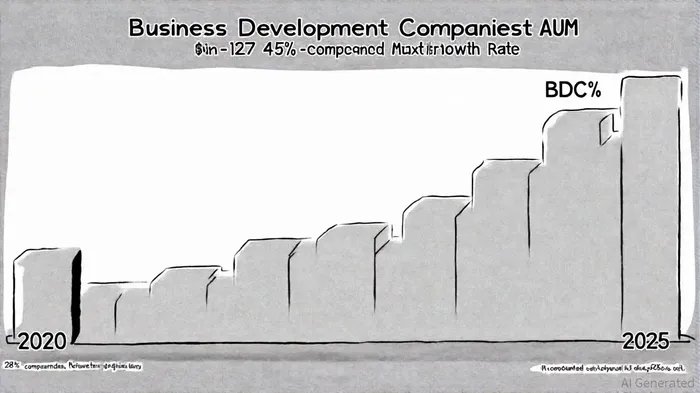
Business Development Companies (BDCs) have long been a cornerstone for investors seeking high-yield returns, particularly in a low-interest-rate environment. However, the sustainability of their dividend yields has increasingly hinged on regulatory shifts and capital structure dynamics. In 2025, a wave of deregulation under the new U.S. administration has introduced both opportunities and risks for BDCs, reshaping their ability to maintain or enhance payouts to shareholders.
Regulatory Tailwinds and Risks
The most significant catalyst for BDCs in 2025 is the anticipated relaxation of leverage restrictions. Building on the 2018 Small Business Credit Availability Act (SBCA Act), which reduced the asset coverage requirement from 200% to 150%, regulators are now expected to further ease constraints, potentially allowing a 2:1 debt-to-equity ratio [1]. This deregulatory push, as noted in a report by Financial Content, aims to streamline compliance and reduce capital requirements, enabling BDCs to deploy capital more efficiently into small and middle-market lending [1]. For instance, the proposed recalibration of the enhanced supplementary leverage ratio (eSLR) for banks—repositioning it as a backstop rather than a binding constraint—signals a broader trend toward risk-based capital frameworks [3].
However, these changes come with caveats. Increased leverage, while boosting net investment income (NII), also heightens credit risk. Smaller or less diversified BDCs may struggle to manage this risk, particularly if economic conditions deteriorate. As highlighted by Mayer Brown's BDC Facts & Stats, BDCs with robust underwriting processes and floating-rate loan portfolios are better positioned to capitalize on deregulation, whereas weaker performers could face margin compression and portfolio stress [1].
Capital Structure Dynamics: Leverage and Refinancing Challenges
The sustainability of BDC dividends is inextricably linked to their capital structure. As of 1Q25, the average leverage ratio for BDCs stood at 0.91x, down slightly from 0.94x in 4Q24, reflecting a cautious approach amid rising interest rates [3]. Larger BDCs ($500M+ in assets) maintained stable leverage at 1.01x, underscoring their ability to manage refinancing risks better than smaller peers.
A critical challenge lies in the looming $10.4 billion in BDC bond maturities due in 2026 and $8.5 billion in 2027. To mitigate this, many BDCs have proactively issued unsecured debt. In January 2025 alone, five BDCs raised $2.6 billion in unsecured debt, a strategy that Fitch Ratings describes as “opportunistic” for addressing near-term refinancing needs [1]. However, this approach risks locking in higher borrowing costs if interest rates remain elevated, potentially squeezing NII—the lifeblood of dividend sustainability [4].
Equity Financing and Dividend Coverage
BDCs are legally required to distribute at least 90% of taxable income, a mandate that ensures high yields but leaves little room for error. Deregulation could enhance dividend coverage by expanding lending opportunities and improving NII. For example, relaxed leverage rules may allow BDCs to increase loan origination volumes, directly boosting income streams [2].
Yet, the interplay between equity financing and leverage remains delicate. While deregulation reduces compliance costs, it also pressures BDCs to raise equity capital to support higher leverage ratios. This dynamic is particularly acute for BDCs with fixed-rate debt, as rising interest rates could erode arbitrage margins. As BDC BUZZ notes, investors must closely monitor credit quality, leverage levels, and interest rate sensitivity to gauge long-term payout sustainability [2].
Conclusion: Balancing Opportunity and Risk
The 2025 regulatory environment presents a dual-edged sword for BDCs. Deregulation offers a tailwind for income generation and operational flexibility, but it also amplifies risks tied to leverage and credit quality. For investors, the key lies in identifying BDCs with strong management teams, diversified portfolios, and proactive refinancing strategies. Those that navigate the regulatory and capital structure shifts effectively could see enhanced dividend sustainability, while weaker performers may face margin pressures.
As the 2026–2027 refinancing wall looms, the ability of BDCs to balance growth with prudence will be critical. In this evolving landscape, the sustainability of BDC dividends will depend not just on regulatory tailwinds, but on the resilience of their capital structures.







Comentarios
Aún no hay comentarios