
BBVA's Strategic Bid for Banco Sabadell: A Catalyst for Long-Term Value Creation in Spanish Banking
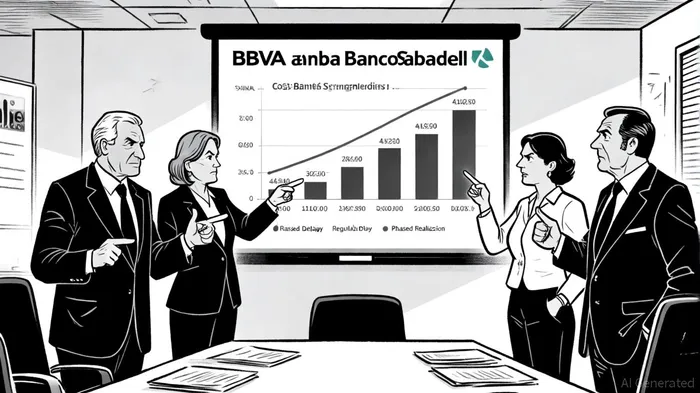
. This move, years in the making, represents more than just a consolidation play—it's a calculated bid to reshape the competitive landscape of European banking while delivering substantial value to shareholders. Let's break down the numbers, the strategy, and the risks.
The Strategic Rationale: Synergies and Scale
BBVA's pursuit of Banco Sabadell is rooted in a clear vision: to create a banking behemoth capable of competing with global giants. The merger is projected to generate , driven by cost reductions and funding efficiencies[4]. These figures, while ambitious, align with broader European trends where scale is increasingly critical to offset rising costs in digitization and cybersecurity[1]. For context, BBVA's digital infrastructure already outpaces many regional peers, and Sabadell's strong SME and retail banking presence in Catalonia could complement this strength[2].
The combined entity would become Spain's second-largest bank by credit volume, . This scale could enable BBVABBAR-- to outmaneuver SantanderSAN-- in key segments, particularly in corporate finance and energy transition lending—a sector where Spain's green transition is gaining momentum[3].
Regulatory Hurdles and the Path to Synergy Realization
The Spanish government's intervention has added complexity. By imposing a three-year separation period for operational integration, regulators have delayed cost synergies by at least a year, reducing the initial €850 million annual savings estimate to [4]. While this softens the short-term impact, it doesn't negate the long-term potential. BBVA's CEO, , has emphasized that the merger remains accretive, with a projected and a under a 100% acceptance rate[1].
The regulatory conditions also highlight a political dimension. Catalonia's resistance to losing a regional banking icon has forced BBVA to accept commitments like maintaining branch networks and SME lending programs[5]. While these concessions limit immediate cost-cutting, they mitigate the risk of prolonged legal challenges.
Shareholder Dynamics and the Retail Investor Factor
The bid's success hinges on shareholder acceptance. With the current offer at a negative differential (due to Sabadell's 58.6% net profit surge in early 2025[3]), analysts like JB Capital argue BBVA may need to raise its offer by up to to secure the necessary 30% threshold[1]. This is no small task, given Sabadell's dispersed ownership—retail investors hold a significant chunk of shares[1].
Sabadell's board, however, remains defiant. It has rejected the offer as “fundamentally undervaluing the bank,” citing its independent growth strategy and recent profitability[3]. This standoff creates a fascinating tug-of-war: BBVA's disciplined cost synergies versus Sabadell's organic growth narrative. For investors, the key question is whether the merged entity can deliver , as BBVA claims[1].
Competitive Positioning in a Consolidating Sector
Spain's banking sector is already highly concentrated, with the top five banks controlling over 80% of market share. The BBVA-Sabadell merger would further tilt this balance, potentially reducing the number of independent regional players. Critics warn of reduced competition, citing the Herfindahl Index—a measure of market concentration—which could rise to levels seen in the U.S. or Germany[5].
Yet, BBVA's leadership argues that consolidation is inevitable. As , BBVA's chair, stated, “The future belongs to banks that can scale efficiently while maintaining customer-centricity.”[2] The merged entity's focus on digital innovation—such as AI-driven customer insights and blockchain-based supply chain finance—could offset concerns about reduced competition[1].
The Bottom Line: A High-Stakes Bet on Scale
BBVA's bid for Sabadell is a high-stakes gamble, but one that aligns with the broader shift toward pan-European banking consolidation. While regulatory delays and shareholder resistance pose risks, the potential rewards—€900 million in annual synergies, a stronger competitive position, and enhanced shareholder returns—are compelling. For investors, the critical takeaway is this: the merger's success will depend on BBVA's ability to navigate political and regulatory headwinds while delivering on its cost-cutting and growth promises.
If executed well, this deal could set a new benchmark for M&A-driven value creation in the sector. If not, it risks becoming a cautionary tale about overreaching in a highly politicized market.







Comentarios
Aún no hay comentarios