
Baytex Energy's Strategic Position in the Heavy Oil Sector: Undervalued Resilience and Long-Term Energy Security
Baytex Energy's Strategic Position in the Heavy Oil Sector: Undervalued Resilience and Long-Term Energy Security
In an energy landscape increasingly defined by the tension between decarbonization and energy security, Baytex EnergyBTE-- Corp (NYSE:BTE) (TSX:BTE) stands out as a case study in disciplined resilience. While the heavy oil sector faces headwinds from regulatory shifts and market volatility, Baytex's strategic focus on production stability, debt reduction, and operational efficiency positions it as a compelling long-term investment. With a trailing P/E ratio of 7.02 and a forward P/E of 27.41, the company's valuation metrics suggest it is undervalued relative to its risk-adjusted cash flow potential and sector-specific tailwinds, according to StockAnalysis statistics.
Strategic Pillars: Discipline in a Shifting Sector
Baytex's May 2025 investor presentation underscores a conservative yet pragmatic approach to capital allocation. The company targets production of 148,000 boe/d in 2025, slightly below its Q3 2024 output of 154,000 BOE per day, prioritizing financial flexibility over aggressive growth. This aligns with its three strategic pillars: disciplined reinvestment, shareholder returns, and financial strength. By allocating $1.2 billion to exploration and development, BaytexBTE-- aims to balance operational continuity with cost optimization, including a 7% improvement in drilling and completion costs per lateral foot in its Eagle Ford operations. Such efficiency gains are critical in a sector where the Dallas Fed survey reported a business activity index of -6.5 in Q3 2025, reflecting elevated uncertainty (Dallas Fed survey).
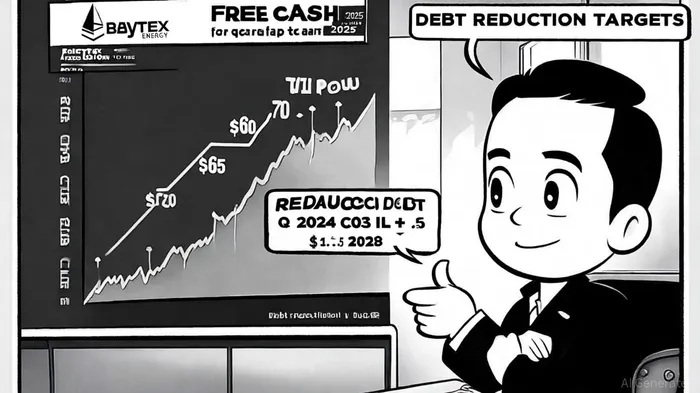
The company's debt reduction strategy further bolsters its resilience. Baytex plans to cut total debt from CAD 2.5 billion in Q3 2024 to $1.5 billion by 2028, targeting a debt-to-EBITDA ratio of 0.7x at $70 WTI, as outlined in the investor presentation. This contrasts with broader sector pessimism, as E&P executives in the Dallas Fed survey indicated a bleak outlook, with the company outlook index falling to -17.6. By prioritizing deleveraging, Baytex insulates itself from the volatility of oil prices, which averaged between $65/bbl and $69/bbl in Q3 2025, according to the Q3 2025 oil report.
Financial Resilience and Shareholder Returns
Baytex's free cash flow projections highlighted in the investor presentation show adaptability to price fluctuations. At $60 WTI, the company anticipates $60 million in free cash flow, rising to $70 million at $70 WTI. This range, while modest, provides a buffer for dividend sustainability and share repurchases. Since June 2023, Baytex has repurchased 11% of its shares, signaling confidence in its intrinsic value. The enterprise value of CAD 4.65 billion appears modest given its asset base and operational scale, particularly in the context of midstream sector expansion driven by AI and LNG demand as noted in the Dallas Fed survey.
Recent market speculation about acquisition talks has further fueled investor optimism, with shares surging 11.08% in July 2025, according to the investor presentation. While such speculation is inherently volatile, it underscores Baytex's strategic appeal in a sector where consolidation could accelerate.
Sector Context: Navigating Transition Risks
The heavy oil sector's challenges are well-documented. The Dallas Fed survey noted a -8.6 oil production index, reflecting minimal changes in output despite elevated uncertainty. Regulatory shifts since January 2025 have reduced break-even costs for new wells by less than $1 per barrel, a marginal improvement in an environment where OPEC+ supply cuts are unwinding and Chinese demand remains weak (as reported in the Q3 2025 oil report). Yet, midstream infrastructure expansion-driven by AI-powered data centers and LNG facilities-offers a counterbalance, a dynamic also reflected in the Dallas Fed survey. Baytex's focus on heavy oil, while less glamorous than renewables, aligns with the reality that fossil fuels will remain central to global energy security for decades.
Conclusion: A Case for Undervalued Resilience
Baytex Energy's strategic positioning in the heavy oil sector exemplifies the balance between prudence and opportunity. Its disciplined capital allocation, debt reduction targets, and operational efficiency improvements create a foundation for long-term resilience. While the sector grapples with transition risks, Baytex's valuation metrics and focus on energy security make it an attractive candidate for investors seeking undervalued exposure to a critical but often overlooked segment of the energy transition.





Comentarios
Aún no hay comentarios