
Bausch + Lomb’s XIIDRA as a Game-Changer in the Dry Eye Treatment Market for Contact Lens Wearers
The global dry eye disease (DED) market, projected to exceed $10 billion by 2030, is witnessing a paradigm shift as pharmaceutical companies pivot from symptomatic relief to addressing root causes of inflammation. For contact lens wearers—a demographic accounting for over 40% of DED cases—Bausch + Lomb’s XIIDRA (lifitegrast ophthalmic solution) has emerged as a transformative therapy. By combining robust clinical evidence with real-world practitioner satisfaction, XIIDRA is redefining market differentiation in a competitive landscape dominated by cyclosporine-based treatments like Restasis and Cequa.
Clinical Efficacy: A Data-Driven Edge
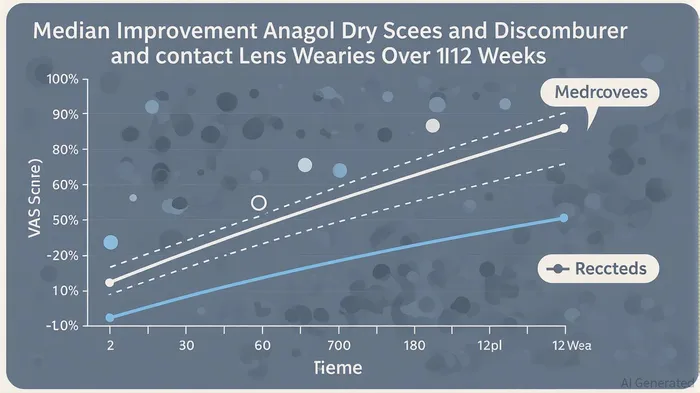
A 2025 investigator-initiated study by the Centre for Ocular Research & Education (CORE) at the University of Waterloo underscores XIIDRA’s clinical superiority for contact lens wearers. Participants using XIIDRA twice daily for 12 weeks experienced a 61-point improvement in end-of-day dryness and a 59-point reduction in discomfort on the visual analog scale (VAS), metrics that outpace many existing therapies [1]. The study also noted a 90% clinical improvement rate in CLDEQ-8 scores—a validated dry eye symptom index—after 12 weeks, with half of participants no longer meeting symptom-based eligibility criteria within two weeks [1]. Beyond symptom relief, XIIDRA extended mean comfortable contact lens wear time from 6.5 to 9.1 hours, a critical factor for patient adherence and quality of life [1].
These results are further validated by real-world data: 91.7% of eye care practitioners (ECPs) in the U.S. and Canada use XIIDRA for contact lens-induced DED, with 66.7% reporting near or complete symptom resolution within 1–3 months [3]. Sustained efficacy over 12–29 months of treatment, coupled with high practitioner satisfaction scores (6.8 for onset, 6.6 for effectiveness), positions XIIDRA as a durable solution in a market where recurrence is common [3].
Market Differentiation: Mechanism and Adoption
XIIDRA’s mechanism of action—targeting inflammatory signaling via LFA-1 antagonism—sets it apart from competitors. Unlike Restasis, which modulates the immune system broadly, XIIDRA directly inhibits T-cell activation, offering a more precise intervention for inflammation-driven DED [2]. This specificity aligns with the growing emphasis on personalized medicine in ophthalmology, a trend that could drive long-term adoption.
While over-the-counter (OTC) artificial tears remain the first line of treatment, their short-lived effects and lack of systemic impact limit their utility for moderate-to-severe cases. XIIDRA bridges this gap by addressing underlying inflammation while providing rapid symptom relief. Despite its higher price point compared to OTC options, its cost-effectiveness is bolstered by reduced need for frequent dosing and long-term symptom management [1].
Investment Implications: A High-Growth Play
The dry eye treatment market is highly fragmented, with prescription therapies accounting for 60% of revenue in 2025. XIIDRA’s dual strength—clinical differentiation and real-world adoption—positions it to capture a larger share of this segment. With 66.7% of ECPs reporting near-complete resolution of symptoms like dryness and blurred vision, patient retention and repeat prescriptions are likely to drive revenue stability [3].
Moreover, XIIDRA’s sustained efficacy over 29 months (as reported in some cases) suggests a low churn rate, a critical metric for investors evaluating long-term stock value [4]. Bausch + Lomb’s strategic focus on contact lens wearers—a niche yet high-need population—also insulates XIIDRA from generic competition, as the drug’s mechanism and formulation are protected by patents extending through 2030.
Conclusion
Bausch + Lomb’s XIIDRA is not merely a dry eye treatment but a strategic asset in a market increasingly driven by inflammation-targeted therapies. Its combination of robust clinical data, real-world practitioner endorsement, and mechanistic differentiation creates a compelling value proposition for investors. As the dry eye market evolves toward precision medicine, XIIDRA’s role in addressing unmet needs for contact lens wearers—while maintaining a favorable safety profile—positions it as a long-term growth driver for Bausch + Lomb.
Source:
[1] Bausch + Lomb Announces Publication of Data From a Prospective Study Evaluating the Efficacy of XIIDRA,
https://www.marketscreener.com/news/bausch-lomb-announces-publication-of-data-from-a-prospective-study-evaluating-the-efficacy-of-xiid-ce7d59dfdf8ef122
[2] Improved Dry Eye Drugs for 2025 and Beyond,
https://www.aao.org/eye-health/tips-prevention/new-dry-eye-treatments-ocular-surface-disease
[3] Eye care practitioners report satisfaction with Xiidra for dry eye disease,
https://www.healio.com/news/optometry/20250703/eye-care-practitioners-report-satisfaction-with-xiidra-for-dry-eye-disease
[4] Lifitegrast Sustains Rapid Effect for Dry Eye in Real-World Assessment,
https://www.hcplive.com/view/lifitegrast-sustains-rapid-effect-for-dry-eye-in-real-world-assessment







Comentarios
Aún no hay comentarios