
Base: The Non-Custodial Layer 2 Revolutionizing Ethereum Scalability
Ethereum's Layer 2 (L2) ecosystem is at a pivotal inflection point. As the network grapples with scalability challenges, the race to deliver user-friendly, secure, and sustainable scaling solutions has intensified. Among the contenders, Coinbase's Base has emerged as a standout, praised by EthereumETH-- co-founder Vitalik Buterin as a “model for how L2s can balance usability with decentralization”[1]. This article evaluates Base's unique value proposition—its non-custodial security, low-risk architecture, and UX-driven design—and positions it as a critical player in Ethereum's next phase of adoption.
Vitalik Buterin's Endorsement: A Seal of Approval
Vitalik Buterin's public defense of Base underscores its alignment with Ethereum's core principles. He emphasized that Base's sequencer, while centralized for efficiency, does not compromise security or user control. “Base is doing things the right way,” Buterin stated, noting that user funds are governed by Ethereum's decentralized base layer, ensuring withdrawals remain possible even if Base ceases operations[3]. This distinction is critical: unlike custodial models, Base cannot seize or block user assets, a feature that meets L2Beat's Stage 1 decentralization standards[1].
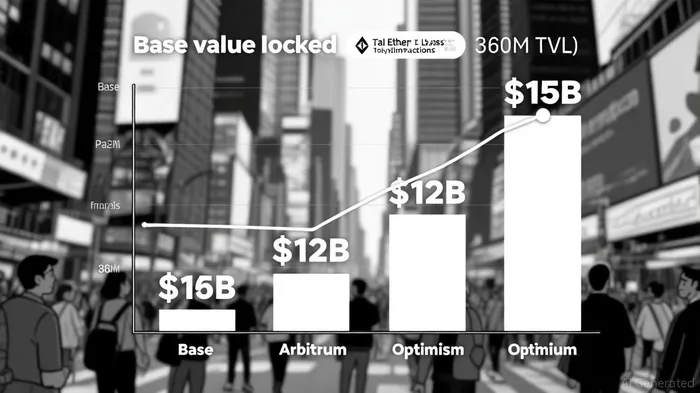
Buterin also clarified that Base's sequencer functions as a “traffic controller,” determining transaction order without influencing trade outcomes, which are governed by Ethereum smart contracts[2]. This design preserves censorship resistance while enabling high throughput—Base processes 160 transactions per second (TPS), a figure that has driven nearly $15 billion in total value locked (TVL) and 360 million monthly transactions[1].
Non-Custodial Security: The Bedrock of Trust
Base's non-custodial model is a cornerstone of its risk profile. Unlike traditional exchanges, Base's sequencer acts as infrastructure, not a custodian. Coinbase's legal team has explicitly defended this distinction, arguing that sequencers are not financial intermediaries but rather tools for optimizing transaction ordering[2]. This legal clarity reduces regulatory uncertainty, a persistent challenge for other L2s.
Moreover, Base's reliance on Ethereum's Layer 1 for finality ensures that users retain full control over their assets. Even if the sequencer were to fail or be compromised, users could bypass it entirely and transact directly on Ethereum[3]. This hybrid approach—centralized sequencing for speed, decentralized security for trust—sets Base apart from competitors like ArbitrumARB-- and OptimismOP--, which rely on different architectures or native tokens[4].
UX-Driven Innovation: Bridging the Gap for Mainstream Adoption
User experience (UX) has become a decisive factor in Ethereum's scalability race. Base's integration with Coinbase's ecosystem provides a seamless on-ramp for millions of retail users. By using ETHETH-- for transaction fees (rather than a native token), Base reduces speculative incentives and focuses on utility[4]. This design choice aligns with Ethereum's ethos of simplicity and accessibility.
In contrast, Arbitrum and Optimism prioritize low fees and EVM compatibility but lag in financial sustainability. While Arbitrum leads in active addresses and transaction count, Base's gross profit has nearly tripled that of its peers, indicating stronger long-term viability[1]. Additionally, Base's 160 TPS outperforms Optimism's optimistic rollups, which face scalability limitations due to their simpler verification processes[2].
The Broader Ecosystem Shift: UX as the New Frontier
Ethereum's ecosystem is increasingly prioritizing UX to drive mass adoption. Base's success reflects this trend: its user-friendly design, combined with non-custodial security, addresses two of the biggest barriers to entry—complexity and trust. As Buterin noted, “The future of Ethereum lies in L2s that make blockchain accessible without sacrificing decentralization”[1].
However, challenges remain. Regulatory scrutiny of centralized sequencers persists, though industry leaders argue that L2s should be treated as infrastructure, not exchanges[4]. Base's legal team has proactively addressed these concerns, reinforcing its position as a low-risk, high-growth asset.
Conclusion: A Strategic Bet on Ethereum's Future
Base's unique value proposition—non-custodial security, UX-driven design, and financial sustainability—positions it as a leader in Ethereum's L2 arms race. With Vitalik Buterin's endorsement, $15 billion in TVL, and a user base growing at an unprecedented rate, Base is not just a scaling solution but a catalyst for Ethereum's next phase of adoption. For investors, this represents a compelling opportunity to bet on a platform that balances innovation with the foundational principles of decentralization and trust.





Comentarios
Aún no hay comentarios