
Why Base Is Built the Right Way
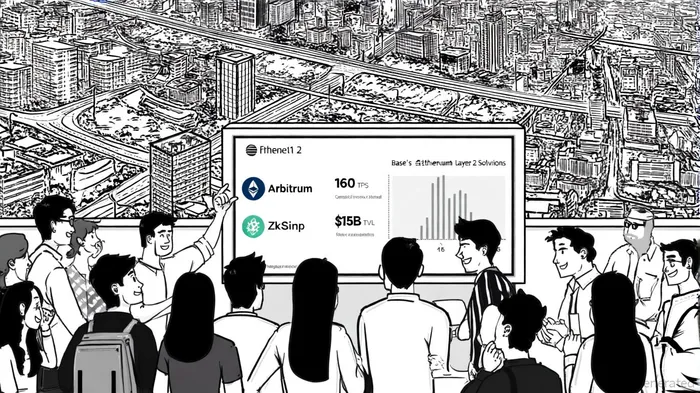
Ethereum's Layer 2 (L2) ecosystem has emerged as the linchpin of its scalability strategy, enabling the network to process thousands of transactions per second (TPS) while preserving the security and decentralization of the EthereumETH-- mainnet. Among the contenders in this space, Base—Coinbase's L2 solution—has distinguished itself through a combination of architectural ingenuity, institutional-grade security, and strategic alignment with Ethereum's long-term vision. By 2025, Base has achieved 160 TPS and secured $15 billion in total value locked (TVL), earning praise from Ethereum co-founder Vitalik Buterin as a “benchmark for secure Layer 2 solutions”[1]. This article evaluates why Base's design and execution position it as a structurally advantaged player in Ethereum's evolving L2 landscape.
Architectural Design: Bridging Security and Scalability
Base leverages the Optimistic Rollup (OP) Stack, a modular framework that allows for rapid deployment of security patches and scalability improvements[2]. Unlike Zero-Knowledge (ZK) Rollups, which rely on cryptographic proofs for instant finality, Base's optimistic model assumes transaction validity and settles state on Ethereum's mainnet, ensuring finality and immutability[3]. This approach balances throughput with Ethereum's trust model, enabling developers to deploy EVM-compatible dApps without significant code rewrites[2].
A critical enabler of Base's scalability is its integration with EIP-4844 (Proto-Danksharding), which reduces data storage costs on the mainnet by 100x[4]. This innovation allows Base to process transactions at near-zero fees while maintaining Ethereum's security guarantees. According to a report by Gate, Base's architecture has enabled it to handle 160 TPS with average fees as low as $0.01, outperforming centralized alternatives and rivaling ZK-rollups like zkSyncZK-- Era[1].
Security Model: Institutional-Grade Trust
Security remains a top concern in the L2 space, particularly for cross-chain bridging and sequencer centralization. Base mitigates these risks through a Stage 1 security model, as defined by L2Beat, which ensures asset protection even during network outages[1]. A decentralized security council can override on-chain code to recover user funds, though independent council members prevent unilateral control[2].
Coinbase's institutional infrastructure further bolsters Base's security posture. The platform employs KYC/AML compliance, real-time transaction monitoring, and multi-signature mechanisms to reduce exploit risks[2]. While sequencer centralization remains a vulnerability—similar to other OP Stack-based L2s—Base plans to implement fault proofs and decentralized sequencer initiatives in 2025[2]. These upgrades aim to address concerns around honest sequencer behavior, a gap in the current OP Stack implementation[2].
Strategic Positioning: User Adoption and Ecosystem Growth
Base's strategic advantage lies in its seamless integration with Coinbase's fiat on-ramps and user-friendly interfaces, which have accelerated consumer adoption[1]. With $15B in TVL, Base has become a critical hub for DeFi, NFTs, and Web3 gaming, leveraging Ethereum's composability while reducing friction for new users[5]. This positioning contrasts with Arbitrum's focus on liquidity and Optimism's grant-driven ecosystem, highlighting Base's role as a bridge between institutional and retail markets[5].
Vitalik Buterin has emphasized that L2s must prioritize “predictable costs and developer-friendly tools” to drive mass adoption[5]. Base's absence of a native token—relying instead on ETHETH-- for transaction fees—simplifies its economic model and aligns with Ethereum's ethos of minimizing fragmentation[5]. This design choice reduces governance complexity and ensures fee stability, critical for applications like high-frequency trading and real-time data processing[5].
Future Roadmap: Privacy and Hyper-Scalability
Base's Q2 2025 roadmap includes upgrades to increase throughput to 200ms effective block times and expand blockspace, addressing bottlenecks in high-throughput use cases[6]. Privacy-preserving account verification mechanisms are also in development, aiming to enhance user anonymity without compromising transparency[6]. These improvements align with Ethereum's modular vision, where L1 focuses on security and data availability while L2s handle execution and throughput[4].
Conclusion: A Model for Sustainable Growth
Base's success stems from its ability to harmonize Ethereum's security model with scalable, user-centric design. By leveraging the OP Stack, EIP-4844, and Coinbase's institutional infrastructure, Base has created a Layer 2 solution that balances throughput, cost efficiency, and trust. As Ethereum's modular architecture matures, Base's strategic focus on interoperability, institutional adoption, and developer accessibility positions it as a long-term winner in the L2 arms race. For investors, this represents a compelling case: a network that notNOT-- only solves today's scalability challenges but also aligns with the future of decentralized infrastructure.





Comentarios
Aún no hay comentarios