
Barrick Mining's Tanzanian Education Push: A Strategic Turnaround for Long-Term Value Creation
Barrick Mining (TSX: ABX) has long been a poster child for the challenges of mining in Africa: volatile commodity prices, geopolitical tensions, and the persistent risk of community conflicts. Yet its $30 million education investment in Tanzania, launched as part of the Twiga partnership with the Tanzanian government, signals a strategic pivot toward sustainable operations and community integration. This move not only addresses Barrick's historical underperformance but positions it to capitalize on rising commodity demand while mitigating geopolitical risks. For investors, the timing couldn't be better—Barrick's stock is undervalued relative to its $35.15 consensus price target, its earnings growth is accelerating, and its operational risks are now better managed. Here's why now could be the moment to invest.
The Education Gambit: Strengthening Community Ties and Operational Stability
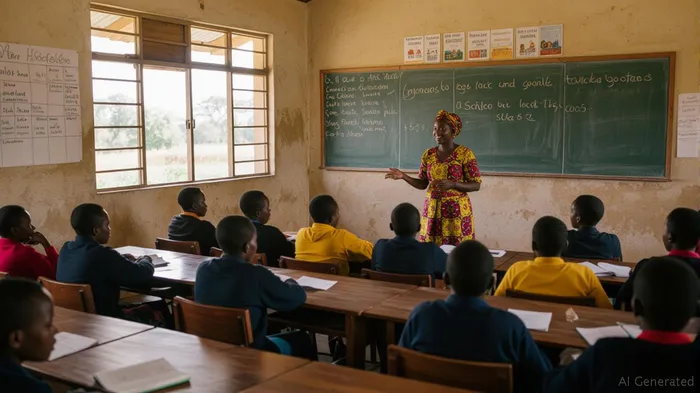
Barrick's education initiative, the Future Forward Program, is no afterthought. The partnership aims to construct 1,090 classrooms, 1,640 ablution blocks, and 270 dormitories across 161 schools, directly serving 49,000 students—a critical step in addressing Tanzania's infrastructure gaps. CEO Mark BristowVTOL-- framed this as a “model for what mining can be when it's done right, in partnership and with purpose.” The program's first phase has already allocated $10 million, with the remainder to follow by year-end.
This isn't just corporate philanthropy. By investing in education, BarrickB-- is tackling the root causes of operational instability: community distrust and labor shortages. For instance, the North Mara mine's $1.9 million investment in 87 schools in Tarime District has turned 14 of them into top-performing schools, while Bulyanhulu's $1.8 million has funded vocational training centers. These projects not only improve local livelihoods but also build a skilled workforce pipeline for Barrick's mines. As Bristow noted, “Education is key to the development of the country”—and to Barrick's long-term stability.
Financial Turnaround: Undervalued Stock, Improved Earnings, and Growing Reserves
Barrick's stock has risen 18% year-to-date, outpacing the market's 13% gain—a sign that investors are beginning to recognize its turnaround. But the stock still trades at a 43% discount to its $35.15 price target, offering a compelling entry point.
The catalysts for further upside are clear:
1. Cost Discipline: Barrick has slashed unit production costs by 14% over the past three years, thanks to operational efficiencies and mine expansions.
2. Reserve Growth: Projects like the Lumwana copper mine in Zambia and the Reko Diq gold project in Pakistan are expected to boost reserves, with Lumwana alone adding 4.5 million ounces of gold equivalent by 2026.
3. EPS Momentum: Analysts project a 22% EPS growth rate over the next five years, driven by higher production and lower costs.
Geopolitical Risks: Mitigated, but Not Eliminated
Tanzania's mining sector has historically been a minefield of regulatory and community risks. Barrick's partnership with the government aims to neutralize these:
- Twiga's “Shared Value” Model: The $4.79 billion invested in Tanzania since 2019—including education, healthcare, and infrastructure—has created a social license to operate that's critical for projects like North Mara and Bulyanhulu.
- Local Employment: Over 96% of Barrick's Tanzanian workforce is local, reducing labor disputes and fostering goodwill.
Yet risks remain. Tanzania's government has a history of renegotiating mining contracts, and Reko Diq's development in Pakistan faces geopolitical tensions. However, the Future Forward Program's tangible benefits—such as the Special Economic Zone at the closed Buzwagi mine—demonstrate Barrick's commitment to long-term, shared prosperity, which could deter expropriation.
Why Invest Now?
Barrick's strategic pivot to education and community integration isn't just altruistic—it's a calculated move to unlock upside potential. By addressing operational and reputational risks, Barrick is positioning itself to capitalize on rising gold and copper prices (driven by inflation and energy transition demand) while reducing its cost of capital.
Investors should note:
- Valuation Discount: At $26.14, Barrick trades at 7.4x forward EV/EBITDA, below its five-year average of 8.8x.
- Catalysts Ahead: The completion of Lumwana's expansion (2025) and Reko Diq's feasibility study (2026) could drive multiple re-rates.
- Dividend Growth: Barrick's dividend has risen 15% annually since 2020, and its free cash flow is expected to hit $2.8 billion by 2026.
Risks to Consider
- Commodity Volatility: Gold prices below $1,800/oz could pressure margins.
- Regulatory Shifts: Tanzania's policies remain unpredictable, though the Twiga partnership reduces this risk.
Conclusion: A Strategic Buy at a Strategic Price
Barrick Mining's Tanzanian education initiative is more than a PR campaign—it's a strategic reallocation of capital to secure operational stability, reduce costs, and tap into Africa's growth potential. With the stock undervalued, earnings accelerating, and geopolitical risks mitigated, now is the time to position for the upside.
Investment Thesis: Buy Barrick Gold (ABX) with a target of $35.15 within 12–18 months. Use stop-losses at $23/share to manage downside risk.
This article is for informational purposes only and should not be construed as financial advice. Investors should conduct their own research or consult a licensed professional before making investment decisions.





Comentarios
Aún no hay comentarios