
Barrick Gold: Strategic Risks and Sector Underperformance Make It an Unattractive Buy Amid Restructuring Turmoil
Investors seeking exposure to the gold sector in 2025 may find Barrick Gold's stock increasingly unattractive despite its operational resilience. While the company has navigated a challenging macroeconomic environment with strong production figures and robust cash flows, a confluence of strategic risks, leadership instability, and sector underperformance raises significant concerns about its near-term upside potential.
Corporate Restructuring and Leadership Volatility
Barrick Gold's corporate restructuring efforts have been marred by leadership upheaval and activist investor pressure. The abrupt departure of CEO Mark Bristow in late 2025, coupled with a deteriorating relationship between Bristow and chair John Thornton, has created uncertainty about the company's strategic direction according to Financial Post. Activist investor Elliott Management, which holds a substantial stake, has further intensified scrutiny, with rumors of a potential breakup of the company gaining traction according to Financial Post. This instability has compounded operational challenges, including declining gold production, safety incidents, and the controversial Reko Diq project in Pakistan-a high-risk venture that has drawn criticism for diverting resources from core operations according to Financial Post.
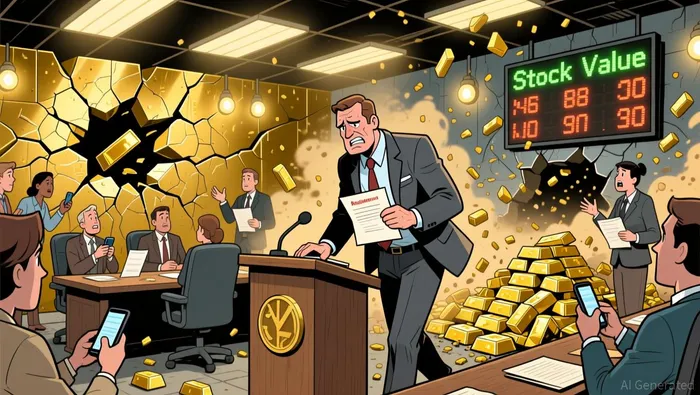 The recent settlement to regain control of the Loulo-Gounkoto gold mine in Mali-after a government standoff that led to its temporary seizure-highlights Barrick's exposure to geopolitical risks. While the company agreed to a $430 million settlement and accepted Mali's 2023 mining code, the resolution underscores the fragility of its international operations according to Investing News. Under interim CEO Mark Hill, Barrick has announced plans to streamline operations by merging its Latin America and Asia Pacific divisions, but such moves may not offset the reputational and financial damage from prolonged instability according to Investing News.
Macroeconomic Headwinds and Sector Underperformance
The gold sector has surged between 2023 and 2025, driven by expectations of Federal Reserve rate cuts and geopolitical tensions. Gold prices surpassed $4,000 per ounce, and the S&P Global Gold Industry Index rose 126% year-to-date in 2025 according to USA Gold. However, Barrick has lagged behind its peers, such as Kinross Gold, which is showing signs of recovery according to Crux Investor. This underperformance raises questions about Barrick's ability to capitalize on the gold price rally, despite its strong operational metrics.
Interest rate dynamics have further complicated the investment case. While lower rates typically boost gold's appeal as a non-yielding asset, Barrick's stock has underperformed relative to the sector. Data from 2025 indicates that gold mining stocks, on average, outperformed major asset classes, yet Barrick's shares fell by -4.3% in December 2025 amid negative sentiment surrounding its strategic shifts according to Stock to Trade. Analysts attribute this to investor skepticism about the company's leadership changes and its pivot toward copper-a move that includes dropping "Gold" from its name and rebranding as "Barrick Mining" with a ticker symbol change to "B" according to StockTwits. While diversifying into copper could hedge against gold price volatility, the abrupt rebranding has been perceived as a lack of clarity in Barrick's long-term strategy.
Strategic Risks and Valuation Concerns
Despite Barrick's operational strengths-such as a 4% quarter-on-quarter increase in gold production and a 34% rise in copper output in 2025 according to Barrick's Q2 2025 Results-its strategic risks remain pronounced. A discounted cash flow (DCF) model suggests an intrinsic value of $198.05 per share, implying the stock is undervalued by 74% according to Yahoo Finance. However, the market's failure to recognize this potential reflects broader concerns about the company's governance and execution. Barrick's PE ratio of 17.2x is below its calculated fair ratio of 25.3x, indicating that investors are discounting its earnings due to perceived risks according to Yahoo Finance.
Moreover, the company's $1 billion share buyback program in 2025, aimed at capitalizing on undervaluation, may struggle to gain traction in a market environment where confidence is eroding. With $5 billion in cash reserves as of September 30, 2025 according to StockTwits, Barrick has the liquidity to fund buybacks and dividends, but the effectiveness of these measures hinges on restoring investor trust-a tall order given the recent leadership turmoil and operational setbacks.
Conclusion
Barrick Gold's operational performance in 2023–2025 is undeniably strong, with record production and cash flows. However, the company's strategic risks-including leadership instability, activist investor pressure, and a poorly communicated pivot to copper-have overshadowed these achievements. Amid a sector-wide bull market for gold, Barrick's underperformance highlights its inability to leverage favorable macroeconomic conditions. For investors, the combination of governance challenges, geopolitical exposure, and valuation skepticism makes Barrick an unattractive buy in the near term, despite its long-term asset base and financial resilience.







Comentarios
Aún no hay comentarios